
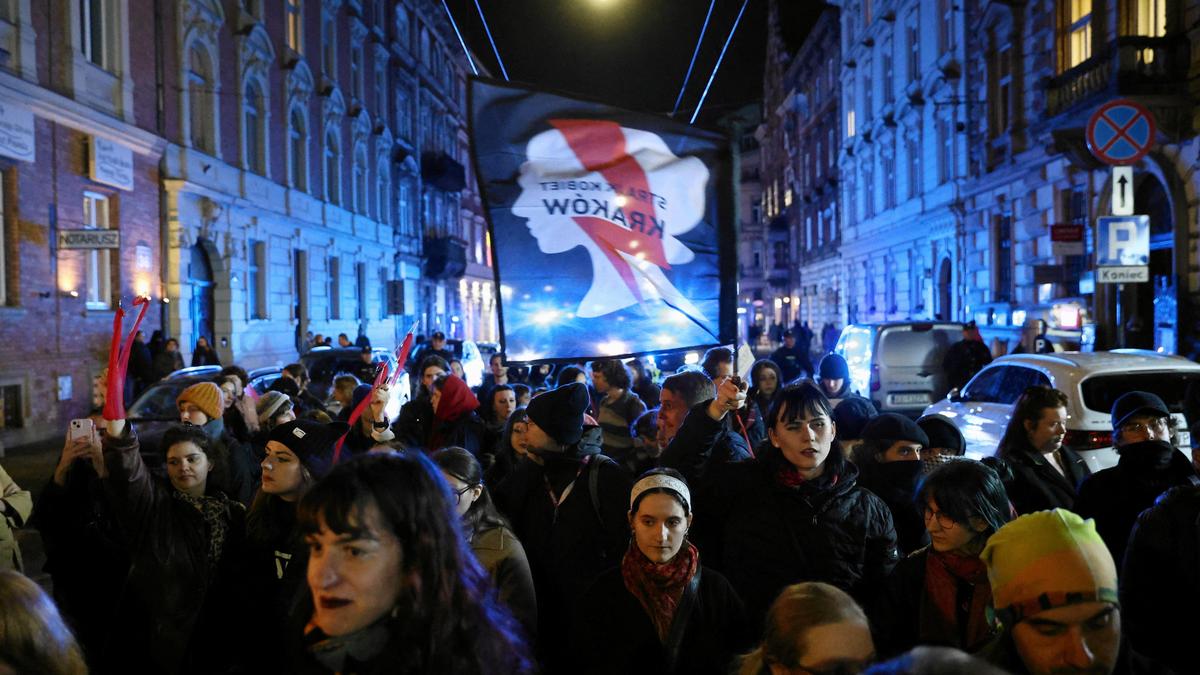
The story so far: Hundreds of women gathered outside Polish Parliament (Sejm) in Warsaw on Thursday (October 22, 2026), braving heavy rain to demand access to free and legal abortion, as demonstrations spread across more than 20 cities in Poland. Signalling rejection of the government’s record, protesters raised pro-choice slogans in a show of anger at Prime Minister Donald Tusk’s failure to deliver on his promise to liberalise the country’s strict abortion laws.The demonstrations came just two days after the lower house, the Sejm, passed two bills seeking to ease the country’s restrictive abortion laws. The proposed changes seek to roll back some of the restrictions on the rights of abortion imposed under the previous government, but their passage into law remains uncertain, with President Karol Nawrocki expected to veto the measures.What does Poland’s abortion law say?Poland has some of the most restrictive abortion laws in Europe. Since 1993, abortions has been allowed in Catholic Poland only on specific grounds. The restrictions tightened in October 2020, when the country’s Constitutional Tribunal ruled that abortion on the grounds of severe foetal abnormalities was unconstitutional. The ruling came into force in January 2021, effectively establishing a near-total ban on abortion. Since then, and under the current law, legal abortion is when a pregnancy threatens the woman’s life or health, or when a pregnancy results from a criminal act, like rape or incest. In cases involving rape or incest, termination is permitted up to the 12th week of pregnancy.Abortion on request is not permitted in Poland, and women seeking such terminations outside the legal grounds face major barriers to accessing healthcare. The law also criminalises assistance in pursuing an unlawful abortion, with penalties of up to three years’ imprisonment. However, the woman undergoing the abortion is not criminally liable. The restrictions have prompted repeated nationwide protests, including demonstrations in 2016 and after the 2020 ruling, with activists accusing the authorities of curtailing reproductive rights and restricting access to abortion care.When Mr. Tusk’s coalition, comprising parties ranging from the left to the centre-right, came to power in December 2023, replacing the national-conservative Law and Justice (PiS) government, it pledged to liberalise abortion laws. However, disagreements between the coalition’s more conservative and liberal factions stalled reform efforts, fuelling criticism that the government had failed to honour its electoral commitments.What do the two bills propose?The issue has now returned to the parliamentary agenda, a year ahead of the next parliamentary election. On October 20, the Sejm passed two bills seeking to ease abortion restrictions.The first bill seeks to partially decriminalise abortion by removing criminal penlties for terminating a pregnancy with a woman’s consent outside the grounds currently permitted by law, as well as for helping or encouraging such an abortion. It also proposes protections from criminal liability for doctors, nurses and midwives who terminate a pregnancy to avert a threat to the woman’s life or health, or in circumstances involving a high probability of severe and irreversible foetal abnormalities or an incurable condition threatening the foetus’s life.The second bill seeks to restore abortion as a legal option when doctors identify a severe and irreversible foetal abnormality or an incurable condition threatening foetal viability. This would reverse the effect of the 2020 Constitutional Tribunal ruling, which removed foetal abnormalities as a legal ground for termination.Both bills would need to clear further legislative and presidential hurdles before becoming law. Even if enacted, they would not legalise abortion on request and would leave Catholic Poland’s near-total ban unchanged. Protesters have dismissed the new measures, calling it token gestures rather than a genuine effort to reform the law, arguing that the government is seeking to demonstrate progress on an issue that could influence its prospects in 2027 parliamentary elections.How do Europe’s abortion laws compare?Abortion laws vary widely across European Union, with countries setting different gestational limits and conditions for access. While several countries permit abortion on request during the first trimester, others maintain restrictive legal frameworks.France became the first country in the world to explicitly enshrine the freedom to have an abortion in its Constitution in 2024. Abortion is permitted on request up to 14 weeks of pregnancy and is covered by the public healthcare system. In Sweden, abortion is permitted on request up to 18 weeks, with medical abortions available at home under approved arrangements and costs covered by the state healthcare system. The Netherlands permits abortion until the foetus is considered capable of surviving outside the womb, generally around 24 weeks in practice, subject to legal and medical requirements.Spain permits abortion on request up to 14 weeks of pregnancy, while Ireland allows it up to 12 weeks. Finland also permits abortion on request during the first 12 weeks of pregnancy, following a reform that took effect in 2023. Portugal permits abortion on request up to 10 weeks.Ireland legalised abortion following a referendum in 2018, while Spain’s 2023 reforms removed the requirement for parental consent for 17-year-olds seeking an abortion.Malta has historically maintained one of the world’s most restrictive abortion laws, criminalising the procedure in almost all circumstances. Before 2023, doctors who performed an abortion to save a woman’s life could face up to four years in prison, while women could face up to three years. In 2023, the country introduced a narrow exception to the near-total ban, allowing doctors to terminate a pregnancy when a woman faces an immediate risk to her life or when her health is in grave jeopardy that could lead to death. In non-immediate cases, the decision must be confirmed by a panel of medical specialists. The reform did not legalise abortion on request
Poland’s abortion law: What will the new bills change? | Explained
Full Article
Original Source
Read the full article at Thehindu →KhanList aggregates and links to publicly available news content. We do not host full articles from third-party sources. Always verify important information with original sources.