
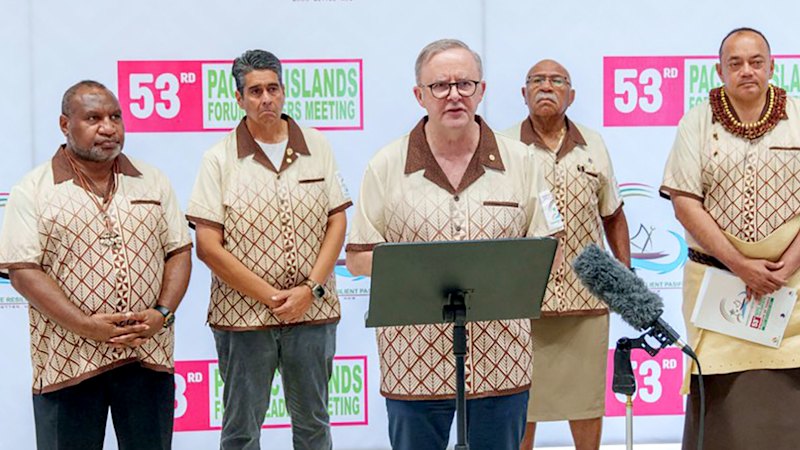
Prime Minister Anthony Albanese’s political cynicism and duplicity knows no bounds. At the Pacific Islands Forum in Palau he looks in the eye of the islands’ leaders, whose countries are being submerged by rising sea levels, and says: “Our three top priorities are climate change, climate change and climate change” (“The world made a ‘covenant with the future’ – and we broke it”, September 4). What is left unsaid is, “Sorry guys, I’ve got to hurry back to approve another few coal mines and to make sure that Murray Watt ticks off the Browse Basin gas extraction. At least we’ve had plenty of practice with extending Woodside’s arrangements for 45 years and approving 34 other coal mines.” Prime Minister, the world is on the edge of disaster. You must do something or your failure will be confirmed – as well as humanity’s fate. John Burman, Port MacquarieAnthony Albanese with the PNG Prime Minister James Marape (left), Palau President Surangel S. Whipps Jr., Fijian Prime Minister Sitiveni Rabuka and the Prime Minister of Tonga Siaosi ’Ofakivahafolau Sovaleni. It takes a special person to keep a straight face as hypocrisy pours from their mouth. Albanese has gone to the Pacific Islands Forum and has said blithely, “It requires strategies and policies to be put in place”, while his government has approved more than three dozen new, expanded or extended fossil fuel projects while in office. It takes a special person indeed. Whatever “strategies” he has in place clearly are not working. The dissonance is staggering, far beyond even the tobacco ads of the last century that insisted that there was no link between smoking and lung cancer. Until now, they were our yardstick for hypocrisy. We are being warned of an enormous El Niño event, a year of bushfires like those that have ravaged the northern hemisphere and droughts, among many other impacts. Indeed, wildfires are currently raging to our immediate north in Indonesia and still our government pretends it is doing all it can to limit carbon emissions. What will it take for them to drop the pretence? We see you, Mr Albanese. Marie Belcredi, EppingAnthony Albanese told the Labor conference in Queensland last weekend that Australians needed to be given real hope for a better future. Unfortunately, he doesn’t seem to know how to do that. He has shown us that he is indecisive, as with his wishy-washy new gambling laws. He had an environment minister who was serious about actually making real change and no longer using Band-Aids as governments had done for decades, but he replaced her with a more pragmatic candidate. Albanese has also signalled support for fossil fuel expansion and subsidies, as well as native forest logging, even as the planet is plagued by fires and flooding as a result of rapid global warming. The Labor government chose to make cuts to the NDIS, which is hurting our most vulnerable people, rather than to rein in the subsidies to the mining industry. None of that is giving people real hope for a better future. Running a gas lobbyist Labor candidate in the last WA by-election didn’t help either. One Nation is definitely not the answer to our current problems, but at least it gives people the illusion that they are listened to. Labor clearly is not. Ute Mueller, Lapoinya (Tas)Raise your voiceMany of us are quiet Australians. We worry about climate change, complain about politics over dinner, then get on with our busy lives. Meanwhile, the loudest voices can sound like the majority simply because the rest of us are silent. That silence matters. Governments are understandably wary of poking noisy bears, particularly when elections are at stake. But the latest UN environment program report, Limiting Overshoot, makes the urgency painfully clear: exceeding 1.5C is now widely seen as unavoidable, and every fraction of additional warming increases the risks. This is science, it’s factual, it’s not politics. Governments need to act, but those of us who want stronger action have a responsibility too. We need to give them some political room, political pressure and permission, to do it. Climate change is not a political football, however enthusiastically we keep kicking it down the road. The science will not change because it is inconvenient. So perhaps it is time for quiet Australians to become a little less quiet. If we want governments to act for our children and grandchildren, we should make sure they know it. Rod Cunich, VaucluseAccording to meteorologists, we are facing the worst El Nino effect in a thousand years. The UN has labelled its effects “supersized”. A UK minister has advised citizens to stock up on essentials for survival during extreme weather events this northern winter. Here in Australia, we are stuck with climate deniers and a government that is in the pocket of fossil fuel producers. There is absolutely no sense of emergency. We need our climate science experts to step up and demand action. We need an emergency plan now – not by 2037. Mark Paskal, AustinmerInequality in the classroomYour correspondent’s suggestion of recruiting more men into teaching (Letters, September 4) evokes the joke-cum-truism: What do you call a male teacher? Answer: Principal. Men have long dominated the power and decision-making echelons of Australian education. Thus, as of 2025, while 72 per cent of teachers were female, women held only 34 per cent of principals’ positions. Males accounted for 28 per cent of teachers and 66 per cent of principals. Further, 75 per cent of school boards were chaired by men. The rate of educational leadership by women in Australia languishes below the OECD average. Meanwhile, Nationals’ leader Matt Canavan tends towards victim-blaming in admonishing female teachers who are experiencing misogynistic mistreatment from schoolboys (“Contos sounds alarm on manosphere”, September 3). He should be focusing on politicians’ failure to prevent children’s access to damaging online material. Where Playboy and such magazines were once out of public reach at news agencies, now, explicit, even violent, pornography can be accessible on devices used by children. The American College of Paediatricians describes this material as pervasive, addictive, extremely psychologically and emotionally damaging, creating a “deformed and maladaptive view of human sexuality”, while generating an estimated global profit of $100 billion as of 2023. Barbara Chapman, South Yarra (Vic) Photo: Megan HerbertSally Shepard’s letter about her school curriculum in the 1960s reminded me of my time in Queensland in the 80s (Letters, September 4). My daughter came home from high school one day, appalled that she was required to attend a course named “Parenthood”. It was compulsory for girls but not for boys. The textbook clearly set out the roles of mothers and fathers, harking back to the 40s and 50s. Together with two of her friends’ parents, we sought withdrawal of our daughters from this course. Neither the headmaster nor the district office could make the decision, which ended up in the minister’s office. They were eventually allowed to prepare assignments on topics the families chose. Our choice was an essay on the different kinds of families that exist in society – gay couples, single parents, blended families, et cetera. The same three girls were also the first to be enrolled in the metalwork course at the school, although I’m not sure whether the subject was the attraction or the boys in the class. Elizabeth Elenius, PyrmontNationals Leader Matt Canavan must be living on a different planet with his totally inappropriate comments blaming the “feminisation of our curriculum” for driving young boys towards the manosphere. “They’re sick and tired of getting lectures about how bad men are at school, and so they go to other places.” Canavan needs some lecturing himself if he talks like this in 2026. As a parent, doesn’t he know about the issues related to young people in social media? Algorithms are killing young people – young ones are being bullied online and are taking their own lives. By making such comments, Canavan is in fact, supporting the manosphere. Mukul Desai, Hunters HillTo add a small piece of data in relation to the culture war going on about boys and education, in NSW, there are about 2200 public schools. Seventy of them have been named after men and just three after women – Elizabeth Macarthur (Narellan Vale), Franklin Public School (Tumut) and Caroline Chisholm School (Padstow). How does this fit in with Matt Canavan’s “anti-boy” ideology permeating our schools? Ron Brown, WallsendTaylor tangledLiberal leader Angus Taylor won’t say whether he thinks boys should be taught about consent in schools (“‘Teaching boys to respect girls isn’t woke’: Clare snaps at Taylor over manosphere debate”, September 4), even though his party spent much of last month calling the prime minister a sexist for making a joke about Japanese melons. Hypocrisy writ large. Nikhil Dhanabal, Clyde North (Vic)Onus on providersAmber Schultz and Waleed Aly write separately about the damage being caused by social media and AI (“I posed as a 17-year-old boy on social media. It took 13 minutes to be shown the manosphere”, “Things seemed so much better in Back to the Future II”, September 4). The focus seems to be on either trying to limit content or restrict access – no discussion of making the platforms and content providers responsible for the dross they publish and the damage it does. We need legislation that makes the platform owners liable for what they publish, as it is for print publications, TV and radio. Legislation also needs to make the platforms responsible for identifying a real person or corporation responsible for each piece of content they publish. Make platforms think about whether they want to be responsible for content, force them back to sensible moderation in their own self-interest. That would be much better than the current situation in which nasty content in all forms is published as so-called free speech. Steven Lee, FaulconbridgeOpting out is no answer to the problems caused by social media.iStockThe ability to opt out of certain types of content will not work, as another piece of weak legislation designed to fail and appease the tech giants. Any teenage boy will be curious and will opt in immediately. Why not simply make it illegal to serve up such offensive content, full stop? We would not tolerate a teacher standing at the front of a class preaching misogynistic ideology. Nor would we tolerate someone standing in a town square spouting racist ideas. So why tolerate tech giants serving up such content? It would be very easy for them to turn it off. It would make little difference to their business bottom line and may help them gain some mainstream respect. Tim Douglas, Hurlstone ParkSwitch targetsNSW Liberal leader Kellie Sloane wants these gangland shootings to stop. She doesn’t have a plan, nor does she advise on how to achieve this, but she is sure the government has “lost control” of our streets. Such hyperbole can be expected from a former journalist turned politician, but it really isn’t helpful. It’s obvious that, as her party comes more and more unstuck at the ICAC hearings, any diversion is welcome. Rhod Jeffrey, Surry HillsBeacon of logicLily Hooper’s misadventure is heartbreaking (“She was fearless’: Lily Hooper farewelled after hiking death”, September 4). I was told by a search and rescue expert that many bushwalkers these days rely on their mobile phones for navigation and emergencies. Batteries run out too soon, the coverage is unreliable, and that’s only the beginning. AI says via Google, “You can hire a personal locator beacon (PLB) for free at select locations in NSW, such as the Blue Mountains Heritage Centre in Blackheath or various National Parks offices, or buy one from outdoor retailers.” Just do it, it could save your life. Tim Egan, MosmanTrouble with tobaccoThe Australian Medical Association is right to call the Coalition’s proposed 80 per cent tobacco excise cut reckless (“Coalition’s 80% cigarette tax cut slammed by health experts”, September 4). Association president Danielle McMullen’s warning is simple: cheaper cigarettes mean more smokers. And the young and the disadvantaged are most price-sensitive. No excise cut can compete with the price offered by organised crime, which pays no tax at all. Cutting the price of legal cigarettes teaches smokers to expect cheaper cigarettes, while the black market can undercut whatever price is set. It would surrender the field to criminal gangs, not defeat them. Excise is not simply a revenue measure, though governments may, like smokers, be addicted to it. Its purpose is to discourage smoking and reduce the burden it places on our hospitals. Sacrificing billions in revenue and decades of health gains to fight organised crime on price is a poor trade. The black market will simply reprice and continue. The better answer is enforcement. Use some of the roughly $8 billion lost annually to illegal tobacco for more container scanning and detector dogs at our ports, plus rewards for information leading to seizures and identifying sellers. We should fight organised crime with policing, not with a price war we cannot win. John Kempler, Rose BayIllicit cigarettes, such as this recent haul of 60 million by the Australian Border Force, are a huge public health and budget issue.Australian Border ForceThe exorbitant cost of legal cigarettes was caused by sky-high cigarette excise and resulted in a huge and still growing illegal cigarette supply. The large illegal market has produced severe consequences, which will only get worse unless cigarette excise is cut substantially. Economics professor Richard Holden had even advocated cutting cigarette excise to zero temporarily to destroy the illegal supply system. A number of other distinguished economists have also supported substantial cuts to cigarette excise. The Liberal Party was also right to support increasing the availability of vapes and nicotine pouches as a cessation measure. Dr Alex Wodak, DarlinghurstThe Coalition’s proposed cigarette tax reduction is a panicked reaction to Pauline Hanson’s nonsense. I heard public health academic professor Simon Chapman beautifully describe it as “a commercially illiterate brain-fart”. He pointed out that the smugglers aren’t charging the lowest price they could for the product, and that they will simply drop their prices further to be below the legal price. These cigarettes are apparently available in Asia at about 34¢ a packet. Good luck getting the legal ones to match that. Ron Wessel, Mount St ThomasEau dearOn the subject of data centres being built in remote areas (“Australia’s massive data centres to be built away from homes”, September 3), your correspondent Mary Billings writes “and where will they get their resources? There is hardly any water” (Letters, September 4). There is water, huge amounts of water. It’s Australia’s hidden treasure – the Great Artesian Basin – and the data centre industry knows all about it. This massive and invaluable underground water reserve must not be squandered. It will be the nation’s lifeline for food production in the uncertain, climate-ravaged age we are now in. As the cartoon on Friday’s letters page points out, “AI is untrustworthy to the point of active deception; it steals art and information; it’s already taking jobs from uni graduates and is threatening the critical thinking of school kids. The data centres that house it are taking land, water and energy during a housing and climate crisis.” Australia has been ripped off by the fossil fuel industry for decades. Are we now going to let another extractive industry rob us of our life-giving water? Politicians take note: this must not happen. Simon Chance, Richmond HillAUKUS a racketI don’t understand why there is so much confusion over why we agreed to AUKUS. It’s not about buying defence capability but more a “protection racket” – the equivalent of the small shop owner paying the Hells Angels for fear of reprisals. Something along the lines of: “If you don’t buy our submarines, allow nuclear docking and Pine Gap, we will no longer regard you as a friend, and we will, among other things, no longer share intelligence, war games, and, goodness me, just watch your trading status with us. You had better pay up!” Robert Hosking, PaddingtonCommission’s omissionsAs Kate McClymont writes, “the commission has developed its own range of euphemisms which various witnesses have used to dress up some distasteful realities” (“Cracking the ICAC code”, September 4). Add to this the factory reset computers, disappearing WhatsApp communications and encrypted messaging. Spare a thought for the counsels assisting, who daily deal with witnesses’ amnesia, obfuscation and lying. Alice in Wonderland at the Mad Hatter’s Tea Party comes to mind. Hopefully, the whole house of cards will eventually collapse and, like Alice, we will all realise it’s just been a horrible dream. Julian Canny, Elizabeth BayHop to itThere is only one head that should appear on any new money if we decide to dump the monarch: Skippy the bush kangaroo. After the last budget, most of our money will jump out of our bank accounts like our favourite marsupial (Letters, September 4). David Sayers, GwandalanTo submit a letter to the Sydney Morning Herald, email letters@smh.com.au. Click here for tips on how to submit letters.The Opinion newsletter is a weekly wrap of views that will challenge, champion and inform. Sign up here.
PM actions give the lie to his climate action promises
Full Article
Original Source
Read the full article at Smh →KhanList aggregates and links to publicly available news content. We do not host full articles from third-party sources. Always verify important information with original sources.