
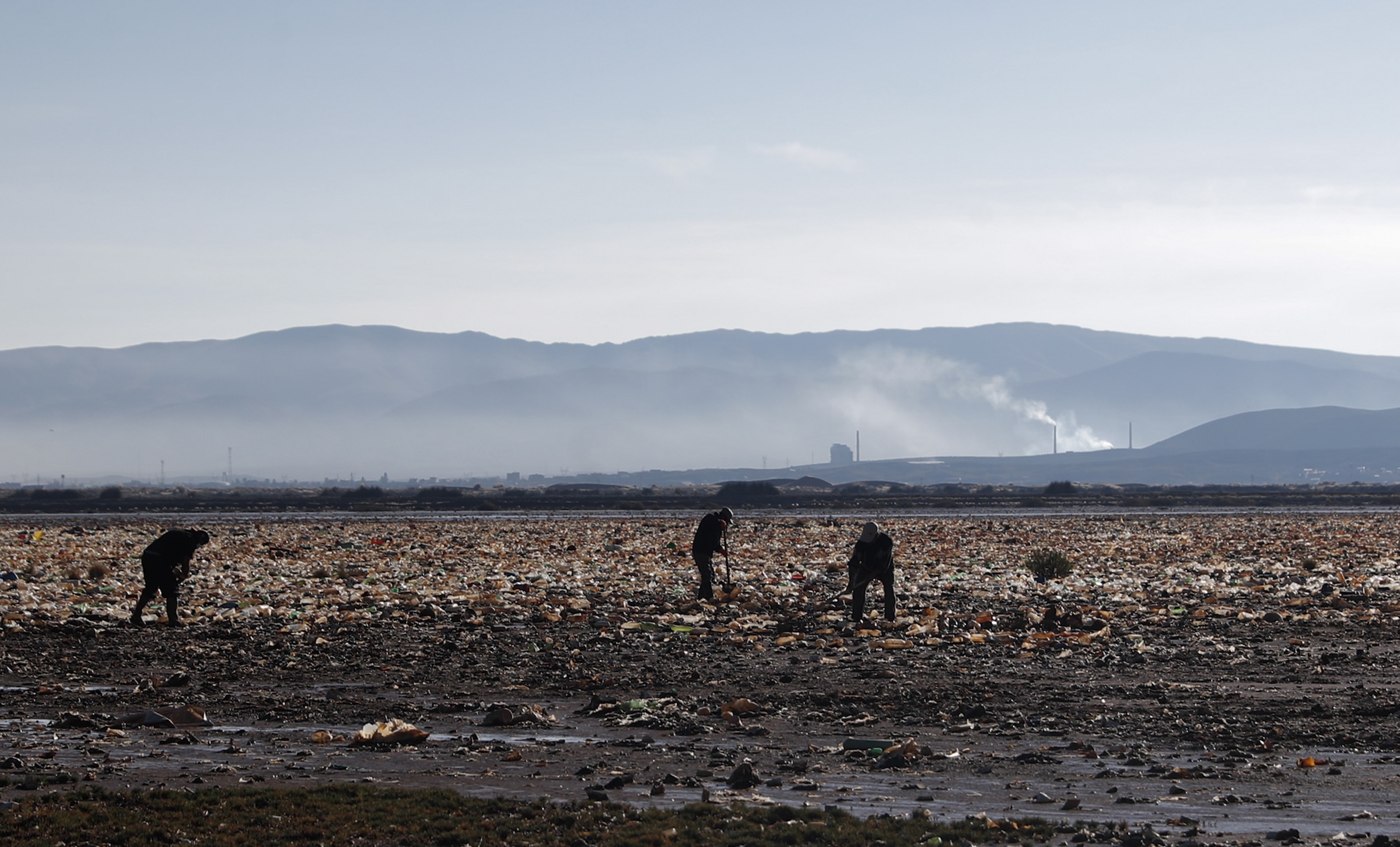
Since 2018, when China banned the import of plastic waste, many countries in Latin America have been struggling to manage a huge increase in the amount of plastic waste imported into the region, some of them becoming “plastic pollution hotspots,” according to a recent study.Overstretched waste management infrastructure and a glut of hard-to-recycle plastics mean that thousands of tons of plastic are leaking out into the environment every day, experts say, with major health implications for communities already facing poor sanitary conditions.With talks for a global plastics treaty set to resume next year, campaigners say only a reduction in plastic production can solve the problem but warn against the influence of the powerful petrochemical lobby. Since China banned the import of plastic waste in 2018, plastic pollution has been having a growing impact on the people and ecosystems of Latin America. As the region imports an increasing amount of the world’s used and discarded plastic, new research shows that waste infrastructure in many countries is already buckling under the strain of dealing with domestic trash. As a result, much of the imported plastic is leaking out into the environment, with experts and the U.N. warning of major consequences for human health. A study published in April found that seven countries in the region — the Dominican Republic, Guatemala, Honduras, Mexico, Nicaragua, Panama, and Paraguay — have become plastic pollution hotspots, or PPHs, where high imports of low-quality plastics meet high rates of mismanaged waste. Global plastic waste generation reached 353 million metric tons in 2019 alone, of which 72% ended up being landfilled or dumped and just 9% was recycled, according to an OECD report. Much of the world’s plastic waste was previously destined for China, but in 2018 the country banned those imports. While Malaysia and Thailand took up much of the slack, Latin America also started importing more plastic waste, although the region has historically been an importer of difficult-to-recycle plastics. “Certain countries in Latin America have started importing more waste but they haven’t actually got the capacity to deal with [it],” Veronica Herrera, lead author of April study and an associate professor at the Luskin School of Public Affairs at the University of California, Los Angeles, told Mongabay in an interview. “Something pernicious is happening in the region.” Plastic pollution hotspots in Latin America. Source: UN Comtrade Data via Herrera et al. The paper, published in the journal Environmental Research Letters, was a collaboration between researchers at UCLA in the U.S. and the University of the Pacific in Lima, Peru. In an email to Mongabay, Alberto Rojas, a Costa Rican-based consultant at the Environmental Investigation Agency, said: “After China’s 2018 import ban, the region absorbed more waste of every type, and imports of difficult-to-recycle plastics such as PVC [polyvinyl chloride] and polystyrene [PS] rose sharply; those plastics were then re-circulated within the region toward lower-income countries with weaker waste systems.” This form of “waste colonialism,” Herrera said, has left Guatemala, Nicaragua and Paraguay in “particularly dire situations,” with Nicaragua increasing its waste imports by 394% between 2015-2022, while Paraguay recorded a 234% increase. Plastic waste has economic value, and in 2024, Latin America imported $1176.82 million worth of it. However, this scrap is often bought in unsorted bales that contain the hard-to-recycle plastics used in products such as plastic cutlery, shrink wrap, and “foam” food containers such as egg boxes, with increasing evidence that importers dump the plastic they can’t use. From left, Tony Agotha, Special Envoy for Climate and Environment Diplomacy of European External Action Service, Sivendra Michael, Permanent Secretary for Environment and Climate Change of Fiji, Juan Carlos Monterrey, head of Panama’s delegation, Andrew Yatilman, Secretary of the Department of Environment, Climate Change, and Emergency Management of Micronesia, and Olga Givernet, French Delegate Minister for Energy, attend a press conference at the fifth session of the Intergovernmental Negotiating Committee on Plastic Pollution in Busan, South Korea, Friday, Nov. 29, 2024. (AP Photo/Ahn Young-joon) “The regional scale is stark,” Rojas said, with roughly 17,000 metric tons of plastic waste going to open dumpsites across Latin America and the Caribbean every day, and close to 40 million people lacking basic waste collection. According to The Solid Waste and Circular Economy Hub, an open data portal managed by the Inter-American Development Bank (IDB), 39% of Latin America’s municipal waste is leaked into the environment, 48% is sent to a controlled landfill, 2% is reutilized or recycled, and the remaining 11% ends up in an unknown destination. “That discarding process is really opaque,” Herrera said. “It’s very difficult to get data about where that material is going.” However, she added, in off-the-record interviews she carried out for her research, people involved in the waste sector told her the material isn’t being sustainably managed. This surge in plastic waste has major health implications, from impacting access to clean water to increasing the risk of disease. More than 16,000 different chemicals go into various plastics to give them their range of properties. These include plasticizers, flame retardants, and PFAS, often dubbed “forever chemicals” because they can persist in the environment for thousands of years, the paper points out. It notes that possible human health impacts from these chemicals include genotoxicity (damage to genetic cells) and pulmonary fibrosis. Open burning is often the default disposal route for plastic waste in many communities. But this releases poisonous dioxins and is increasingly flagged as an urgent public health issue. According to the UCLA-led paper, the mortality rate associated with air pollution is especially high in countries importing difficult-to-recycle plastic waste, “underscoring a stark imbalance between countries that are producing global plastic waste and those who are burdened by its environmental risk.” Vulnerable communities at greatest threat “The people most heavily impacted are people in vulnerable situations, who already lack appropriate sanitation,” Marcos Orellana, the former U.N. special rapporteur on toxics and human rights, told Mongabay in an interview. “They live close to where the plastics are dumped and burned, by streams, rivers and coastal communities … where the water becomes contaminated.” They also live in areas that are more flood-prone, and where infrastructure may be less resilient, he added. It’s a problem Orellano said he’s seen firsthand during a recent visit to the Dominican Republic, one of the plastic pollution hotspots. In his report to the U.N. Human Rights Council, he wrote that the country was “facing a plastic catastrophe,” with polystyrene posing a particular problem. Jesus Cuevas, a Petgas technician, carries a bag filled with shredded plastic at a recycling center in Boca del Rio, Veracruz, Mexico, Jan. 4, 2025. Many countries in Latin America lack the capacity to recycle the growing amount of plastic waste being imported (AP Photo/Felix Marquez, File). He reported on plastic pollution blocking sewers and storm drains, not only causing flooding but also creating a breeding ground for mosquitoes, with polystyrene the perfect medium on which to lay their eggs. “Mosquitoes that carry dengue fever, malaria, these are very serious public health issues,” Orellano said. The problem is exacerbated by the use of insecticides such as DDT, which has proven public health implications. Orellana also pointed out that the foam itself is a public health risk. Cheap, light polystyrene products are full of hazardous chemicals, he said, many of which, such as benzene and styrene, are known to be carcinogenic, especially when burned. They also contain endocrine-disrupting chemicals, he added, which cause many imbalances and diseases and can have long-lasting effects on human health that “can even be passed on to future generations.” When the waste is left to decompose, microplastics become the issue. According to Rojas, a 2026 regional review found microplastic concentrations as high as 1,194 particles per liter of drinking water (the equivalent of 315 particles per gallon). In some instances, microplastics were found in 70-100% of commercial seafood tested. Although research into links between cancer and plastics is still nascent, microplastics are implicated in several cancers, including ovarian, gastric, and blood, Herrera said. Is a global plastic treaty the solution? The idea of a global treaty on plastics was first discussed in 2022, but despite several attempts, no agreement has been reached. The talks have been divided, with one cohort of nations pushing for a treaty that curbs production, while another group of largely oil-producing nations has argued that better recycling and waste management is the answer. The next round of talks is scheduled for March 2027, but Orellana said he fears the powerful lobbyists from the petrochemical industry could once again call the shots. “The waste management system simply cannot take the amounts of plastic waste that are being generated,” he said. The place to start is with single-use plastics, he said, alongside efforts to prioritize high-quality plastics that can remain in circulation for longer. Different types of plastic are seen inside Petgaserita, a non-catalytic pyrolysis machine, which will be converted into fuel, in Boca del Rio, Veracruz, Mexico, Jan. 4, 2025. But recycling is not a true solution to the plastic waste build-up, some experts warn.(AP Photo/Felix Marquez) Relying on recycling is “a mirage that confuses,” Orellano continued, and not a true solution, because it’s “unable to deal with cheap, unrecyclable plastic waste that is spreading around the world through international trade in plastic waste.” Rojas, however, pointed to the possibility of a breakthrough when the talks reconvene. A majority bloc known as GRULAC, which includes most of Latin America, already backs an approach that addresses the full life cycle of plastics, he said, while the talks also have a new chair in Chile’s Julio Cordano, a diplomat specializing in environmental affairs, which “raises the region’s leverage.” Some Latin American countries are taking action. Chile and Colombia are among those to have introduced an extended producer responsibility, which shifts the onus onto producers to deal with waste. Colombia has also introduced legislation to phase out 21 single-use plastic items by 2030. Uruguay has mandated 40% recycled content in beverage bottles from 2025, while Costa Rica runs a national single-use strategy and a marine litter plan. “Latin America is both a dumping ground and a high-ambition bloc,” Rojas said. “Its progress is real but fragile amid a regional wave of environmental rollback, and the only durable fix is an ambitious, legally binding treaty that regulates plastic across its full life cycle, production included, not just downstream waste.” Banner image: Volunteers remove garbage from the polluted Tagaret River which flows into the Uru Uru Lake, near Oruro, Bolivia, Wednesday, April 7, 2021. A cleanup operation began Wednesday in an effort to restore the lake to its natural beauty which has been overrun by plastic rubbish and other man-made waste. (AP Photo/Juan Karita) Citations: Herrera, V., Muñoz Chirinos, P., & Silva Zárate, I. (2026). Plastic pollution hotspots: Global waste trade and environmental risk in Latin America. Environmental Research Letters, 21(7), 074006. doi:10.1088/1748-9326/ae46b0 Husaini, D. C., Mendez, R. K., Arzu, M., & Harris-Thurton, L. (2024). Plastic waste in Latin America and the Caribbean (LAC): Impact on the environment and public health — A systematic review. Journal of Toxicology, 2024(1). doi:10.1155/2024/5698516 Pathak, G., Nichter, M., Hardon, A., & Moyer, E. (2024). The open burning of plastic wastes is an urgent global health issue. Annals of Global Health, 90(1). doi:10.5334/aogh.4232 Santos, L. F., Deus, R. J., Sucupira, I. M., Brasil, D. D., & Mendes, R. D. (2025). Potential risks to human health caused by the use of pesticides in soils of three municipalities impacted by localized malaria in the Brazilian Amazon. Toxics, 13(10), 900. doi:10.3390/toxics13100900 Vallejo, F., Yánez, D., Molina, L., Pino-Cortés, E., Espinoza-Pérez, A., & Espinoza-Pérez, L. (2026). Microplastic contamination in Latin American drinking water and food chains: Exposure assessment, toxicological mechanisms, and public health implications in vulnerable populations. Microplastics, 5(2), 117. doi:10.3390/microplastics5020117 Nivedita, J., Megha, P., Daisy, P. S., Sivachandran, R., Ramprasath, A., Rajkumar, M., & Anitha, T. S. (2025). Microplastics and cancer: A comprehensive review of their impact on tumor progression and mechanisms of carcinogenesis. Journal of Environmental Pathology, Toxicology and Oncology, 44(4), 31-46. doi:10.1615/jenvironpatholtoxicoloncol.2025054888 FEEDBACK: Use this form to send a message to the author of this post. If you want to post a public comment, you can do that at the bottom of the page. Credits Topics
‘Plastic pollution hotspots’ spawn a public health crisis across Latin America
Full Article
Original Source
Read the full article at News →KhanList aggregates and links to publicly available news content. We do not host full articles from third-party sources. Always verify important information with original sources.