
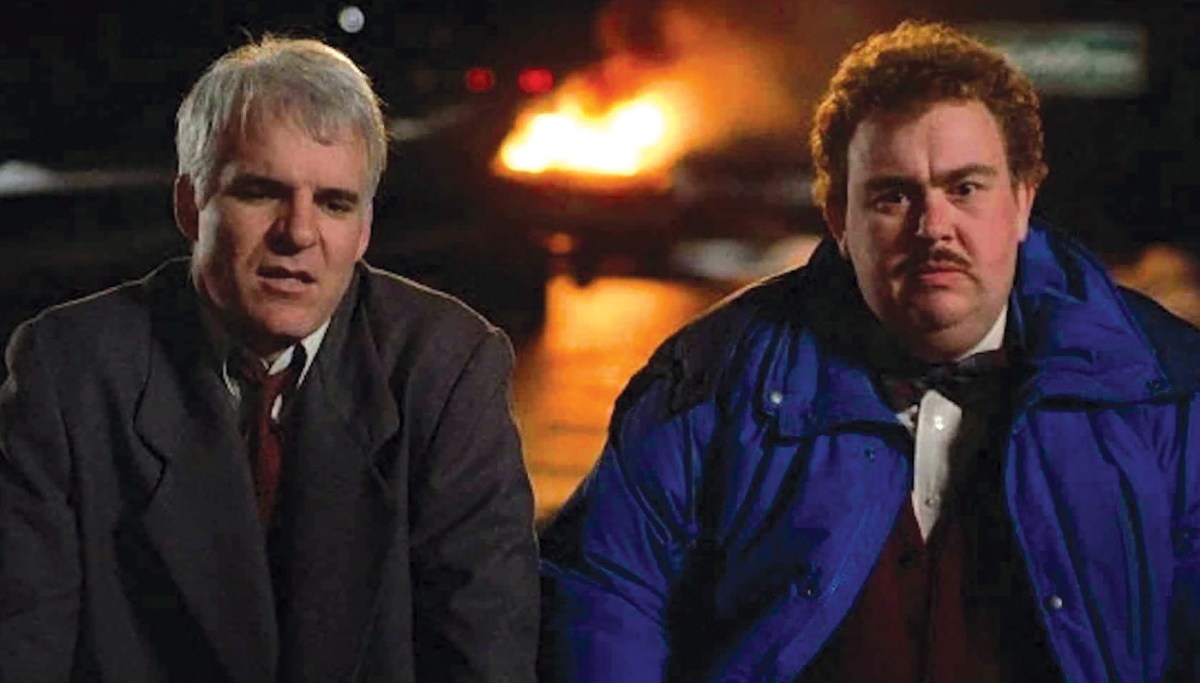
In November, as thousands of people around the country learned their flights were canceled and struggled to make new travel arrangements, more than a few must have been reminded of the 1987 comedy Planes, Trains and Automobiles. Maybe they were even inspired to watch it on their phones or laptops as, like the characters played by Steve Martin and John Candy, they sought to overcome the obstacles that fate, in the form of the Federal Aviation Administration’s copper wires, threw in their way and find a way to their loved ones. There are worse ways to kill time in a crowded airport than by watching two superb comic actors partner with John Hughes, the writer-director who was then at the height of his powers.Planes, Trains and Automobiles is basically The Odyssey set during Thanksgiving week, with snowstorms and rental car agencies standing in for the Cyclops and Calypso. Marketing executive Neal Page (Martin) has a Tuesday evening flight from New York to Chicago. Theoretically, he should have no trouble spending the holiday with his wife and three children. But his boss drags out a meeting, and then he can’t get a cab. When he finally boards his plane, he’s stuck next to a talkative lout who takes off his shoes and socks and declares, “My dogs are barking today.” The fellow is a traveling shower curtain ring salesman named Del Griffith (Candy), and it turns out he and Neal had already encountered each other: Neal had tripped over Del’s enormous trunk while running for the cab that Del eventually got.So begins an unlikely partnership. When the flight to Chicago is rerouted to Wichita, Kansas, Neal and Del share a hotel bed. Then they get a train. When that breaks down, a rental car. Then a bus, and so on. Del, whose motto is “go with the flow,” irritates the uptight, stressed-out Neal with his slovenliness and nonstop talking, so Neal tries to ditch him at every opportunity. Yet he never succeeds. One reason is that Del is helpful. Sure, he’s uncouth and ill-mannered, but Del’s charm means he has connections in every city, can lead bus riders in a sing-along, and sell shower curtain rings as earrings. Steve Martin and John Candy in “Planes, Trains and Automobiles.” (Courtesy of Paramount/Everett Collection) It’s more than self-interest, though. Neal also keeps returning to Del out of loyalty born of gratitude — the perfect motivation in a movie about Thanksgiving. There are several occasions when he could ditch Del but instead returns to help carry his trunk, the one that made him miss his cab, or come in from the cold. Yes, he seems as chilly as the Midwestern weather. (“What do you figure the temperature is?” Neal asks Del as they ride in the bed of a pick-up. Del replies, “One.”) But from the start, we see that Neal cares about the family he’s desperate to see, and he gradually expands his care to include Del.In one of the movie’s most poignant scenes, Neal goes on a tirade about Del’s annoying habits. “I’m not changing,” Del replies. “I like me. My wife likes me. My customers like me. Because I’m the real article. What you see is what you get.” In John Candy: A Life in Comedy, biographer Paul Myers writes, “In that moment, it was hard not to imagine that Hughes had somehow tapped deep into the soul of the real John Candy.”But in classic Hughes style, that emotional scene is followed by a cathartic one in which the characters wake up in their shared bed to find themselves cuddling. Martin’s ad lib — “Those aren’t pillows!” — remains one of the most memorable, if least plausible, punchlines of 1980s screen comedy. The funniest moment, though, comes when Del’s careless late-night driving nearly gets them plowed over by two 18-wheelers.Planes, Trains, and Automobiles marked Hughes’s departure from a string of great teenage comedies, including The Breakfast Club (1985) and Ferris Bueller’s Day Off (1986). Even though the characters’ ages and interests are different, Hughes still delights in cartoonish images and funny sound effects. Many actors from his other comedies appear here, too. Edie McClurg, the vice principal in Ferris Bueller, is a rental-car clerk subjected to a blitzkrieg of f-bombs. Lyman Ward, who played Tom Bueller, plays Neal’s colleague in the first scene. And Kevin Bacon, who later starred in She’s Having a Baby (1988), fights Neal for a cab. Dialogue from that yet-to-be-released movie plays from a TV later, a subtle sneak preview of a coming attraction.The soundtrack is a Thanksgiving-sized feast for music obsessives. As is the case with most Hughes films, English new-wave artists take over the Midwest. Unfortunately, the movie’s final scene is marred by an inferior cover of Hall & Oates’s “Everytime You Go Away” performed by Blue Room, which was featured in both Ferris Bueller and Some Kind of Wonderful (1987). Otherwise, the scenes and songs pair well, especially the Silicone Teens’ bouncy cover of “Red River Rock.” The Dream Academy, whose version of the Smiths’ “Please Please Please Let Me Get What I Want” plays when Ferris and his friends visit the Art Institute of Chicago, contributes the song that accompanies Neal’s crucial realization about Del’s life, “Power to Believe.” Neal’s most frustrating moments are set to “I Can Take Anything” — an attempt to replicate Yello’s “Oh Yeah” from Ferris Bueller, this strange song features samples of dialogue set to music by David Steele and Andy Cox of Fine Young Cannibals and, before that, the English Beat.The success of a road-trip buddy movie relies on the chemistry of the leads, and it’s hard to top what Candy and Martin have in this film. “John and I ad-libbed a lot during the movie,” Martin recalls in his graphic memoir, Number One is Walking. “The first cut of the movie was four and a half hours” — the released film runs just over 90 minutes. Martin also described Candy as “sensitive, complex, but [he] had the biggest heart of anyone I’ve ever known. We loved each other.” That affection helps explain why the film’s final moments are so convincing: Neal realizes that when his own homeward journey finally ends, Del’s never will, so he welcomes him to his family’s celebration. We don’t see anyone actually celebrate the holiday. It’s enough to know they’ll be celebrating with loved ones.THE SUN NEVER SETS ON HARLAN COBEN’S EMPIRE The relationship between Candy and Hughes can’t be overstated, either. In last year’s documentary John Candy: I Like Me, Candy’s son explains that when the comedian started working with Hughes, “he really hit his stride. Those two were like brothers.” Director Chris Columbus agrees that “those two guys were kindred spirits.” And actor Macaulay Culkin observes that while Hughes is most often associated with young actors such as Molly Ringwald, Candy is the actor who appeared in the most of his films and inspired his best work.Planes, Trains and Automobiles is a perfect recipe of physical humor, great dialogue, ad-libbed jokes, and well-earned emotion. Martin explained that in lines cut from the movie’s ending, “John’s character explained our friendship. … ‘I sort of attach myself to people from time to time … but this time, I just couldn’t let go.’ Every time John said the line, I wept off-screen. Strangely, the line was cut, but the ending still worked. When I saw the movie with an audience, they wept too.” I wasn’t in that audience, but I still have that same reaction.Christopher J. Scalia is a senior fellow at the American Enterprise Institute, author of 13 Novels Conservatives Will Love (but Probably Haven’t Read), and host of The Back of the Book podcast.
‘Planes, Trains and Automobiles’ remains as hilarious and touching as any Thanksgiving film
Full Article
Original Source
Read the full article at Washingtonexaminer →KhanList aggregates and links to publicly available news content. We do not host full articles from third-party sources. Always verify important information with original sources.