
ERENHOT, Inner Mongolia: Opening a heavy machinery business in Erenhot, his hometown in China’s Inner Mongolia region, seemed like a promising bet for Zhao Youjun when economic activity picked up after the pandemic.Having previously worked in an unrelated industry, the 60-year-old ventured into selling excavators and other construction equipment about five years ago.But the optimism was short-lived."Business was good when things first reopened, but it has been very slow these past few years," he told CNA. Zhao attributed the slowdown to a lack of construction activity, particularly across the border in Mongolia, where he said limited economic resources had held back demand. Zhao Youjun, 60, stands beside heavy machinery at his equipment business in Erenhot, Inner Mongolia, China, where he says sales have slowed in recent years. (Photo: CNA/Hu Chushi) Against this backdrop, renewed Russian efforts to advance a major gas pipeline linking Russia and China through neighbouring Mongolia could offer fresh opportunities for businesses in the region.While the pipeline's final route has yet to be confirmed, Erenhot's position as a major trading gateway to Mongolia could put local businesses in a position to benefit from related construction and logistics demand.Zhao knows little about the project's details, but welcomes the prospect of more investment in the region."If more projects come and there's more construction, of course that's good for business. That's what we're hoping for," he said. Zhao Youjun shows a catalogue of heavy machinery sold by his equipment business in Erenhot, Inner Mongolia, China. (Photo: CNA/Hu Chushi) The proposed pipeline, known as Power of Siberia 2 until September, would carry up to 50 billion cubic metres of Russian gas annually to China through Mongolia.That is equivalent to about 11 per cent of China's natural gas consumption in 2025, according to International Energy Agency figures.The project was renamed Power of Baikal in September at Russian President Vladimir Putin's direction to reflect its planned route near Lake Baikal in Russia.It would be a major addition to the existing Power of Siberia 1 pipeline, which began supplying Russian gas to China in 2019 and reached its annual design capacity of 38 billion cubic metres in 2025. But despite years of negotiations and repeated political commitments, the two countries have yet to agree on key commercial terms, particularly pricing.For Moscow, which has lost much of its European gas market since invading Ukraine, the project offers an important alternative export route. Beijing, however, has its own gas production and multiple import options, giving it greater bargaining power, analysts said."Beijing appears content to keep the project on the negotiating table and is in no rush to move things along," Erica Downs, a senior research scholar at Columbia University's Center on Global Energy Policy, told CNA.A PIPELINE STILL ON PAPERPlans for a western gas pipeline linking Russia and China date back to 2006, when the two countries discussed a route through the Altai Mountains, bypassing Mongolia.The project stalled despite renewed talks in subsequent years, before plans for a route through Mongolia gained momentum in 2019.On paper, the project has made progress.In September 2025, Russia's state-owned energy giant Gazprom announced what it called a "legally binding memorandum" with China to build the pipeline, including a transit section through Mongolia known as Soyuz Vostok.But the agreement fell short of a final gas supply contract, leaving crucial questions over pricing and financing unresolved.More than a year later, Moscow is still pushing for a breakthrough.In October, Russian Deputy Prime Minister Alexander Novak expressed hope that Gazprom and China National Petroleum Corporation could reach commercial agreements by the end of 2026. Russian President Vladimir Putin signs a pipe during a ceremony marking the welding of the first section of the Power of Siberia gas pipeline near Yakutsk, Russia, on Sep 1, 2014. (Photo: AFP/RIA Novosti/Kremlin Pool/Alexey Nikolsky) The stakes are particularly high for Russia.Since its invasion of Ukraine in 2022, Moscow has seen its once-lucrative European gas business shrink dramatically as European countries sought alternative suppliers.Russian pipeline gas exports to the European Union fell by nearly 90 per cent between 2021 and 2025 - a decline of about 120 billion cubic metres annually, according to the International Energy Agency.That lost volume was equivalent to nearly half of Russia's total natural gas exports in 2021.Power of Baikal would allow Russia to redirect gas from western Siberia, which has traditionally supplied European markets, to China. This differs from the existing Power of Siberia 1 pipeline, which began supplying China in December 2019 and carries gas from eastern Siberian fields."Russia has been desperate to get this deal moving despite its own concerns over increasing economic reliance on China,” Kristina Lozinskaya, an affiliated researcher specialising in China-Russia relations at the Asia Society Policy Institute's Center for China Analysis, told CNA.“(Russia) has long avoided letting Beijing take equity stakes in major pipelines on Russian territory,” she pointed out.WHY BEIJING CAN WAITChina, meanwhile, has more options for securing natural gas, including substantial domestic production.In Uxin Banner, a county-level area in Inner Mongolia about 700km south of Erenhot, shops selling drilling equipment and machinery parts, as well as offering repair services, are commonplace.The area is home to Sulige, one of China’s largest natural gas fields, which has supported a network of businesses catering to the industry. Natural gas extraction facilities amid farmland near Uxin Banner, Inner Mongolia, China. (Photo: CNA/Hu Chushi) Wang Yadong, 49, moved to Uxin Banner from neighbouring Yulin in Shaanxi province more than a decade ago to set up a vehicle and equipment maintenance business.For years, work was plentiful, with gas-field operators regularly calling on him to service their machinery, sometimes even during public holidays."We used to get calls almost every day. There was always something that needed repairing," he told CNA.But business has slowed over the past year or two, Wang said, attributing this to reduced activity at some older gas-field sites.After more than two decades of development, Sulige faces declining output at some ageing wells.PetroChina, the state-controlled energy company whose Changqing Oilfield subsidiary leads development of Sulige, said in January 2025 that the number of low-producing wells was increasing, prompting efforts to improve extraction and develop additional reserves.Wang said he had heard that further exploration was underway, but was unsure when that might translate into more work."If there's no more business here, I'll have to look for something else to do," he said.Other suppliers have felt the slowdown too. Yan, 40, who declined to give his full name, said business at his equipment store had fallen by about half over the past two years."I've heard there are plans to explore and develop more gas fields, but we haven't seen much activity yet," he told CNA. A shop selling equipment and spare parts for the natural gas industry in Uxin Banner, Inner Mongolia, China. (Photo: CNA/Hu Chushi) Despite the challenges, Sulige remains a major contributor to China's domestic gas supply.The site has maintained annual production of more than 30 billion cubic metres of natural gas for four consecutive years, according to a 2026 report published by China's National Energy Administration.Nationwide, natural gas production reached 262.1 billion cubic metres in 2025, up 6.3 per cent from the previous year, according to the National Bureau of Statistics.Beyond domestic production, China imports gas through pipelines from Central Asia and Russia, while buying liquefied natural gas (LNG) shipped from suppliers including Australia and Qatar."What matters more for China is energy supply diversity. Beijing doesn’t want to rely on any single supplier, including Russia, for energy supplies," Qiu Mingda, a senior analyst covering China and Northeast Asia at political risk consultancy Eurasia Group, told CNA.Russia already supplied around one-third of China's natural gas imports in 2025, through pipelines and LNG shipments, according to Downs from Columbia University. THE PRICE OF PARTNERSHIPAn additional overland pipeline would offer China greater protection against disruption to maritime gas shipments - a risk brought into sharp relief by the war in Iran."The main benefit of the PoS2 (Power of Siberia 2) is the security of supply that does not depend on geopolitical volatility of maritime routes of China’s LNG imports (Malacca Strait, Taiwan Strait, Middle East),” said Philipp Ivanov, founder and CEO of GRASP, an Australia-based geopolitical advisory firm, referring to the project’s former name.But the strategic benefits have not been enough to overcome disagreements over commercial terms.In September, the South China Morning Post reported that talks had stalled over a wide gap in price expectations, citing sources familiar with the negotiations.According to the report, Beijing was hoping to secure prices as low as US$50 per 1,000 cubic metres of gas, comparable to the subsidised price paid by Russian households. Failing that, it was seeking a price of US$120 to US$130, roughly equivalent to what Russian industrial customers pay.Moscow, meanwhile, was reportedly seeking about US$250 to US$260 per 1,000 cubic metres, broadly in line with prices under the existing Power of Siberia 1 agreement.Neither side has publicly confirmed the prices being discussed. A tanker truck parked in Uxin Banner, Inner Mongolia, China, where businesses provide transport and equipment services to the local natural gas industry. (Photo: CNA/Hu Chushi) The two sides also differ over the length of the proposed agreement and how much gas China would be obliged to purchase.In September 2025, Gazprom CEO Alexei Miller outlined plans to supply gas to China through the pipeline over 30 years, according to Russian news agency Interfax.For Moscow, the prospect of locking in unfavourable prices for decades presents a dilemma, said Lozinskaya from the Asia Society Policy Institute."Moscow is between a rock and a hard place: sign a bad deal now and lock in 30 years of losses, or wait and risk further losses from the war and idle capacity.”Meanwhile, Beijing wants a shorter agreement and greater freedom to adjust its purchases, Ivanov said."Unlike with LNG shipments where China can have a choice of partners, routes, volume and timing, the pipeline reduces flexibility and locks China into a partnership with Russia."Downs from Columbia University said that if China could take “as little or as much gas as it pleased” from Power of Baikal, it would be more likely to approve the project.China's calculations are also shaped by uncertainty over its future energy needs, particularly as renewable energy technologies advance, analysts said."There is a chance - in China’s judgement - that renewable technology will advance much faster than the current trajectory and will replace or dramatically reduce gas and other energy sources, therefore reducing China’s demand for gas," Ivanov said. Wind turbines stretch across the grasslands of Inner Mongolia, China. (Photo: CNA/Hu Chushi) WHEN INTERESTS DIVERGEThe prolonged negotiations highlight how China and Russia's economic interests can diverge, even as their leaders emphasise the strength of their bilateral relationship.At a meeting on the sidelines of the Asia-Pacific Economic Cooperation (APEC) summit in Shenzhen on Nov 18, Chinese President Xi Jinping described bilateral ties as having stood "rock-solid against all odds", while Russian President Vladimir Putin called for deeper cooperation, including in energy.Yet warm ties have not translated into a final agreement on Power of Baikal.For Qiu from Eurasia Group, the prolonged talks underline the importance Beijing places on commercial considerations, even in its dealings with a close strategic partner."Commercial feasibility is a crucial consideration. Beijing is not pegging itself to Moscow in diplomatic manoeuvres; it has its own calculations," he said.Ivanov offered a similar assessment."Their alignment is based on mutual and current transactional interests, not values or longer-term convergence of strategic interests,” he said. A Mongolian border checkpoint seen from the Chinese side of the China-Mongolia border in Erenhot, Inner Mongolia, on Sep 29, 2026. (Photo: CNA/Hu Chushi) The proposed pipeline also has implications for Mongolia, which would serve as a transit country between Russia and China if the project goes ahead."The deal envisions economic wins for Mongolia, centred on substantial transit fee revenue, job creation, and greater geopolitical importance, among others," said China-Russia relations researcher Lozinskaya.But closer economic ties with its two larger neighbours could complicate Mongolia's efforts to avoid becoming overly dependent on either country.Lozinskaya pointed to Mongolia's longstanding "third neighbour" policy, under which it has sought to strengthen relations with other partners, including the US and Japan.For now, those potential benefits remain contingent on Beijing and Moscow reaching a final agreement.In Erenhot, businesses are still waiting to see whether the proposed pipeline will bring new opportunities.Zhang, 39, who declined to give his full name, joined his uncle three months ago in a business renting out land for storing construction materials."My uncle has been doing business here for about 10 years. He thinks there will be more opportunities in the future," he told CNA. A wheel loader at a yard storing construction materials in Erenhot, Inner Mongolia, China. (Photo: CNA/Hu Chushi) But Zhang was cautious about banking on the proposed pipeline, saying locals had heard little about its progress or seen signs of development."I'm not sure if my uncle thinks there will be more opportunities because of the pipeline," he said."But I wouldn't count on it."
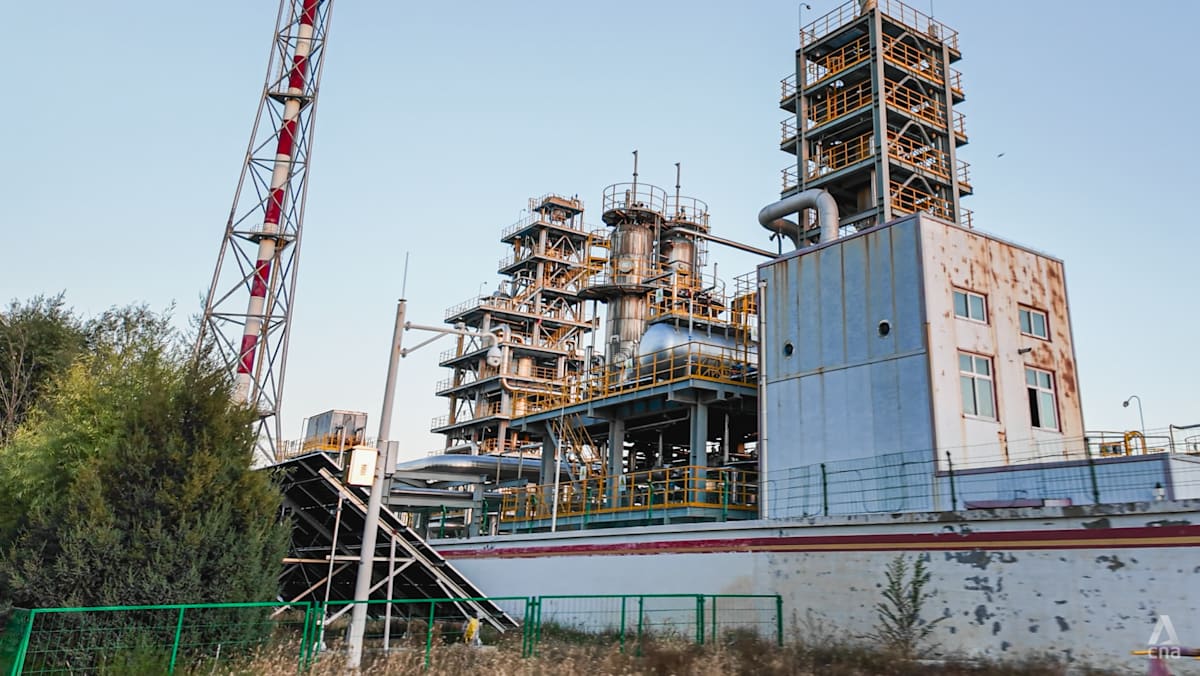
Pipe dream? Why China is in no rush to seal major gas pipeline deal with Russia
Full Article
Original Source
Read the full article at Channelnewsasia →KhanList aggregates and links to publicly available news content. We do not host full articles from third-party sources. Always verify important information with original sources.