
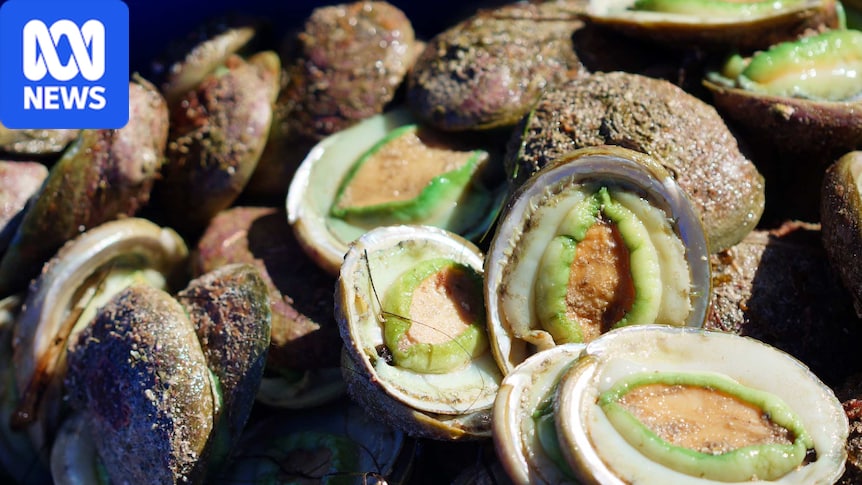
The world's first ocean-ranched abalone operation is winding down on Western Australia's southern coast as export prices fall and losses rise.In 2019, the business was riding high on an export "gold rush" to Chinese consumers, making it the biggest employer in Augusta.Locals were employed to dive and harvest abalone off artificial reefs in Flinders Bay, as well as process the molluscs at a nearby facility.Now, Rare Foods Australia (RFA) is winding down the business, having accumulated losses of more than $25 million as of June last year, according to financial documents. The molluscs are considered a delicacy in a number of Asian countries. (ABC News: Nicholas Martyr)The company's financial hardship comes amid a slump in the global abalone market, driven by drastically expanded supply from China's farmed abalone industry.The company's 2024–25 financial report, lodged with the corporate regulator earlier this month, shows RFA sustained a yearly loss of $4,833,469, and that its net assets had halved from $9.6 million to $4.7 million.A wind-down strategy adopted in 2025 included workforce restructuring and reductions in operating expenditure.By June, it had delisted from the Australian Securities Exchange to "reduce the significant costs associated with ASX listing".The company also stopped seeding juvenile abalone into its artificial reefs in Augusta.RFA declined ABC's request for comment.Family founder leaves industryAfter founding the company, then known as Ocean Grown Abalone in 2011, long-time managing director Brad Adams left RFA and the wider seafood industry earlier this year.Having followed his father's footsteps into the industry, he said stiff competition from Chinese producers had effectively halved export prices for greenlip abalone.Brad Adams says adapting to changed conditions is essential, but not always possible. (ABC South West WA: Jon Daly)"We were probably averaging around $55 to $60 a kilogram. Ranched abalone is now around $30, $35," Mr Adams said."Any business that loses half its margin that quickly has to respond and adapt pretty quickly."Sometimes you can't adapt, and you just have to look for other opportunities, and that's not the end of the world either."Aquaculture output 'halved'A drastic expansion over two decades has seen the Chinese industry reach production of around 200,000 tonnes per year.The result has been a flooded Chinese market, once the biggest consumer of Australian abalone.Mr Adams said other big players were also exiting Australia's aquaculture industry."It's probably halved production in the last two years," he said.Last year, two Tasmanian farms closed, including an operation at Bicheno owned by Yumbah Aquaculture, Australia's largest producer.Yumbah Aquaculture's Kangaroo Island facility, which has operated for more than 30 years. (Supplied: Yumbah Aquaculture)The devastating algal bloom along South Australia's coast also saw Yumbah close its farm on Kangaroo Island.The challenging conditions have also halted plans for the industry to establish another foothold along WA's southern coast near Esperance.A proposal for an abalone ranch and broader aquaculture precinct began in 2017, backed by the Esperance Tjaltjraak Native Title Aboriginal Corporation [ETNTAC], in collaboration with Rare Foods Australia and Yumbah.But the project has sat on the shelf since.ETNTAC chief executive Peter Bednall said it made sense to investigate the project's future potential, but the recent downturn meant further expansion was in question.Peter Bednall says more needs to be done to build community resilience in small towns reliant on international industry. (ABC News: Emily Smith)"The reality is the concept we explored needs an awful lot of capital," he said."We think that's really important for towns like this, that our young people have the opportunities to stay here and develop their expertise in a range of different areas."
Pioneering WA abalone ranch winding down amid mounting losses
Full Article
Original Source
Read the full article at Abc →KhanList aggregates and links to publicly available news content. We do not host full articles from third-party sources. Always verify important information with original sources.