
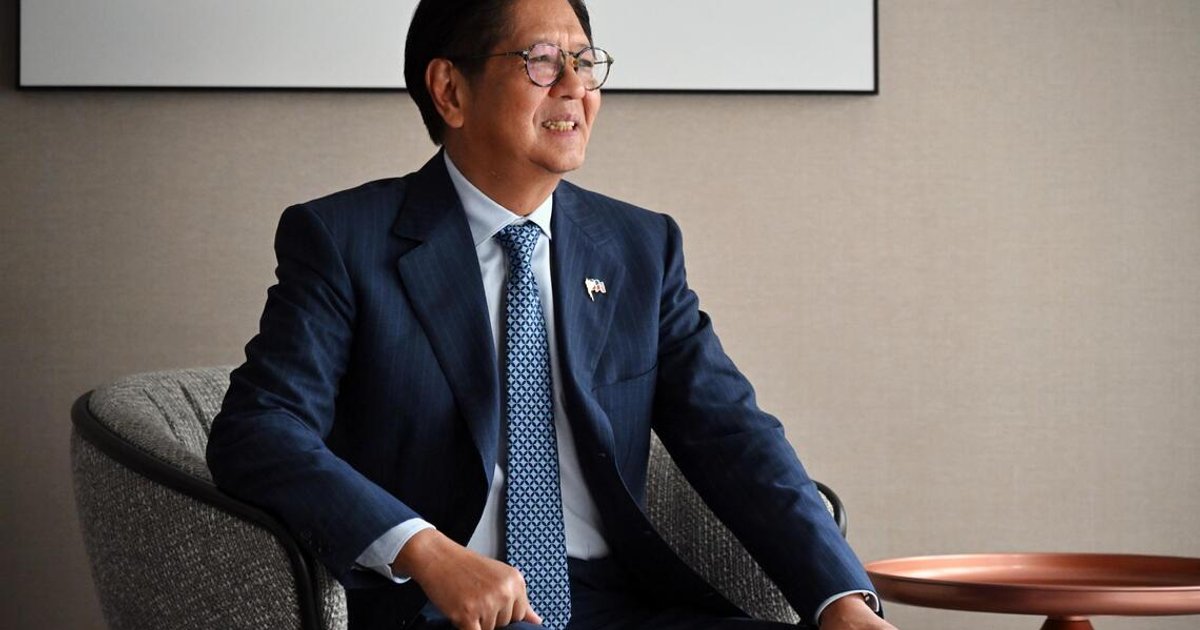
SINGAPORE - Philippine President Ferdinand Marcos Jr. said some progress had been made in bringing Myanmar’s military regime to the table, even as ASEAN continues to face criticism for its ineffectiveness in ending the five-year civil war in the country.In an exclusive interview with The Straits Times on Oct 8, Marcos said the Philippines sought to reset ASEAN’s approach to Myanmar as the grouping's chair in 2026, given that the Five-Point Consensus peace plan was not working.The peace plan calls for an end to violence, constructive dialogue among the parties, the appointment of a special envoy, humanitarian assistance, and an envoy visit to Myanmar. Drawn up by ASEAN two months after the military regime overthrew Myanmar’s elected government in February 2021, it is the central document for ASEAN’s engagement with the regime.Since the coup toppled Aung San Suu Kyi’s National League for Democracy (NLD) government, ASEAN has barred the regime’s leaders from attending its summits and maintains that the junta needs to show progress on the Five-Point Consensus plan.However, Marcos told ST that while the Five-Point Consensus was “absolutely correct”, it was not working.“That’s one of the initiatives that in our chairmanship we were able to move forward, because in May, during the ASEAN (summit) in Cebu, I proposed and said we need to have a new approach on Myanmar,” he said.“Nothing’s happening, so we had to do something else. And I am happy to know, because today I saw the news that the leader of Myanmar has visited Malaysia, has visited Cambodia. And that is the beginning which has never happened before,” he said.Marcos disagreed with the frequently made argument that the regional group’s non-interference and consensus-driven approach limited its ability to take meaningful action.“I think it’s that continuing search for consensus that gives ASEAN its strength,” he said, noting that while there are “shades, nuances and differences” between member states, the central elements are agreed and can be built on.Describing the recent developments in Myanmar as “shoots coming out of the ground”, Marcos said they had grown out of the ASEAN summit in May where leaders agreed that they needed to do more, or do something different, on Myanmar.“So hopefully you know, these things always start in small ways, but they grow and progress into something that’s much more, much more widespread and much more important, and hopefully it’s a complete final resolution,” he added.Not all ASEAN members share Marcos’s view.Timor-Leste, the newest of the group’s 11 members, for instance, supports the pro-democracy movement in Myanmar and initiated legal proceedings in February this year against Myanmar’s junta for war crimes.An estimated 100,000 people have died in Myanmar since the coup, which had displaced an estimated 3.8 million people by June 2026, and precipitated one of South-east Asia’s most severe humanitarian crises.Violence continues to rock the country, with a military airstrike on a crowded marketplace in Rakhine state on Sept 28 killing at least 50 people.Resistance forces continue to challenge the control of the country’s military regime.Meanwhile, Min Aung Hlaing, the former junta leader whose party won elections in December and January that excluded the deregistered NLD, has been trying to court legitimacy on the world stage. He has visited China and Russia, as well as five ASEAN member states so far, with Malaysia the latest.Bangkok and Kuala Lumpur have both drawn flak for rolling out the red carpet for Min Aung Hlaing.In particular, some activists have criticised Malaysia's Prime Minister Anwar Ibrahim for hosting the former junta leader from Oct 7 to 8 without getting any commitments on ending the violence in Myanmar and for repatriating Myanmar nationals, including Rohingya refugees, in Malaysia back to Myanmar, where they could face persecution.On Oct 8, Anwar said: “We, of course, are reminded of the ASEAN mechanism but we also understand that the President and your government have made a lot of efforts in order to enhance better relations but to have the necessary reform, policy changes, adjustments in your own country.”“We, on our part in Malaysia, will do whatever is possible to make sure that we enhance this collaboration and ultimately take Myanmar as part of our community of nations without prejudice and particularly in the context of ASEAN,” he added.Both Anwar and Min Aung Hlaing made no mention of the Five-Point Consensus at a press conference in Kuala Lumpur on Oct 8.On July 12, Singapore Foreign Minister Vivian Balakrishnan had said that ASEAN hopes to see demonstrable progress from Myanmar on the Five-Point Consensus such as the release of all political detainees including Aung San Suu Kyi.“The most important point was that we all reaffirmed the central importance of the Five Point Consensus – it was and it remains valid,” he told reporters after an informal meeting in Bangkok between ASEAN foreign ministers and Myanmar’s foreign minister Tin Maung Swe.Human rights groups warned that countries run the risk of legitimising former junta leader Min Aung Hlaing, while not extracting any concrete improvements in the situation in the war-torn country.Asked if ASEAN was moving towards recognising the Myanmar government, Marcos said the grouping has to move towards that if it is going to play a part in resolving the conflict in the country, even as he maintained that the Five-Point Consensus was non-negotiable.
Philippine President Marcos claims progress on Myanmar under new approach
Full Article
Original Source
Read the full article at Straitstimes →KhanList aggregates and links to publicly available news content. We do not host full articles from third-party sources. Always verify important information with original sources.