
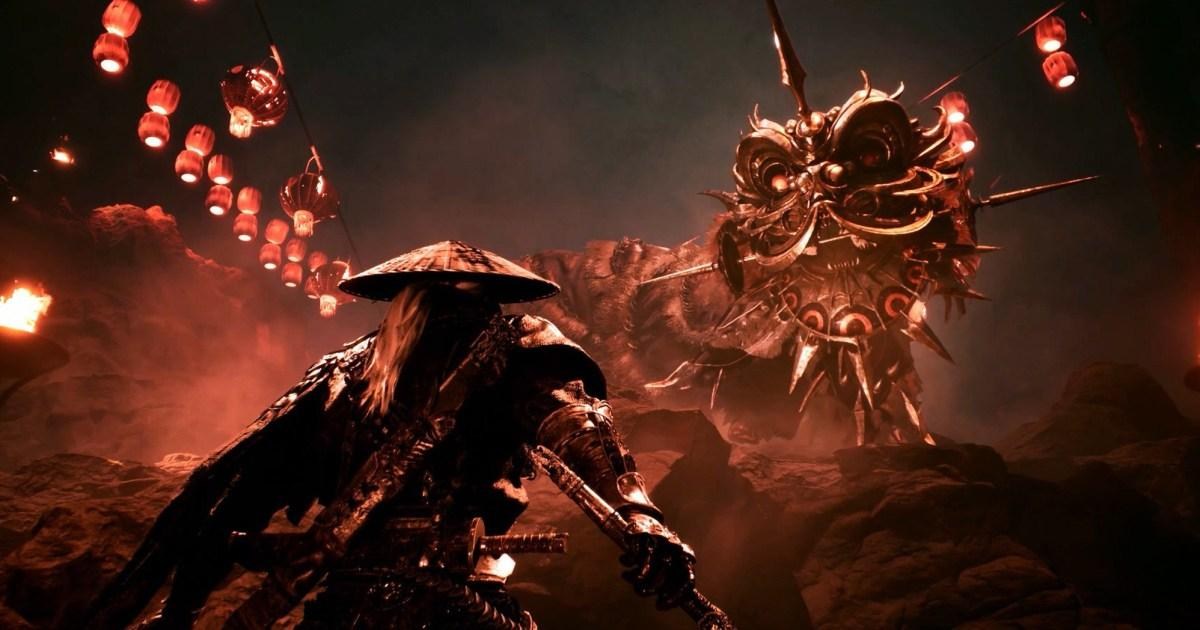
The lion, the blade and the Phantom (S-Game) GameCentral speaks with composer Caisheng Bo about breaking away from Chinese tradition with Phantom Blade Zero, why he won’t return for a sequel, and the country’s console boom. Phantom Blade Zero is a dizzying action game in many ways, between its kinetic boss fights, kung fu inspirations, and vast array of weapons, but one of the most distinctive aspects of its design is the chaotic soundtrack. Developer S-Game may have created a wuxia action role-player, but the music draws from both Chinese and Western influences, with blasts of metal, dance, and hip hop. This electric melting pot is best showcased in the boss fights, where the music can thrillingly shift between phases. As we learnt from composer Caisheng Bo, the game’s musical smarts runs deeper than the soundtrack – to the point where it’s even embedded into the game’s difficulty in subtle ways. Just prior to the game’s launch, we got a chance to speak with Caisheng Bo about his history with the Phantom Blade series, challenging expectations, and why he won’t return for a potential sequel. GC: So what is your background with music? Is it mainly composing for other video games? Want GTA 6 news? Sign up to the GameCentral newsletter for the latest GTA 6 news, reviews of new games you should play and exclusive analysis of the biggest stories of the week. CB: Mainly video games. I started when I was a high school kid. I emailed [S-Game founder] Soulframe Liang and I didn’t know anything about music. I was just a high school kid playing with instruments and playing in a band. And I like games, so why not? I studied economics because my parents forced me to. They were like, ‘Music? No, come on. We spent all this money, sent you to study abroad. Like, why would you even think about that?’ So I got a degree as an economics student. [When] I came back, I asked Soulframe, because he was doing his mobile game at that time called Phantom Blade 2. I was like, maybe I can join you and I can keep making music for you. He’s like, ‘yeah sure, why not?’ And that’s how I officially entered the industry and started creating music. GC: You’ve composed music for the Phantom Blade series since then, has it always had this musical style seen in Phantom Blade Zero? CB: Yes, it’s always been this but I think this one, Phantom Blade Zero, is the most polished and matured one. Because, 10 years ago, my skill wasn’t polished enough. We didn’t have the budget to record everything – all the weird Chinese ethnic music instruments and stuff like that. It costs a lot of money actually. For Phantom Blade Zero, we finally had the budget and I think I had prepared myself well enough to achieve what I always wanted to do to blend the new with the old. The Chinese with Western, or pop culture, electronic music, and all those and blend them together. I think not many people are doing that, which is a shame actually. Maybe a lot of people are doing it, but in the C-pop [Chinese pop] industry, so to foreigners, not many people have heard it. So I think a game in itself is a great way for everyone to enjoy. GC: It’s interesting because Phantom Blade Zero isn’t necessarily targeted at a Western audience, but it’s certainly the first in the series to be pitched worldwide. CB: Yeah one thing we found is that Westerners, or people outside of China, were more excited compared to Chinese local players. Because to a lot of local Chinese players, the music was probably too aggressive, or maybe a little bit offensive to some people. GC: Oh really? That’s interesting. CB: Because I’m using Chinese instruments in a way that’s never been used before. For example, the pipa – think of it as the Chinese guitar. I’ve tuned the pipa in a really weird way. A lot of people are like you shouldn’t tune the pipa, it’s just too much. [People are like] you shouldn’t do that to the pipa. There’s a lot of cultural background that sort of affects what people judge about the music, I think. So I sort of ignored all that [laughs]. I just went on with what I wanted to do. Phantom Blade is all about kungfu punk (S-Game) GC: So that applies more to Phantom Blade Zero than previous games? CB: Yes. The previous ones, because for mobile games, there isn’t as much narrative storytelling going on as AAA single-player games. I think now they do, but like, 10 years ago, five years ago, it’s more about the gacha element. It’s more about pushing out new characters that you have to pay in order to get them. But when you’re trying to focus on the storytelling part of the game, you’re trying to make it more cinematic. I found I had to put even more creativity into the music side of it because just doing what I used to do for Phantom Blade 2 or 3, the mobile games, just wasn’t enough for me. Also, [for] the sound of AAA games or single-player games, the players demand more. You have the environment, ambience going on, the water, you hear a lot of things and people pay more attention to the sound. So the music has to be more polished and it has to be more creative. GC: You mentioned earlier about how you believe other Chinese games that have come out have a more stereotypical soundtrack. Is that something you wanted to avoid with this? Does that style bother you? CB: I don’t have a thing with traditional music composers. Like for me, we need to make a step forward as a Chinese composer, because staying in the past isn’t always a good thing. We’re sort of tackled by our heritage and our musical history because we have like 5,000 years of history. It’s a national pride. When we talk about Chinese culture, everyone’s like we have a long history, we have tradition to protect and stuff like that. I mean, to me, the best way to protect the culture, the best way to defend your culture, is by innovation. You have to constantly innovate. Because a lot of the Chinese instruments that we know today, they are the product of cultural exchange. It’s not like the Chinese people invented this 2,000 years ago and it’s stayed that way. It’s not like that. GC: Yeah it’s been influenced from everywhere. CB: Exactly. So I’m pretty touched by that, by all the histories of how the cultural exchange actually improved our instruments and shaped the sound of our instruments. So, you know, why not? I feel like I should do the same thing. It’s very challenging, but I hope you like it. GC: Oh I think it’s great. I was thinking from a Western perspective, when you’re talking about the traditional side of it, I think the sounds of these games colour a lot of our view – at least more than we realise – of how we view Chinese culture at large. So when you hear something like this, which is throwing in more contemporary and Western elements, it’s quite arresting in breaking down our perceptions. CB: Yes, and also because as a composer, I feel like nowadays more and more in film and TV composition, you hear the same thing – even though it’s not by the same composer. But [it’s] this sort of safe zone that the composers and artists rather stay in. It’s not a bad thing. Maybe sometimes it’s because the team didn’t want to take a risk. Or because of the tight budget, time constraints, there’s a lot of factors that might affect the way we create music. But I just want to break away from that. I want to break people’s expectations. Nowadays, movies – even though they have different stories – they all sound the same, which is a shame. But I know a lot of composers, they want to do creative stuff, but they just don’t have the chance to. So I mean, for me, Phantom Blade is a great chance. So I have to take this chance and give it all I got. GC: When you’re aiming for that direction, was there a concern that breaking expectations could impact its appeal in China? I mean, it seems like pre-orders are through the roof… CB: It does [laughs]. The graphics and the combat is pretty awesome, everyone’s talking about that, but some local Chinese players, there are some people who weren’t very happy about the music. I fully respect that. But I guess that’s the downside of being too creative. I don’t know [laughs]. GC: I wonder if that’s a generational thing or not. CB: Yeah, maybe. The Lion Dancer’s music was created before the boss itself (S-Game) GC: I wanted to ask logistics wise as well, what was the process like in terms of development in making the music for Phantom Blade Zero? Were you involved all the way through? Was your music finished a while ago? CB: For Phantom Blade Zero, it’s a completely different thing. For some bosses, the director would ask me to come up with the music first. The Lion Dancer, that’s one. In 2023 I think, he asked me to do a track for the Lion Dancer boss, and he didn’t have anything, like nothing. [He was just like] ‘Inspire me!’ I was like, OK, sure. So because we’ve been working together for 19 years, we didn’t really work in a way that most game developers do. It’s not like they gave me an assignment, and then gave me another assignment. What we do is just not the same. What we do is that, if he’s done a chapter of content, which is like five hours of gameplay, he’ll play it, he’ll record the whole thing, and he’ll send it to me. He doesn’t give me an assignment, like, ‘from this point A to point B, I need a music’. None of that. He just gave me the recording, the video of him playing, and I do the entire design. Like I tell them, OK, from this point to that point, I’ll do a loop. And to that, I give you a little cue, a stinger, that you play for only once. And then it follows another loop. I do the entire design because I know what I want to hear. So that way, the music is more integrated. And also, it breaks your expectations. Because I play tricks. I establish your expectation first. And then I know like 10 minutes later, I’m going to break your expectations. I do tricks like that. And that makes the listening experience more fun. GC: So did you work on all the sound effects too? CB: Yes, I also work with the sound effects team. GC: Oh, because I love the wind-up of the axe when it does the [impersonates high pitch sweep noise]. That’s so cool. CB: [laughs] Yes, exactly. I mean, I have to make an apology to the sound effects team, because they have to yield to my music. Because in the world of digital sound, the space is limited. If you have louder music, the sound effect has to go softer. If you have loud music and loud sound effects, like your sound will clip. So there’s a set amount of space allowed for the general loudness. So if my music is louder, then the sound effects have to get lower. So I have to apologise to them [laughs]. Because for more games, it’s the other way around. Sound effects are more important than music, because a sound effect actually helps you to make judgements. So, in this game, we want to keep the players more focused on the music, but still, at the same time, we don’t want the music to be too aggressive – I want you to focus on your combat. So, if you die too many times in one boss fight, you’ll probably feel the music going down a little bit, bit by bit. Like, the next time you respawn, you go fight the boss, the music will not be as loud. And you’ll hear more of the sound effects. So we have that design in our game. GC: That’s interesting. Is the music also reactive to the gameplay in other ways? CB: That’s one of the systems we designed. There’s also, if you’re engaged in an exploration, like you’re exploring the map and you start fighting the enemies, the music won’t change to a battle track. It would still stay in that exploration music, but with like drums or other instruments adding on top of that. So the transition is smoother. GC: So are you involved in the creation of those systems? CB: Yeah. I give them assignments and the programmers do all the programming. It’s like, I want this. And they’re like, sure [laughs]. GC: It feels like you’re selling yourself short by calling yourself only a composer on this game. CB: I guess so, but I don’t know the technical details. I just tell them like, in order for my music to sound better, like I demand this and that. They’re like, okay, sure [laughs]. I mean, I can’t say this enough, I have to apologise to the entire team. Sometimes I make all these weird requests and they’re like, ‘No, we can’t do that, we can’t do that’. GC: It obviously feels like the Chinese games market is having a moment right now, at least in the console space in the wake of Black Myth: Wukong. Why do you think that’s happening right now? CB: I would say like 99% of game creators, or people in the Chinese gaming industry, they like AAA single-player games but they had to make mobile games because that’s what the market demanded. That’s where the money was like 10 years ago, five years ago. And people didn’t have their high-specced personal computers back then. Cell phones were more accessible and more affordable. So after Black Myth: Wukong, a lot of people bought new computers, new PCs, or PlayStation 5, just for Black Myth: Wukong. So now you have this new generation of PCs and PlayStation 5 [players] ready to play single-player games. Like, all of a sudden, all those customers magically appeared. They used to only play on their phone because it was accessible. I think a lot of people realise that and now, since we are all fans of single-player games, why don’t we just make single-player games? It’s like that. Personally I think it’s like that. We always wanted to make single-player games. I think the market demands something more polished, more focused on storytelling and narrative. The boss fight music is the highlight (S-Game) GC: Also, in the introductions earlier, did you say this might be your last Phantom Blade game? CB: Yes because I think as a team, at S-Game, we’ve given it all. We’ve done everything we wanted to do in terms of wuxia and Chinese fantasy games. If you asked me to compose for another wuxia-inspired game, I don’t know what else I could write. That’s why I said it’s probably my last one. Because I don’t know, I’ve done it enough [laughs]. So I’m doing Tides Of Annihilation. It’s a Western setting [London, in fact – GC] so I can finally do all the Western fantasy motifs and the orchestration stuff. It’s a good detour from all this Chinese right now, you know? [laughs]. GC: [laughs] Well, I think the music in this game is refreshing. I was thinking in comparison to the music of boss fights in other games of a similar scale, like FromSoftware titles. It’s very different in the way it gets you amped up. CB: Yes, because those types of games, their music is more orchestra-focused. You have a very big band. When you have a big band, you have to crank up the reverb, the space, and the epicness of the music is all about the space. But for Phantom Blade Zero, everything is so close to your ears because we don’t have as many instruments as the Miyazaki Soulslike games, or those epic games, or epic movie blockbusters. Because I don’t need them. I don’t need that many instruments. Maybe one or two Chinese instruments in one track and I feature them heavily, and I add all kinds of effects on them. That’s what I need. So you’ll find those instruments are very close to you, but they still give you a sense of [scale]. So I think that’s probably why it’s very different. GC: So if someone did give you a massive budget, would you reject it? CB: [laughs] Yeah, I don’t need this money! GC: Brilliant, thanks so much for your time. Phantom Blade Zero is out now (S-Game) Email gamecentral@metro.co.uk, leave a comment below, follow us on Twitter. To submit Inbox letters and Reader’s Features more easily, without the need to send an email, just use our Submit Stuff page here. For more stories like this, check our Gaming page. Arrow MORE: Star Wars: Battlefront 3 is why EA shut down Mass Effect and BioWare says report Arrow MORE: Roblox sees decline in players as company brags it can import ‘any game’ with AI Arrow MORE: PS5 console sales after six years are stronger than PS4 and PS3 GameCentral Get the latest GTA 6 news, reviews of new games you should play and exclusive analysis of the biggest stories of the week.
Phantom Blade Zero composer reveals why his music is ‘offensive’ in China
Full Article
Original Source
Read the full article at Metro →KhanList aggregates and links to publicly available news content. We do not host full articles from third-party sources. Always verify important information with original sources.