
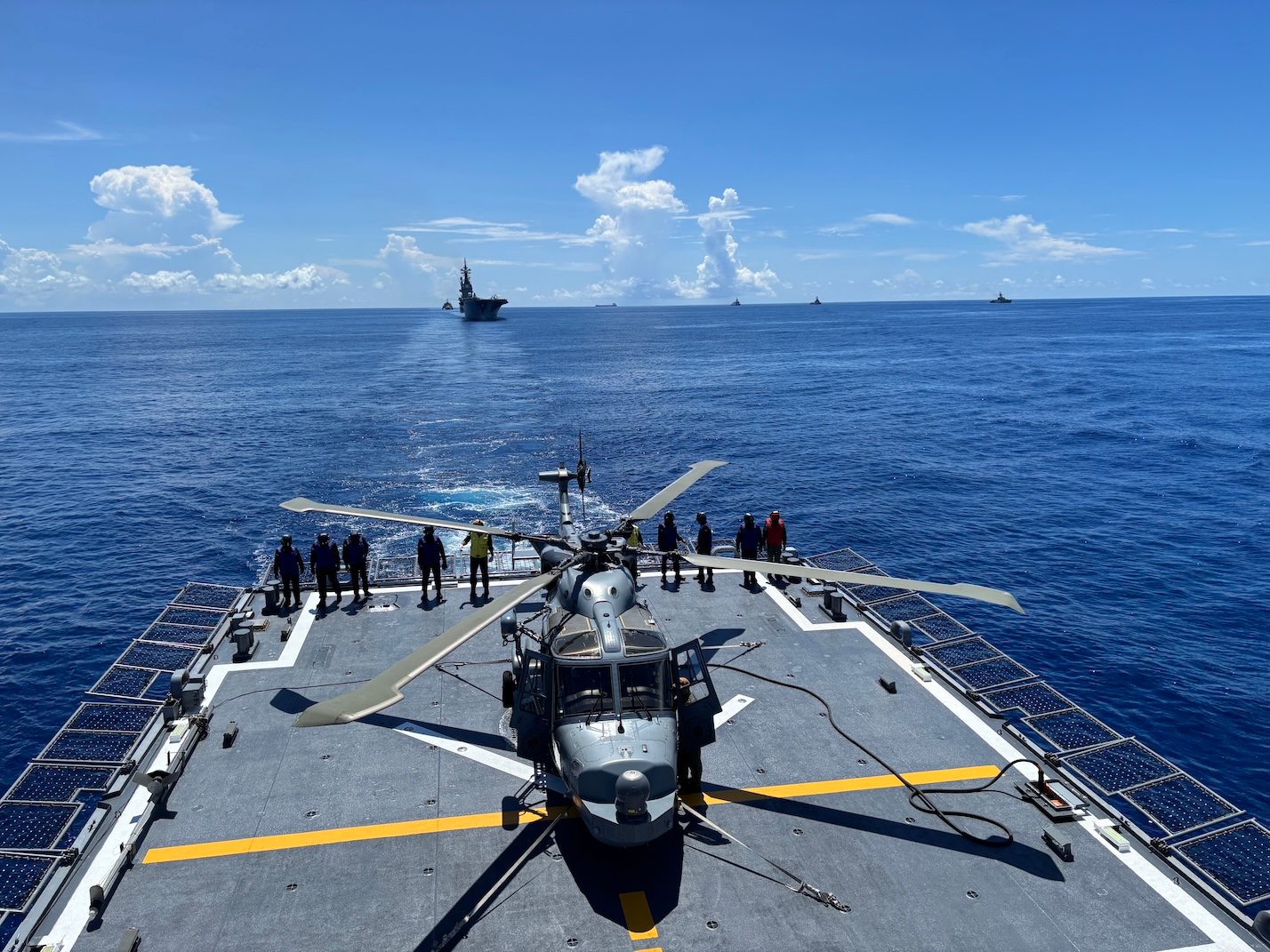
ADMM-PLUS DRILLS. Ten navy vessels from eight different countries sail behind the BRP Jose Rizal on September 23, 2026, during a joint cooperative activity in waters off the coast of Zambales. Bea Cupin/Rappler A Chinese Navy vessel is seen close to where eight countries are sailing for the drills, but it does not respond to challenges from the Philippine Navy The Philippines hosted a joint maritime security exercise involving eleven ships from eight countries as part of the ASEAN Defense Ministers' Meeting-Plus (ADMM-Plus) EWG-MS. The exercises focused on interoperability among regional navies and included drills for medical evacuation, search and rescue, and aiding grounded vessels, while China did not participate in the sea phase despite being present at the opening. Maritime security in the South China Sea remains a critical concern for ASEAN nations, with ongoing tensions between the Philippines and China over territorial claims, particularly in the West Philippine Sea. This is AI-generated. Read the article for full context. Report any errors. ABOARD THE BRP JOSE RIZAL – In waters off the coast of Zambales on the morning of Wednesday, September 23, the domineering figure of the helicopter destroyer JS Ise inched closer and closer to the Navy’s flagship, the BRP Jose Rizal. It was a welcome sight — a signal that a joint activity under the Association of Southeast Asian Nations (ASEAN) would soon commence. Dotting the waters around Rizal was an impressive array of gray ships — the Philippine Navy’s own BRP Tarlac, two from India, two from New Zealand, and one each from Singapore, Brunei, Australia, the United States, and Japan. All eleven ships from eight countries were in these waters for the sea phase of the ASEAN Defense Ministers’ Meeting-Plus (ADMM-Plus) Experts’ Working Group on Maritime Security (EWG-MS). ADMM-Plus is the premier platform for the region’s defense ministers to take up a long list of issues. For the ADMM-Plus EWG-MS, the focus was on maritime security and environmental resilience in the face of climate change. On Wednesday, the Rizal was the lead ship for formation drills and a medical evacuation, while the Japanese forces led search and rescue efforts. The BRP Tarlac, meanwhile, practiced aiding a grounded oil tanker and cross-deck landing drills. China did not participate in the sea phase of the ADMM-Plus EWG-MS, although they could have. Representatives from China were present at the opening of the ADMM-Plus EWG-MS in Zambales on Monday, September 21. Reporters embarked on the Rizal, including a team from Rappler, saw at least one People’s Liberation Army Navy or Chinese military warship close to the area where the vessels were sailing together. The Rizal issued radio challenges to the Chinese vessel but did not get a response. Regional cooperation The sea phase and even the meetings on land aren’t just for showing off new and old assets. They’re meant to test and practice interoperability, or the ability of different navies and units to work with each other. On a more human level, it’s about establishing familiarity and trust between the armed forces of the bloc and its partners. Aside from chairing ASEAN, Manila is also chair of the ADMM. The Philippines, with Defense Secretary Gilberto Teodoro Jr. as host, is expected to host ministers of the ADMM-Plus before 2026 ends. “Our collaboration and cooperation not merely in response but in early prepositioning, working together, and in detection becomes more critical,” said Teodoro on Monday, at the opening of the ADMM-Plus EGW-MS. Alongside the joint cooperative activity is a Future Leaders Program or FLP, which brings junior officers of different navies together to “engage their counterparts on climate change, maritime security, and key topics, including the United Nations Convention on the Law of the Sea and Critical Underwater Infrastructure security.” In the region — and in ASEAN especially — maritime security is a major concern. The South China Sea, where up to a third of global trade passes through, encompasses several ASEAN countries. It is also the flashpoint for regional tensions, mostly between Southeast Asian claimant nations and superpower China, which is part of the ADMM-Plus and is an ASEAN dialogue partner. Malaysia, Vietnam, Brunei, and the Philippines are all claimants to various areas and features of the South China Sea. Wednesday’s drills were within the Philippines’ exclusive economic zone, an area where Manila should have sovereign rights or the exclusive rights to exploit and responsibility to protect marine resources. Beijing claims almost all of the South China Sea, including the Philippine EEZ, which is part of the West Philippine Sea. China has also refused to recognize the landmark 2016 Arbitral Award. Tensions between Manila and Beijing have meant confrontations in the West Philippine Sea for the Philippines’ maritime frontliners. China has had tense confrontations, including skirmishes, with other ASEAN claimants in the past. ASEAN, with Manila as chair, has aspirations of concluding a Code of Conduct on the South China Sea with China before 2026 ends. Teodoro has publicly cast doubt over Beijing’s trustworthiness. – Rappler.com How does this make you feel? Loading
PH leads ASEAN, partner navies in West Philippine Sea drills
Full Article
Original Source
Read the full article at Rappler →KhanList aggregates and links to publicly available news content. We do not host full articles from third-party sources. Always verify important information with original sources.