
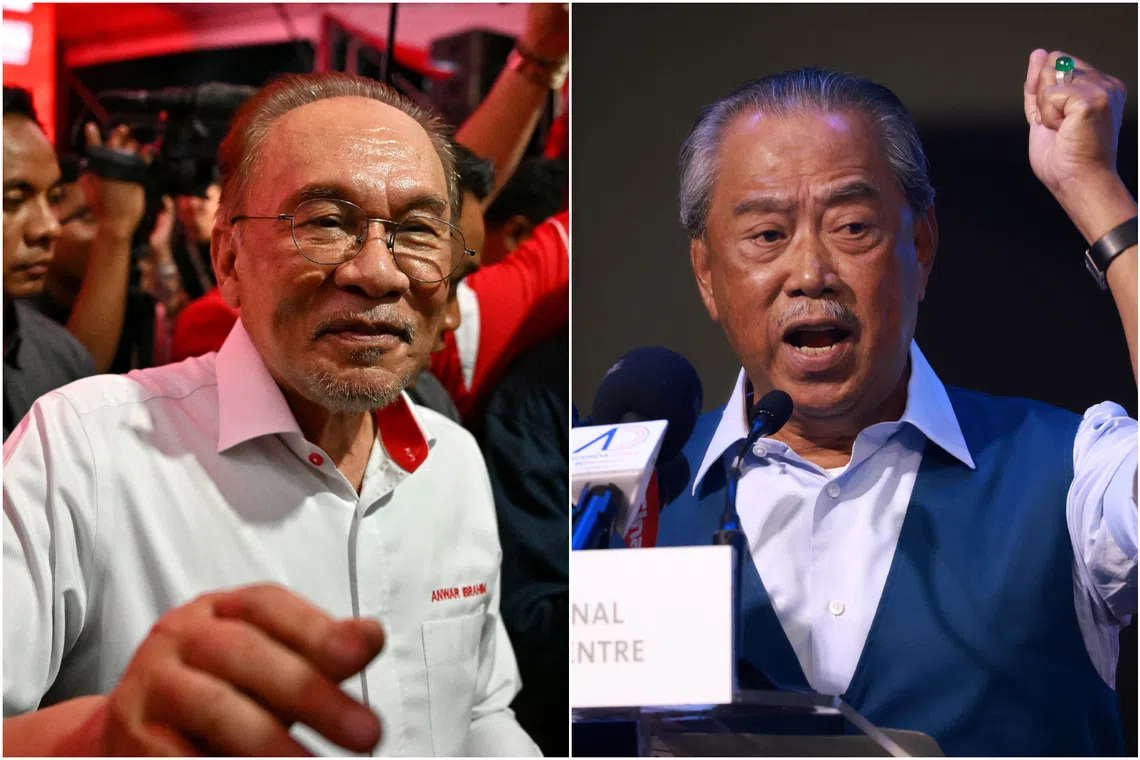
KUALA LUMPUR – Malaysia’s opposition party Parti Pribumi Bersatu Malaysia and ruling coalition Pakatan Harapan (PH) are exploring a confidence and supply agreement (CSA) ahead of upcoming state polls and budgets, a move that could swiftly reconfigure the country’s political landscape.Official sources told The Straits Times that a proposed pact in Selangor and a potential electoral arrangement in Melaka are being discussed to bridge political divides following recent state election setbacks.A CSA in Selangor would cement a commanding 43 seats in the 56-seat state legislature – surpassing the two-thirds supermajority threshold required for major constitutional amendments.“This opens up the possibility of redelineating electoral districts. Currently, the seats held by PH and Bersatu are much larger than those under PAS and UMNO, so we can redraw the boundaries or create new constituencies to make the map fairer,” said a state government official who wished to remain anonymous.Seats won by PH at the last state vote in 2023 include Kinrara, with over 120,000 voters, six times the size of UMNO’s Sungai Air Tawar.The average number of voters in seats won by PH at the last state polls in 2023 was close to 74,000, compared with just 50,000 for PAS and UMNO. This does not include Dusun Tua, which PH made way for UMNO as a gesture of goodwill within the unity government. The average for Bersatu was nearly 67,000.Beyond Selangor’s borders, this tactical recalibration is already reshaping electoral calculations elsewhere. PH Melaka chief Adly Zahari confirmed on Sept 19 that talks were ongoing for a “PH Plus” collaboration with parties including Bersatu.“If the PH–Bersatu electoral pact materialises in Melaka, one of the issues is voter transferability, as we have to explain to our respective grassroots why we should help each other,” said one top-ranking party leader involved in the negotiations.“Having a CSA in Selangor will give our campaign the narrative push for why this cooperation is mutually beneficial.”High stakes for state leadershipWith state alignments in flux, attention has turned sharply to how individual state leaders will manage these delicate negotiations on the ground. Malaysian Prime Minister Anwar Ibrahim, who is PH chairman, said discussions on political pacts will be led by PH election director Amirudin Shari.“We shouldn’t be arrogant. If someone says they are ready to discuss, we discuss – what’s wrong?” Anwar told reporters during his working visit to China on Sept 23.The Parti Keadilan Rakyat (PKR) president’s consistent stance since the party’s July national congress that “Amirudin will decide” on electoral strategy is significant.This is because the PKR vice-president is also Selangor chief minister. And Bersatu is strongest in Malaysia’s richest state, being led by Amirudin’s own former mentor Azmin Ali.Bersatu secretary-general Azmin was a PKR deputy president and the Menteri Besar before handing over the reins to Amirudin.Amirudin and Azmin’s relationship has remained cordial even after the latter led a clutch of PKR MPs out of the party in 2020. This had resulted in the PH government falling and Muhyiddin becoming prime minister in what was dubbed the “Sheraton Move”.Aside from Amirudin and Azmin, others involved in the discussions include Anwar’s senior political adviser Tengku Zafrul Aziz as well as Marzuki Mohamad, a close aide to Muhyiddin who was his principal private secretary when the latter was prime minister.Azmin is currently state opposition leader and his party has 11 assemblymen in the 56-seat chamber, more than in any other state.Selangor remains PKR’s primary bastion, but analysts believe a potential rival BN-PAS alignment could swing enough Malay voters to reduce PH’s haul in Parliament and even threaten its four-term reign in the state.“There is also a high possibility that PH will not only return to being the opposition bloc – barely able to defend 40 to 50 parliamentary seats – but even the Selangor state government held by PH since 2008 might fall,” Taylor’s University adjunct professor Ong Kian Ming, who was previously a PH deputy minister, said in a Sept 26 interview with local daily Sinar Harian.When contacted, Azmin told ST that “discussions are ongoing with several parties”.“Other parties have differing views of how to partner Bersatu and the strategic value of our base of 20 to 30 per cent of Malay voters. We are keeping our options open,” he said.Federal dynamics and party motivationsThese state-level tactical alignments are further compounded by mounting pressures at the federal level.Parti Islam SeMalaysia (PAS) ditched Bersatu in June in favour of a so-called Malay Unity pact with UMNO, a strategy that resulted in major wins at the Johor and Negeri Sembilan polls in July and August.This leaves Muhyiddin’s Bersatu as the only major party without an active national alliance.Both Muhyiddin and Anwar have said that talks between Bersatu and PH are under way, though framed as an open-door policy of discussions across party lines. ST understands that olive branches were extended as early as July after both sides suffered heavy losses in Johor.The Anwar administration has struggled to win over the Malay-Muslim majority since taking office following the 2022 general election, which produced the country’s first hung Parliament.A unity government of former rivals saw UMNO’s Barisan Nasional (BN) become a key ally, bolstering Malay representation. However, the PAS-led Perikatan Nasional (PN) bloc retains the largest share of Malay voters.This dynamic drove BN to end its electoral pact with PH and align with PAS in Johor and Negeri Sembilan, where they secured two-thirds supermajorities.This sense of political isolation has intensified following recent administrative setbacks for the opposition coalition.PN was suspended on Sept 23, as the Registrar of Societies issued a show-cause letter over Bersatu’s complaint that it was omitted from a July leadership meeting.This could prevent the PN logo from being used in Melaka and raises the possibility of the coalition being deregistered altogether if the registrar is unsatisfied with the explanation.Nonetheless, Malay voters are unlikely to be deterred by whether they vote under the PAS or PN banner.Although Bersatu failed to win any seats in those two state elections, it is estimated to have secured up to 20 per cent of Malay votes in several Johor constituencies, Muhyiddin’s home state. Combining PH and Bersatu support could alter the political landscape in Melaka and nationally.Such an arrangement would mirror dynamics from a decade ago, when Bersatu was formed under former prime minister Mahathir Mohamad and joined PH, helping end UMNO’s six decades of uninterrupted rule in 2018 before leaving the coalition in 2020.At Bersatu’s 10-year anniversary celebrations on Sept 19, Muhyiddin said the party did not favour any single partner in deciding its future following the end of its relationship with PAS, adding that its losses in Negeri Sembilan “proved our position that cooperation is important”.Top political sources also told ST that BN has also approached Bersatu in hopes of broadening the Malay Unity umbrella and gaining leverage against PAS.Meanwhile, the UMNO-PAS alignment has shown signs of strain, as both parties laid claim to leading the Malay Unity alliance and key executive leadership during their respective annual assemblies in September.But if the PH-Bersatu pact works out, then it could turn out that UMNO and PAS are counting their chickens before they hatch. Sign up for our weekly Asian Insider Malaysia Edition newsletter to make sense of the big stories in Malaysia
PH and Bersatu: Could Anwar and Muhyiddin bring the band back together again?
Full Article
Original Source
Read the full article at Straitstimes →KhanList aggregates and links to publicly available news content. We do not host full articles from third-party sources. Always verify important information with original sources.