
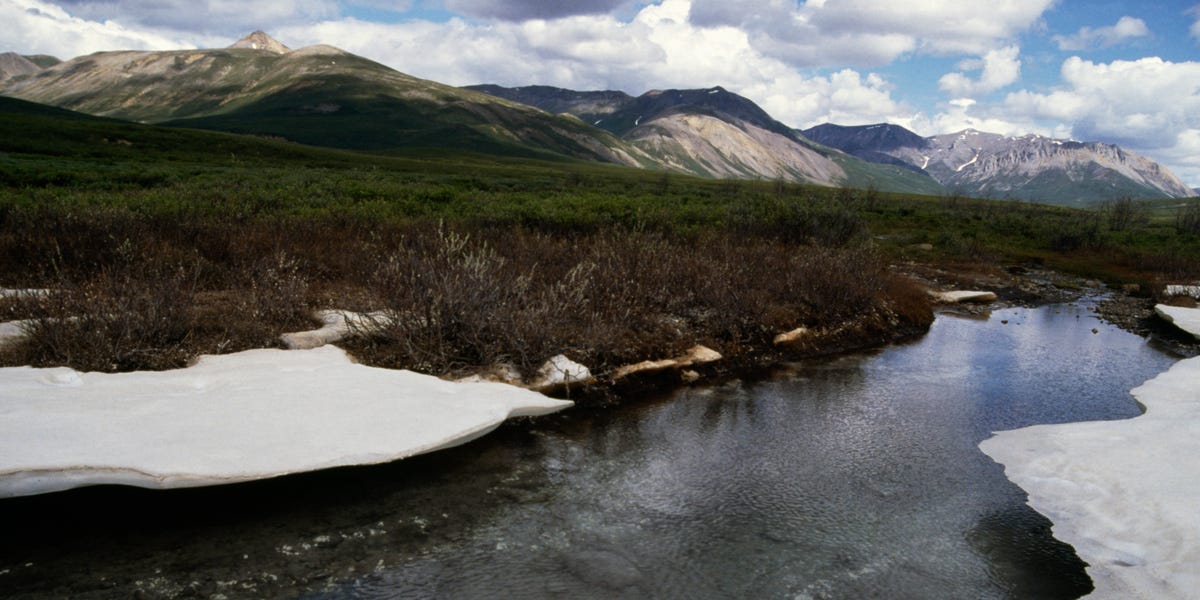
The largest northward-flowing river in North America, Canada’s Mackenzie River carries roughly 78 cubic miles of freshwater out of Great Slave Lake, winds through the frozen expanse and pristine forests of the Northwest Territories, and eventually empties into the Beaufort Sea, a marginal sea of the larger Arctic Ocean. The river represents the second-largest drainage basin on the continent, covering roughly 20 percent of Canada’s total landmass. The river valley served as the ancestral home of the Dene people, who in Slavey (a group of Athabaskan languages) called the river dehcho, or simply “big river.”For thousands of years before the arrival of industrial revolution, permafrost—soil, rock, and sediment that stays frozen at least two consecutive years—encased this part of the world in frozen beauty. But with rising anthropogenic carbon emissions, that immemorial stability is crumbling away. And in some places in the central Mackenzie Valley, melting permafrost is changing the landscape in surprising ways.Stasz D Sirotkin//Getty ImagesThawing permafrostIn 2017 and 2018, two gargantuan landslides impacted the area, moving 4.5 and 18 million cubic meters of frozen ground respectively. Landslides, on their own, aren’t necessarily surprising. As the climate warms and permafrost thaws, boreal and tundra ecosystems, whether in Canada, Alaska, or other northern regions of the world, have seen an increasing risk of landslides. However, the leftover evidence of these huge terrestrial deluges raised a few questions, chiefly because they appeared to carry large chunks of frozen ground with them.In 2019, permafrost geologist Joseph Young, then with the University of Alberta as a Ph.D. student, traveled by helicopter to a remote field site when he spotted slopes “just collapsing with landslides everywhere,” he told Science News. Young admits he was puzzled by these particular landslides because permafrost typically melts from the top down, making a muddy slurry that forms a slow-moving landslide.However, the Mackenzie Valley landslides contained chunks of still-frozen earth that had moved hundreds of meters, and initial ground observations showed that sliding occurred roughly 20 meters under the top layer of permafrost. To better understand the mechanics of this strange landslide formation, Young and a team of researchers from the University of Alberta set up instruments to track ground temperature from 2020 until 2022. They hypothesized that wildfires—including some that occurred decades in the past—and rising summer temperatures formed tension cracks, allowing water to seep in and cause the permafrost to thaw from below. They called this new kind of landslide “permafrost detachment slides” and reported their observations in the journal Geophysical Research Letters.“Climate warming and wildfire work together to drive heat to depth over decades, weakening the permafrost base,” the authors wrote. “Exposed ice-rich scarps continue thawing, triggering secondary landslides and irreversibly reshaping the landscape.”Melting permafrost isn’t just rearranging these long-standing slopes, it's also unleashing previously trapped metals into riverbeds, turning them in some cases a bright, eye-popping orange. Shifting permafrost is also swallowing up villages in Alaska’s remote tundra, and studies estimate that continued thawing could cause upwards of $50 billion in damage to buildings and roads in Alaska by 2050.The impact of climate change can’t be ignored, from rising sea levels inundating coastal communities to roiling wildfires that blanket world-renowned cities in smoke. And in the coldest regions of the world, climate change is quite literally changing the ground beneath our feet.Darren lives in Portland, has a cat, and writes/edits about sci-fi and how our world works. You can find his previous stuff at Gizmodo and Paste if you look hard enough.
Permafrost Is Thawing From the Inside Out—and It’s Unleashing an Entirely New Kind of Landslide
Full Article
Original Source
Read the full article at Popularmechanics →KhanList aggregates and links to publicly available news content. We do not host full articles from third-party sources. Always verify important information with original sources.