
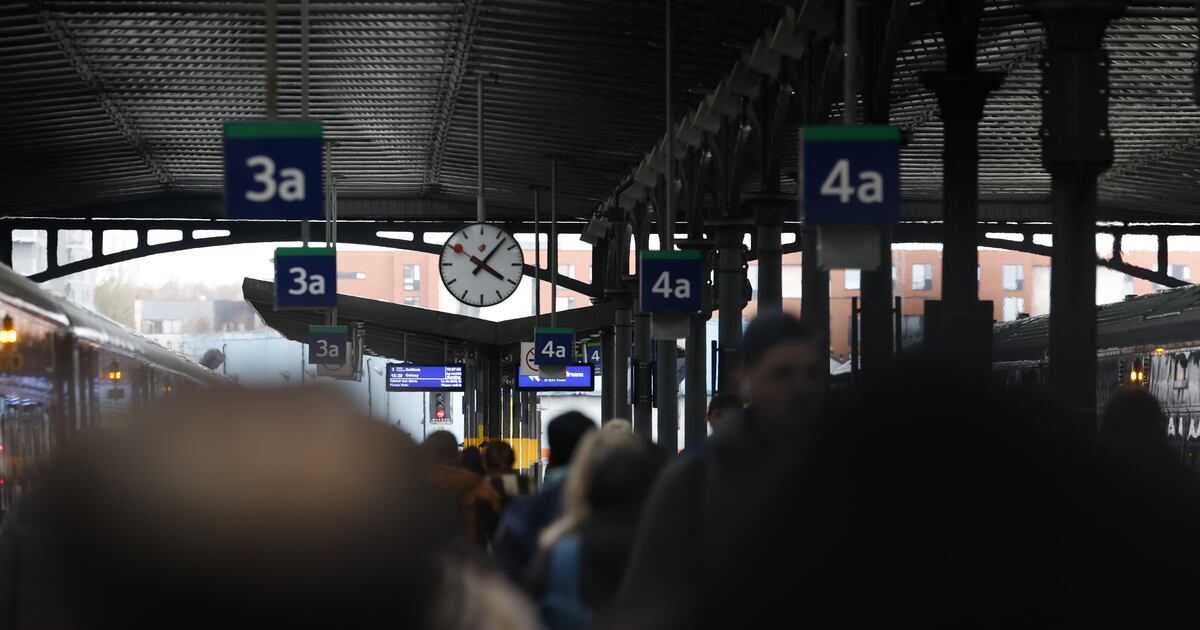
Irish commuters face the daily reality of jam-packed journeys, with some describing services as a public health risk12/03/2026 - News - General view from Dublin's Heuston Station. Photograph Nick Bradshaw Wrestling to get on board jam-packed public transport services is a daily reality for thousands of Irish commuters.Sinéad Hickey, a 25-year-old architect who commutes into Dublin city centre five days a week from Co Carlow, sees the strain it puts on people as she completes her 2½-hour journey from home to office.Her train from Carlow at 7.05am brings her to Heuston Station for 8.15am, followed by a mad dash via a Luas and bus to make it to Drumcondra for 9am.“The Luas at Heuston is scandalous,” Hickey said. “It’s by far the worst part. I find myself waiting for the third or fourth tram to arrive before I can get on, the others are all too full.READ MORE“Then, people on the Luas are annoyed, they’re trying to push on, and then they end up getting mad at each other,” she added.The last leg of her journey is the bus. “You just never know when they’re coming – it’ll say two minutes for about 10 or 15, then suddenly a random bus shows up,” she said.Sinéad Hickey, a 25-year-old architect who commutes five days a week from her home in Carlow to her office in Dublin. Hickey was one of more than 70 Irish Times readers who responded to a call-out for people to share their experiences of overcrowding on public transport at a time of record demand for services.Responses ranged from commuters being unable to reach their seat on a train because the carriage was too full, to 30km journeys lasting up to two hours on a bus due to congestion. [ Commuters to face increased fares on buses and trainsOpens in new window ]Even those who work for public transport bodies voiced their discontent at the services provided.One Dublin Bus driver spoke to The Irish Times of his frustration at being unable to rely on the bus to get to work. His employer “cannot even supply adequate public transport for the people that run” it, he said. He asked that his real name not be published out of concern that it may jeopardise his employment with the company, which undertakes its services under contract with the National Transport Authority. “It’s crazy,” he said, that a designated staff-only bus service “doesn’t run early or late enough to cover all the shifts for various routes supplied by the garage” he is primarily stationed in. “It means some people are forced to drive or cycle,” he continued.“It doesn’t make any sense that they’ve decided to run these earlier routes, but the staff service just isn’t there.”12/01/2026 Archive Dublin buses in Rathmines. Photo: Bryan O’Brien / The Irish Times Keyword: transport public dart las travel commute The driver, who only began his job recently, said he understands people’s annoyance at so-called “ghost buses” – services that appear in real-time updates on the Transport for Ireland app or live timetables at bus stops. He explained that overcrowding on earlier routes often considerably slows the service down throughout the morning, meaning operational managers will have to cancel later routes he is scheduled to drive as he is sometimes still completing the earlier one.Jason Campbell, a 52-year-old from Skerries in north county Dublin, said his train into the city centre most mornings is “absolutely chaotic” and “completely overwhelming” at times because of passengers being “packed like sardines” into the carriage. “It’s been markedly worse since colleges have started back,” he went on, with “a significant increase” in people unable to board the train at stops closer to the terminus. “Apart from it being unpleasant, it is actually unsafe,” Campbell said, with “commuter trains having no air conditioning” and some people “wilting away, close to collapsing”.“I don’t want to sound like a whinger,” he said, “but this is only going to get worse” given large housing developments in the area and public transport services not planned to increase alongside the population. Mark Walsh, a civil servant from Co Kilkenny, travels to the capital twice a week to work from the office. “The train is so crowded,” he said, owing to only six carriages in use, “and you might see very elderly passengers who haven’t pre-booked a seat”.“You’d worry for them,” he said. Mark Walsh, a 42-year-old civil servant who commutes twice a week from Co Kilkenny to Dublin city centre. And on the other end of things, “I see more and more students taking the very early trains,” he said, “probably because student accommodation is so scarce as well”.“I’ve started to see carriages full of people standing” for the 90-minute journey, “it’s starting to look more like a Luas”, Walsh said.[ ‘It’s just stressful’: Workers facing two and three hour commutes into DublinOpens in new window ]Yasmin Tello commutes by rail from Park West station in west Dublin to Drumcondra and describes her morning journey as “absolutely horrible”. “The 7.55am train is consistently extremely overcrowded, with passengers regularly struggling to board and being forced to squeeze into already packed carriages. Sometimes people are left behind because there simply is not enough space. “People should not have to start their working day worried about whether they will even be able to board their train,” she said.“It raises a genuine question about whether train sizes and capacity are being allocated according to passenger demand.“In terms of solutions, I believe Irish Rail needs to prioritise longer trains during morning and evening rush hours, ensure services operate at full capacity wherever possible, and review the scheduling and allocation of trains based on actual passenger numbers.” 12/03/2026 - News - General view from Dublin's Heuston Station. Photograph Nick Bradshaw In Co Kildare, Lori Scanlon has recently returned to work following maternity leave. She speaks of new housing developments adding to overcrowding and “lateness ... or a technical fault with the line” nearly guaranteed.“Every day I leave the house dreading the commute because I am either wedged into a vestibule or right under someone’s armpit on the Luas,” she said. Scanlon says it has become “a passenger safety issue” – something reiterated by Peter Moonlight, who commutes from Wicklow town on the Rosslare line. He said he had seen people collapse in overcrowded conditions, and once witnessed a passenger who had a seizure, during which “there was no response at all from the driver or guard to the passengers pressing the emergency intercom”. “Passengers were left helpless, and simply had to wait until the train stopped at the next station, having passed through several intermediary stations without stopping, before they themselves got off with the ill passenger to call for help.” Moonlight said he sent a complaint to Irish Rail. Some 672 complaints were made to Irish Rail in 2025. Delays in services were the largest single issue, accounting for nearly half of all grievances recorded.IN THIS SECTION
‘People try to push on and end up getting mad at each other’: Overcrowding on public transport
Full Article
Original Source
Read the full article at Irishtimes →KhanList aggregates and links to publicly available news content. We do not host full articles from third-party sources. Always verify important information with original sources.