
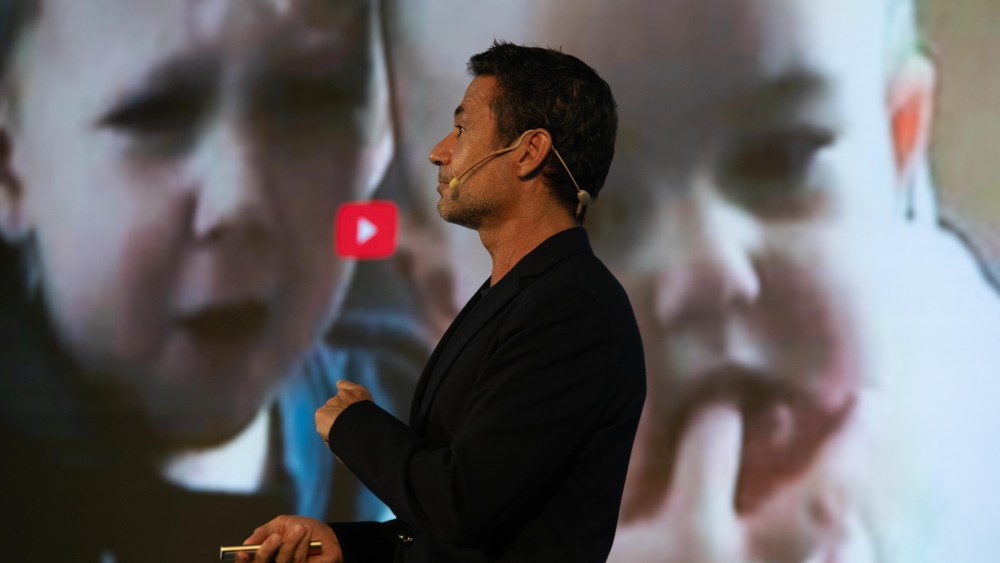
Speaking at the Iberseries & Platino Industria conference, Pedro Pina, YouTube VP for Europe, the Middle East and Africa, regaled a full house with a striking presentation that traced the evolution of YouTube to the powerhouse platform it has now become after 20 years. He showed milestones that marked its progress, from the first viral video of baby Charlie biting his brother’s finger, to the cultural impact of Susan Boyle and her powerful rendition of “I Dreamed a Dream” from the musical “Les Misérables” to South Korea’s “Gangnam Style,” the first of its kind to make a trans-national impact despite being in Korean. Susan Boyle’s audition only aired on Britain’s Got Talent but it kept getting uploaded despite the many times they took it down to honor the broadcaster’s request, he related. “The most interesting thing is that the broadcasters all of a sudden found out that, hang on, there’s something about fandom that is important. Fans love content and they kept going back to Britain’s Got Talent because they were in love with videos like that. So, this was the first time the overall broadcaster industry understood that it should be working with YouTube because it helped build a fanbase,” he said. Popular on Variety Then artists, led by Justin Bieber and Ed Sheeran, broke out on YouTube, followed by the proliferation of Live Sports along with the back stories of athletes, and now audiovisual hits, exemplified by the extraordinary box office success of genre features “Backrooms” and Obsession,” which originated on the platform. In the panel that followed, Pina pointed out: “The number we have for the U.K. only so far is that about 85% of the people that have a creative career in the industry have started their career on YouTube. So, it’s a greenhouse of the future of creativity, which can express itself on the platform or anywhere else.” “The objective of being here at this event is really to explain how our model works. The majority of people in the industry, fortunately, don’t understand it as much and that’s 100% our fault. We never spend enough time explaining to the industry how we work, how you can monetize. A lot of people were afraid of YouTube, mostly because they did not understand how the platform works, how their content could be protected, how it could reach new audiences and, more importantly, how they could monetize. Once you start breaking down that information, providing examples and showing the way, you see more and more people starting to work with us.” Sitting with him at the panel were execs from companies that have been able to tap YouTube’s advantages, led by Roger Rofín Sanglas of Catalan streamer 3Cat, Minerva Pictures Chairman & CEO Gianluca Curti of Italy and RTP Hugo Figueiredo of Portugal. “Three years ago, we began a transformation to adapt to the way audiences consume content. It’s no longer just through our linear channels. We’ve made our content available on the platform and on social media to attract our audiences there as well. And we believe we should be on platforms like YouTube,” said Rofín Sanglas. “We launched this platform precisely to respond to these changes in how our audiences are consuming content, and we believe it’s all compatible. YouTube is our destination, but at the same time, it’s our gateway to our own platform. Our platform is the third most chosen by Catalans, after Netflix and Prime Video in Catalonia, so we have an important path ahead of us to keep attracting audiences,” he said, pointing out the success of their children’s content on YouTube, in particular. Said Minerva’s Curti: “We started working on YouTube about 15 years ago, right at the beginning. Even in our best year, we sold less than 10% of our catalog, so we started thinking about how to optimize our income. At first, people told us, ‘You’re kind of pirates,’ but within a few weeks we understood that YouTube was, for real, the place to be.” “Since then, we’ve built an environment with more than 180 channels, worldwide in more than 25 languages, and around 7,000 movies. We keep working with broadcasters and platforms, but we also started producing our own YouTube Originals. So far, we’ve produced 15 independent movies, and our plan is to release 150 a year—roughly one per week.” “We’re delivering content made with real people and real studios, but we’re also exploring AI. These two worlds have to learn to live together, because you cannot stop the wind of the future or innovation with your hand,” he added. For Portuguese public broadcaster RTP, it has only recently tapped YouTube, said Figueiredo. He pointed out that public services can’t forget their mission, especially on the information front. As legacy companies, their content has traditionally been closely linked to TV and radio, but they need to move away from that. “Young audiences are on YouTube, and we cannot ignore that and try to push them back to linear. It’s true for entertainment, kids, talent shows, and now also sport. We started last week with live football, first the Champions League and now the Nations League, and it’s proving really successful. We’re starting from zero, but the numbers are very good, and it’s not affecting the broadcasting of those games.”
Pedro Pina, YouTube VP at Iberseries & Platino Industria: ‘YouTube is a Greenhouse of the Future of Creativity’
Full Article
Original Source
Read the full article at Variety →KhanList aggregates and links to publicly available news content. We do not host full articles from third-party sources. Always verify important information with original sources.