
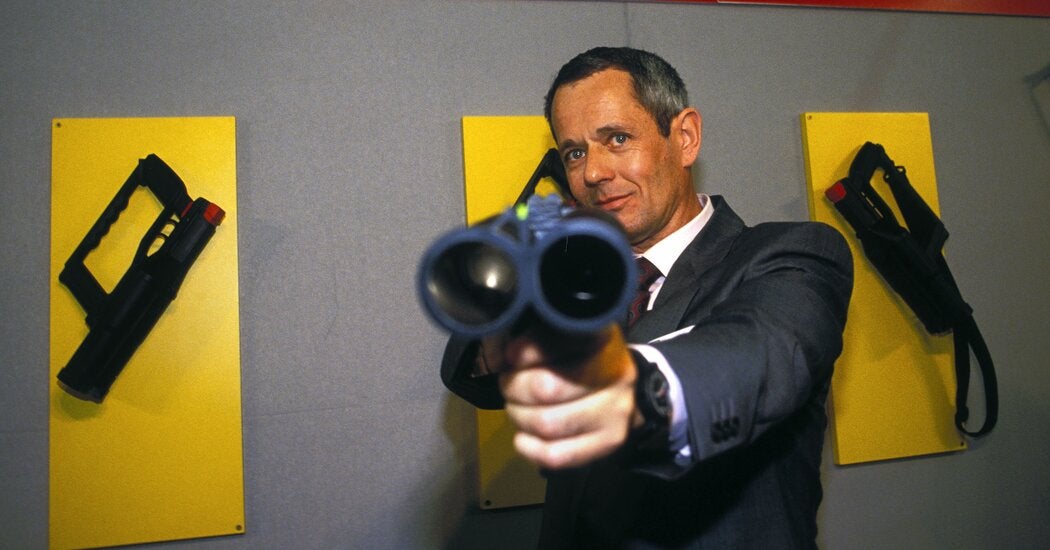
AdvertisementSKIP ADVERTISEMENTAfter years in elite police units, he drew scrutiny from human rights groups for selling arms and providing other services to unsavory governments. He was 80.Paul Barril in 1991. After he left the gendarmerie, or French national police, in the 1980s, he became a security adviser and mercenary provider.Credit...Jean-Michel Turpin/Gamma-Rapho, via Getty ImagesNov. 12, 2026, 6:01 p.m. ETPaul Barril’s offer to African dictators was straightforward: Your opponents will be subjected to surveillance and manipulation. Newspapers will be “infiltrated.” Plots against the state will be “neutralized.”Plenty of heads of state took up the services he offered, including Omar Bongo in Gabon and Denis Sassou-Nguesso in Congo. Other clients went to Paris to do their shopping at his Security Action Store, which offered the latest in bulletproof vests or night-vision goggles, as Mr. Barril recounted in one of his six autobiographies, “The Elysee’s Secret Wars” (1996).Mr. Barril was often described in the news media as a former French “supergendarme” for his longtime work in elite units. After he left the gendarmerie, or national police, in 1984, he became a security adviser and mercenary provider across the African continent and was implicated by human rights groups in the Rwandan genocide of 1994.His death, on Oct. 20 at 80 at his home in Antibes, France, was announced by the French interior ministry. He had Parkinson’s disease.By the time he founded his mercenary-security company, Secrets, a French acronym for Security Equipment Planning and Realization Company, in 1984, Mr. Barril was a well-chronicled public figure.In the gendarmerie, which in France is under the military, he joined a new military police intervention unit, the GIGN, in 1974. The French news media chronicled Mr. Barril’s reputation as an ultrafit top cop, a military-grade swimmer and diver, a black belt in karate, a parachutist, a hostage liberator and a policeman working inside and outside the law. With the GIGN, he participated in the 1979 operation against Islamist militants who had seized the Grand Mosque in Mecca, taking dozens hostage.In 1982, he became part of President François Mitterrand’s special antiterrorism police unit. That year, Mr. Barril was implicated in a murky affair in which he was alleged to have having planted weapons and explosives in the apartment of Irish nationalists in Vincennes, near Paris. French judicial authorities dropped the court case in 2002 on legal technicalities.ImageMr. Barril in 1983 during a police training exercise.Credit...Jean-Claude Delmas/Agence France-Presse — Getty Images“We did the operation. We prevented bloodshed. I don’t acknowledge anything, ever,” Mr. Barril said on the French television program “Tout Le Monde En Parle” in 2000. “I would do the same thing all over again.”It was in Africa that Mr. Barril gained the reputation that was to keep him at the center of French newspaper investigations, judicial probes and human-rights group complaints for decades.With another former colleague from the gendarmerie, Mr. Barril was “at the service of the principal despotic governments of Africa and the Middle East, under the forgiving eye of the French security services,” according to the 2021 book “The Empire That Won’t Die: A History of Françafrique,” written by a collective of historians, journalists and human rights activists.The book called Mr. Barril and his former colleague “emblematic figures” of “Françafrique,” a term employed in France and Africa to designate the murky official and unofficial networks — military, financial and political — entangling France with its former colonies. In 1990, Mr. Barril, for instance, recruited 15 mercenaries to teach the police in Gabon how to use tear gas against demonstrators, according to the book.His connections with the Hutu government of Rwanda, responsible for the 1994 genocide in which close to one million Tutsis were murdered, earned him his greatest scrutiny.In 2013, the Human Rights League of France, Survie, a human rights organization, and the International Federation for Human Rights accused him of “complicity in genocide” for supplying weapons and training to the Hutus. French magistrates investigated Mr. Barril’s role in Rwanda for years but never charged him.Mr. Barril didn’t deny being in Rwanda at the time of the genocide. During a search of the Paris offices of his company, the French authorities found a May 1994 contract signed by Mr. Barril and the Rwandan prime minister in which Mr. Barril committed to supplying the Hutu government with “20 men for training purposes,” “two million cartridges” of varying calibers, “shells and mortars” and “grenades.”The contract, which noted a fee of $3.13 million, was a violation of the United Nations arms embargo on Rwanda, and it was evidence that his men were helping the killers.In June 1994, the Rwandan government paid him $1.2 million of the sum, according to Human Rights Watch; but before the contract could be fully carried out, Paul Kagame, who led a Tutsi-dominated rebel group and later became president, entered Kigali, the capital, on July 4, 1994, and halted the killing by the Hutus.“There were three million dead” during the Rwandan civil war, Mr. Barril said on a television program six years later. “It’s the greatest historical lie ever. They’ve put it over that one ethnic group massacred another, when really, it was the opposite.”Mr. Barril always hinted to investigators that he had been acting under the indirect direction of President Mitterrand’s administration, which had been allied with Rwanda’s Hutu government.But his former boss in the GIGN, Christian Prouteau, said in an interview that Mr. Barril’s claims were nonsense.“He had no mission, despite what he pretended subsequently,” Mr. Prouteau said. “As soon as he left the gendarmerie, at no moment whatsoever did he have a mandate from France.”“He passed from the light to the darkness,” Mr. Prouteau added.Paul Barril, the son and grandson of gendarmes, was born on April 13, 1946, in Vinay, in the Vercors region in southeastern France. He spent his childhood in the high Alps, the area where his father was posted.At 18, Mr. Barril joined the army, was assigned to a tank unit in West Berlin, then returned to France for training at the gendarme sub-officers’ school, emerging top of his class. He went back to West Berlin, where one of his missions was to guard Rudolf Hess, the last remaining Nazi war criminal at Spandau Prison.ImageMr. Barril, second from left, in 2005 with Jacques Verges, his lawyer. The former policeman received a six-month suspended sentence and a fine for his role in an illegal wiretapping ring.Credit...Gilles Bassignac/Gamma-Rapho, via Getty ImagesMr. Barril took pity on the old man and, in the first of his memoirs, “Missions Très Spéciales” (1984), fantasized about liberating him. In 1975, he graduated from the gendarmes officer-training school in Melun, France, again at the top of his class.Not long after Mr. Prouteau helped organize the GIGN in the 1970s, Mr. Barril presented himself in his office, and he became the older officer’s second in command. “He was a flamboyant young officer, brilliant and courageous,” Mr. Prouteau recalled. “He made some dangerous arrests, without arms.”Things turned sour with the scandal over the arrest of the Irish militants. Twenty years later, Mr. Barril was caught up in another state scandal dating from those years: He received a six-month suspended sentence in 2005 and a fine for having been part of an illegal wiretapping ring in which dozens of politicians, actors, journalists, union leaders and others were bugged during the Mitterrand years.“You’re not necessarily bugging people to hurt them,” Mr. Barril said on the 2000 television program.In the meantime, according to Mr. Prouteau, Mr. Barril had gained a considerable fortune working for the emir of Qatar, among others, until illness overtook him at the beginning of the 2010s.Mr. Barril is survived by his wife, Angélique, and his son, Patrick.“He always had a nasty relationship with money,” Mr. Prouteau recalled. “And he was fascinated by mercenaries.”After Mr. Prouteau was shot during a 1980 GIGN operation, he added: “Paul was in the hospital every day. Then, he became the other Barril. I can’t accept that.”Daphné Anglès contributed research.Adam Nossiter has been bureau chief in Kabul, Paris, West Africa and New Orleans and is now a writer on the Obituaries desk.Related ContentAdvertisementSKIP ADVERTISEMENT
Paul Barril, French ‘Supergendarme’ Turned Mercenary, Has Died
Full Article
Original Source
Read the full article at Nytimes →KhanList aggregates and links to publicly available news content. We do not host full articles from third-party sources. Always verify important information with original sources.