
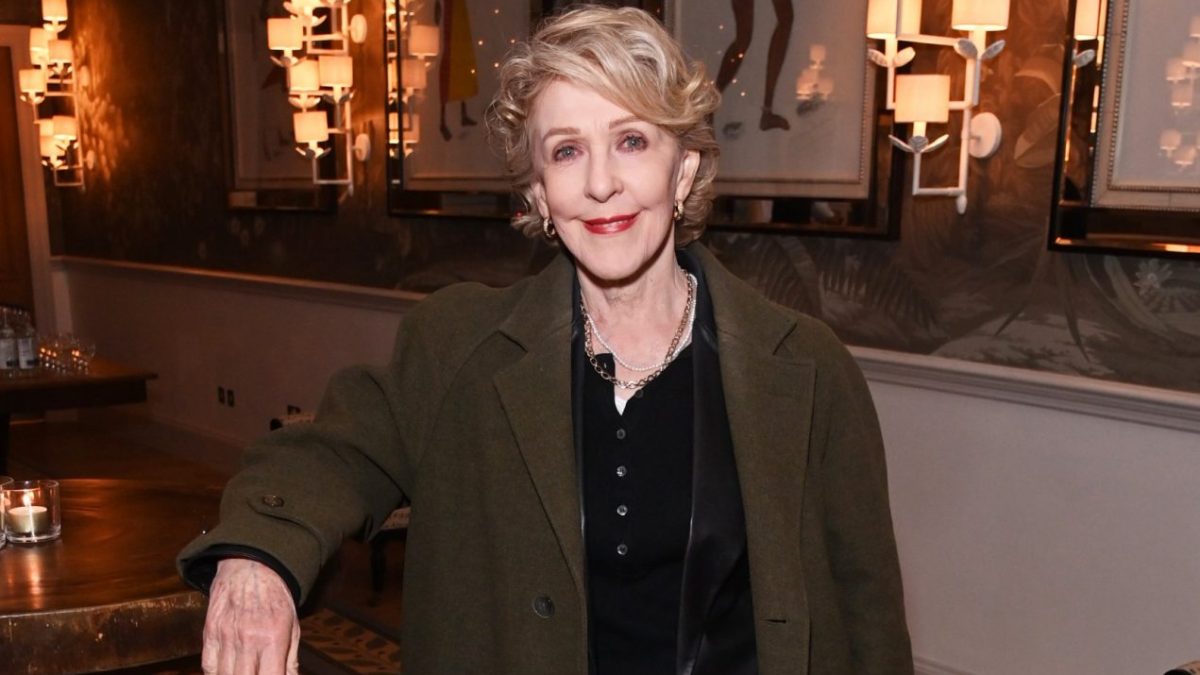
Patricia Hodge looks like a hostage victim. There she is, grim-faced, on my computer screen, mouthing the word “help”. She can’t get her microphone and speaker to work on our video call, so after a torturous few minutes of flapping, mutely muttering and miming, she resorts to scribbling down her phone number in biro and holding it up to the camera. It’s the sort of daft mishappery that would have befallen her character, Penny, in Miranda Hart‘s 2009 sitcom Miranda. A jolly Surrey snob determined to keep up with the Snootington-Joneses, Penny had her ambitions consistently thwarted by the gloriously clumsy, convention-defying silliness of her daughter (Hart). And now here’s Hodge – still impossibly glamorous at 79 and dressed for the country club in a crisp navy blazer and equally crisp slash of crimson lipstick – rendered adorably ridiculous by the tech. “Do I seem stylish?” she asks me later. “It’s not always quite the way I feel inside. I feel very aware of my flaws and overcompensate…” With her her pale, aquiline features, Hodge has been cast in a long series of icy, aristocratic roles – from the haughty, husband-snaring romance novelist Mary Fisher in the 1987 BBC drama The Life and Loves of a She-Devil, to eccentric Pekingese pup lover Mrs Pumphrey in Channel 5’s rebooted All Creatures Great and Small, to scone-scoffing toff Lady Chalfont in the recent TV adaptation of Anthony Horowitz’s Marble Hall Murders. The truth is that Hodge is a warm-hearted hoot. Her friend Miriam Margolyes let the cat of the bag on this as early as 1995, when she said that Hodge “loves pranks” and is a “wonderful giggler”. The pair first met in 1974 when they were in The Girls of Slender Means on BBC One. “Pat used to be the number one ‘corpser’, which, in the business, means laughing so much that you can’t speak your lines,” said Margolyes. Patricia Hodge played the glamorous and snobbish Penny in Miranda Hart’s sitcom ‘Miranda’ (Photo: Gary Moyes /BBC) “True!” laments Hodge once I’ve called the biroed number. “I’m very embarrassed to think back to my early days in rep.” On one occasion she was in a Keith Waterhouse play – “one of those well constructed marital comedies of confusion” – when one of the other actors got a line wrong. “It meant we all had to repeat the line wrong and it was incredibly suggestive and…” – she’s close to corpsing again now – “Ohhh, by the end my shoulders were shaking so hard.” She becomes more serious. “I think you have to get to a point at which you’re seriously ashamed of yourself and then you can control the laughter.” A pause. She compares the vice with drinking. “It’s like the day when you wake up with one hangover too many and you think: ‘I’m never going through that again’. You control it through shame.” There’s the crispness again. This tendency to drift off and then snap-to might come from Hodge’s childhood. She was raised in a Grimsby hotel where, as a child, she relished slipping between the front of house and backstage worlds. “We had a ballroom,” she recalls, “a wonderful space with a sprung wooden floor. There was a grand piano, which I practised on from the age of six.” She invites me to picture her as a small child – toes just touching the floor – feeling the sound of that keyboard resonating through the grand space. “Sometimes the waitresses setting tables for the evening were not at all happy about hearing me, practicing scales.” A dry chuckle. “I remember one of them coming near me and saying ‘Oh, my head! Shut up!’ But it was wonderful for the imagination, that ballroom. I turned the space into everything I wanted: Sunday night at the London Palladium, a ballet studio, a roller skating rink.” In ‘The Life and Loves of aCaption: Life and Loves of a She-Devil’ adapted from a Fay Weldon novel in 1987, Hodge played husband-snatching romantic novelist Mary Fisher (Photo: BBC Archives) It was “the glamour” of acting that drew Hodge to the stage. “Well, ‘glamour’ isn’t completely true,” she corrects herself. She was also thrilled by the “realness” of the child actors she saw at her first trip to the theatre, aged 10. “It was a show called Where the Rainbow Ends. It was a Peter Pan story and it was Christmas; I remember being absolutely blown away.” In her early twenties, Hodge found herself imitating the thrilling “trueness and charm” of actresses like Zena Walker (who stunned her in the 1960 TV adaptation of AJ Cronin’s The Citadel) and Joanne Woodward, who won an Oscar for her 1957 film The Three Faces of Eve, in which she played a woman with three distinct personalities. “Anthony Hopkins said actors are like magpies,” says Hodge. “We take a bit from here, a bit from there…” I was 12 in 1987, when Hodge strode onto my family’s TV screen in The Life and Loves of a She-Devil, bringing the first conversations about feminism into my lounge. Based on Fay Weldon’s 1983 novel, the show told the tale of an abnormally tall and ugly housewife called Ruth who lost her husband to a rich, successful and impossibly feminine romance novelist, Mary Fisher (Hodge). Ruth wreaks revenge by forcing Fisher into the drudgery of caring for her children while she builds a business empire and undergoes brutal cosmetic surgery to become the more beautiful of the two women. Through it all, Ruth would recite the name of Mary Fisher and Hodge tells me that “for a long time, women came up to me and said the name: Mary Fisher”. The character’s allure and independence represented everything that married women feared in the 80s – and maybe still do fear today. Hodge played a prime minister based on Margaret Thatcher in Michael Samuels’ 2002 film ‘The Falklands Play’ (Photo: BBC Archives) Fifteen years later, Hodge played another “fearsome” woman – Margaret Thatcher – in Michael Samuels’s 2002 film The Falklands Play. “Although the character was called ‘Prime Minister’ and not Margaret Thatcher,” Hodge tells me. “I made a point of not doing an impersonation of her because at that time she was still subject to ridicule for her voice. I just wanted to think of her as a woman. I was also thinking of other female politicians of the era, like Barbara Castle and Shirley Williams – those women fighting to be taken seriously in rooms filled with men.” Hodge’s froideur made her a perfect fit for the part. “On day one of shooting, I dressed in shoulder pads with buffant hair and junk jewelry – Margaret’s daughter Carol told me she never wore anything real – and when I emerged from the trailer our script writer Ian Curtis stopped still and said, ‘My God! You’ve turned into Margaret!'” Intensely aware that politicians – like hoteliers and actors – also have an on-stage/off-stage life, Hodge found her performance shifting depending on the character’s context. “I’d come up with the ways Margaret might change at home in my head.” But when the BBC repeated the film a few years ago, Hodge got a call from Michael Portillo (a loyal member of the Thatcher government from 1986-1990), who asked, “How did you know what she was like in private?” She laughs. “Well, I didn’t! But it turns out that most actors had played her the same in public and private.” Just as Hodge believes that – whatever you think of her politics – Thatcher helped women be taken seriously, she also thinks Miranda helped to “shift the dial” on women being able to celebrate their silliness. “To have the confidence to laugh at yourself and to allow others to laugh at you? There’s a real magic and warmth in that,” Hodge says. “Every character in Miranda was laughing at themselves. Everyone of all ages and genders. Everybody’s darkness comes out and it’s…” Such fun? “Yes!” Hodge’s latest role is as Lady Chalfont in the recent TV adaptation of Anthony Horowitz’s ‘Marble Hall Murders’ (Photo: Jonathan Hession /Eleventh Hour / Sony /BBC) In that old interview, Miriam Margolyes described Hodge as a woman who had experienced great joy and great sadness. Before she was sandbagged by the heartache of her late husband’s dementia, it turns out Hodge had a long battle to conceive before finally giving birth to her first son when she was 42 and her second at 45. Today she looks back on that period as “a test of endurance, really. I desperately wanted children. Now my sons are 34 and 37”. It turns out her distracted tech failure was the result of joyful befuddlement. “My second grandson was born today,” she explains. “It’s too complicated to go into here,” she says. But apparently the baby’s journey into existence has “been stressful, for everyone concerned, for all manner of reasons you couldn’t make up”. She lets out a blissful sigh. “But the fact is that he’s here, he’s absolutely fine!” Hodge is giddy. “I love babies. I love children. I’m just so lucky this has happened in my lifetime.” I picture her brushing down that perfectly cut blazer as she plans her granny shopping. “It’s a good job it’s a baby boy. If I had a granddaughter I’d be unstoppable at the till.” ‘Marble Hall Murders’ is streaming on BBC iPlayer
Patricia Hodge on conceiving at 45: ‘It was a test of endurance’
Full Article
Original Source
Read the full article at Inews →KhanList aggregates and links to publicly available news content. We do not host full articles from third-party sources. Always verify important information with original sources.