
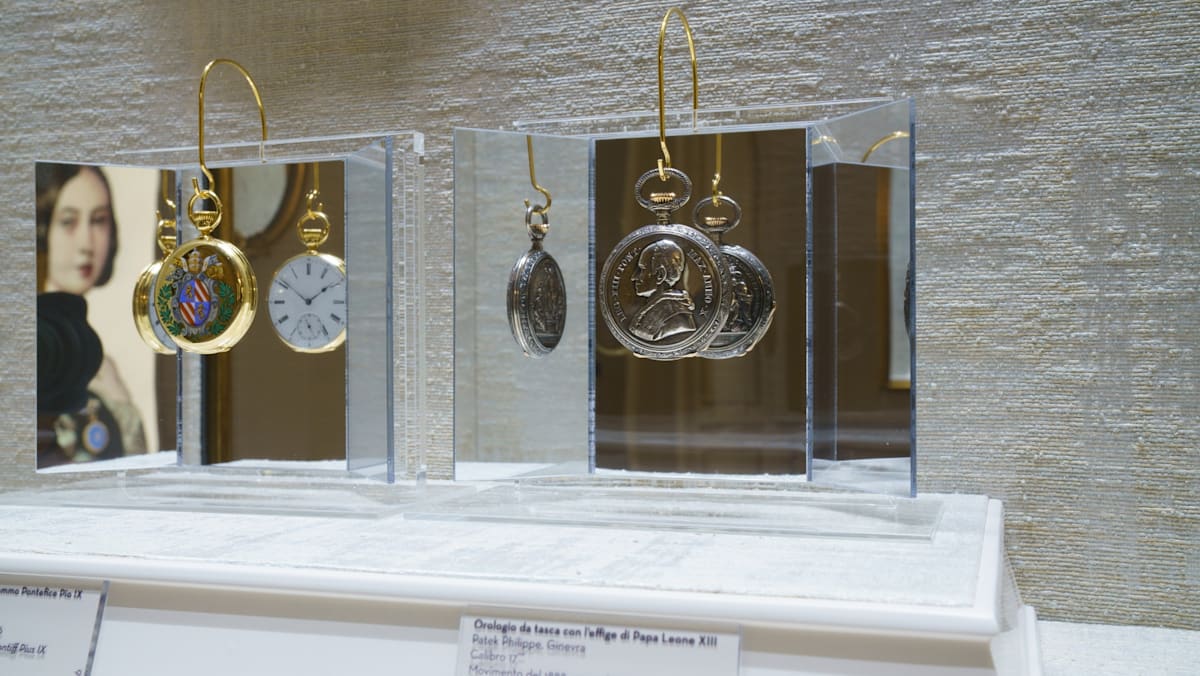
Obsessions More than 500 watches, museum pieces and rare handcrafts are on show, alongside seven limited editions created for the Italian market. Patek Philippe’s Watch Art Grand Exhibition in Milan brings together historic watches, current creations and rare handcrafts under one roof. (Photo: Patek Philippe) New: You can now listen to articles. This audio is generated by an AI tool. For a watchmaker known for producing some of the world’s most sought-after timepieces, Patek Philippe is taking a decidedly open-door approach in Milan.From Oct 2 to Oct 18, the Geneva manufacture is staging the seventh edition of its Watch Art Grand Exhibition at CityOval, formerly known as the Palazzo delle Scintille, in Milan’s CityLife district. Admission is free, and visitors do not need to be collectors to make sense of what is on show.Spread across more than 2,900 sq m, it is the largest Watch Art exhibition Patek Philippe has organised to date, bringing together more than 500 watches, movements and objects across 15 themed areas. Around 80 pieces from the Patek Philippe Museum have travelled from Geneva to Milan for the Watch Art Grand Exhibition. (Photo: Patek Philippe) The idea is to give visitors a look at the wider world behind the watches – from how movements are made to the decorative crafts that go into some of the manufacture’s most elaborate pieces.Watch Art began in Dubai in 2012, followed by editions in Munich, London, New York, Singapore and Tokyo. Together, the first six exhibitions drew around 225,000 visitors. Milan is the seventh stop.A LITTLE OF GENEVA IN MILAN A nine-metre-high installation made from 2,028 translucent droplets recreates Geneva’s Jet d’Eau at the entrance to Patek Philippe’s Watch Art Grand Exhibition in Milan. (Photo: CNA/Boon Tan) Inside CityOval, the exhibition recreates several landmarks associated with Patek Philippe, including its historic headquarters on Rue du Rhone, its manufacture in Plan-les-Ouates and the Patek Philippe Museum. A nine-metre-high installation made from 2,028 translucent droplets greets visitors in the atrium, referencing Geneva’s Jet d’Eau. Beyond it, the exhibition moves through rooms dedicated to the current collection, complicated watches, research and development, historical archives, watchmaking and decorative crafts. There is plenty here for visitors who prefer history to mechanics. The exhibition’s archives section offers a closer look at Patek Philippe’s history, from family stewardship to landmark watches and technical developments.(Photo: Patek Philippe) Around 80 pieces from the Patek Philippe Museum in Geneva have travelled to Milan for the occasion, spanning early horology as well as the manufacture’s own history. Among them is Patek Philippe’s first known perpetual calendar wristwatch from 1925, a World Time wristwatch from 1948 and a 1918 pocket watch with a minute repeater and 30-day power reserve that once belonged to American automobile manufacturer James Ward Packard.Another section looks at watches associated with prominent historical owners, including a pendant watch presented to Queen Victoria at the Great Exhibition in London in 1851 and a pocket watch bearing the portrait of Pope Leo XIII. For those more interested in how watches are made, Patek Philippe watchmakers are demonstrating their craft on site, while artisans work on techniques including enamelling, wood marquetry, guilloche and gem setting. WHY MILAN?Italy has had a long relationship with Patek Philippe. According to the company, some of its earliest watches were sold to Italian clients, while the Stern family, which has owned the manufacture since 1932, has maintained close ties with the country. That connection becomes particularly visible in the watches created for this exhibition.Patek Philippe has unveiled seven limited editions for the Italian market, ranging from familiar sporty models to highly complicated watches. Reference 5978P-010. (Photo: Patek Philippe) The headline release is the new Reference 5978P-010, a platinum perpetual calendar chronograph limited to 120 pieces. In simple terms, it combines a stopwatch function with a calendar designed to account automatically for different month lengths and leap years. Its calendar indications are displayed in Italian, while small red, white and green stitches on the strap reference the colours of the Italian flag. It is also the first Patek Philippe watch to combine its manually wound CH 29-535 chronograph movement with an instantaneous perpetual calendar. At midnight, the relevant calendar displays change almost simultaneously, completing their jump in 30 milliseconds. For most visitors the appeal may be easier to grasp visually. The 42mm platinum watch comes with a navy-blue sunburst dial that darkens towards the edge, punctuated by red chronograph details. The other Milan editions play with colour in a more obvious way.A trio of white-gold watches draws on red, green and white. There is a minute repeater with a vivid red lacquer dial, limited to five pieces; a green perpetual calendar limited to 100; and a white Calatrava date model limited to 200. All three carry subtle tricolour stitching on their straps. The Aquanaut Reference 5167A-014. (Photo: Patek Philippe) The Aquanaut also gets a Milan edition. Limited to 250 pieces, Reference 5167A-014 pairs a blue sunburst dial fading to black with red accents on the minute track and seconds hand. Two of the smallest editions are also the most closely tied to Milan. The World Time Minute Repeater References 5531G-012 and 5531G-013 are limited to five pieces each, with cloisonne enamel dials depicting central Milan by day and by night. Even the city names around the dial are rendered in Italian. ITALY, IN MINIATUREThe exhibition’s connection to Italy goes beyond the seven new watches.Patek Philippe has also created 25 Rare Handcrafts pieces for the Italian market, including dome clocks, a table clock, pocket watches and wristwatches. Together they explore Italian cities, landscapes, traditional crafts, painting and decorative arts through techniques such as enamelling, engraving and wood marquetry.Some are charmingly literal.Four Calatrava watches follow a Fiat Cinquecento through different parts of Italy. One winds along the Amalfi Coast. Another passes the trulli of Puglia. A third travels through Chianti vineyards at dusk, while the fourth arrives at Lake Como. Each scene combines cloisonne enamel with miniature painting. Elsewhere, a table clock dedicated to Milan places the golden silhouette of the Duomo at its centre, surrounded by a stylised city map in shades of blue, green and turquoise. Patek Philippe’s Ref. 995/147G-001 “Venetian Cruise” pocket watch depicts a wooden pleasure boat entering Venice’s Grand Canal, combining wood marquetry with miniature painting on enamel. (Photo: Patek Philippe) A pocket watch titled Venetian Cruise takes a different approach. Its depiction of a wooden pleasure boat entering Venice’s Grand Canal is assembled from 334 tiny pieces of veneer and 15 smaller wooden inlays. Other pieces look to Burano lace, Murano glass, the mosaics of Ravenna and Florentine hardstone work. A pocket watch inspired by Sandro Botticelli’s portrait of Dante Alighieri brings Italian painting into the mix. Seen together, these watches make the Milan exhibition feel less like a conventional product launch and more like a broad survey of how Patek Philippe wants its history and craft to be understood.That may be the most useful way to approach Watch Art, particularly for visitors who do not know a tourbillon from a minute repeater. There are watches of formidable complexity here, but there are also familiar entry points – a city skyline, a landscape, an old car on an Italian road, an artisan working by hand.And for a few weeks in Milan, much of what usually stays behind the doors of Patek Philippe’s workshops and museum in Geneva is gathered under one roof.
Patek Philippe brings its largest Watch Art exhibition yet to Milan
Full Article
Original Source
Read the full article at Cnaluxury →KhanList aggregates and links to publicly available news content. We do not host full articles from third-party sources. Always verify important information with original sources.