
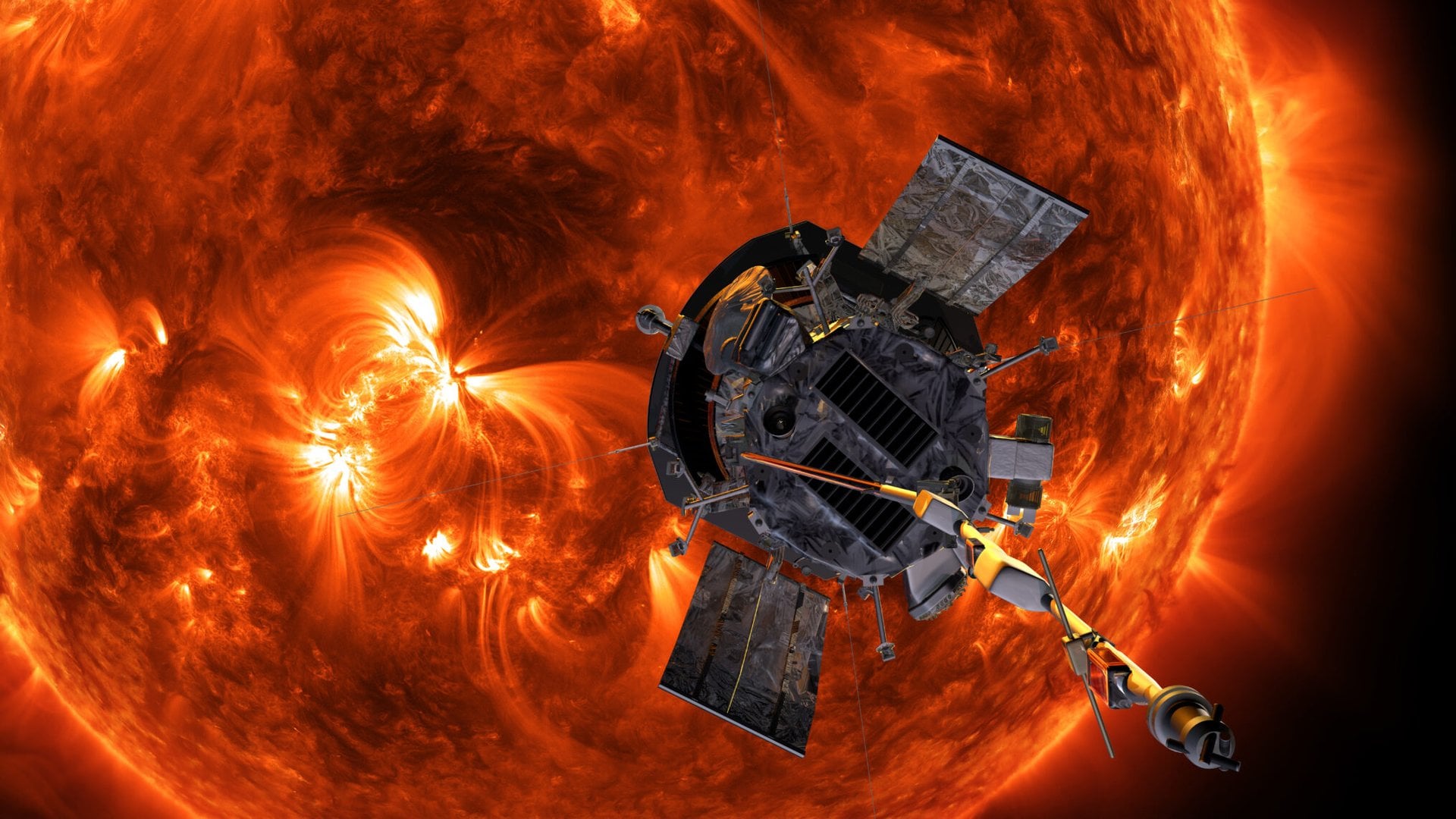
The magnetic environment around the Sun is a jumbled mess of chaotic fields and streams of charged particles. Recently we’ve been getting at least slightly better at mapping out its complexity, thanks in large part to data collected by missions like the Parker Solar Probe and Solar Orbiter. But there’s still a large grey area surrounding the interface between the large scale hydrodynamic properties of plasmas and the microscopic properties of individual ions, and scientists believe understanding large scale features of the Sun, such as why its corona is so much hotter than its surface, may rely on our knowledge of that interface. A new paper that directly tackles some of the outstanding questions about that interface was recently published in The Astrophysical Journal Letters by Masatomi Iizawa of the Technical University of Braunschweig and his co-authors. For decades, solar physicists have used two competing methodologies to handle their models of the solar wind. One paradigm treats it as a conductive fluid. To understand this side of the wind, scientists use a specialized version of the mathematics behind fluid movement, but with an added nuance of magnetism. This framework, known as magnetohydrodynamics, handles the large-scale interactions of the solar wind with other magnetic features as well as the solar system at large. Zoom in far enough on the giant plasma streams, though, and it will soon become clear that they are just made up of individual charged ions that are banded collectively together. Modeling these individual particles is the centerpiece of the other framework that solar physicists use to describe the solar wind. In this model, protons and electrons both spin around magnetic lines, and are subjected to the fundamental forces on a much more granular scale. Fraser and Pamela discuss the Parker Solar Probe The problem lies when trying to combine the two frameworks. Much like quantum mechanics and relativity, another famous physics dichotomy, they don’t play well together. But understanding how they could help physicists answer the decades old question of why the corona of the Sun burns millions of degrees hotter than our star’s surface. Tackling that question comes down to energy transfer - if the Sun’s corona is so hot, it’s obvious it must be heated by something, right? To figure out where that heat is coming from, Dr. Iizawa and his team turned to a property called magnetic helicity. It describes the amount of twisting, looping, and linking that the lines of a magnetic field do. Critically, it comes with a feature called “handedness” which plays a crucial role in understanding the interface. Handedness is best explained by using an old analogy. I might be dating myself, but imagine a telephone cord as a stand-in for a magnetic field line. Twisting it clockwise give it “right-handed” helicity, whereas twisting it counter-clockwise gives it “left-handed” helicity. In the overall chaos of the Sun’s magnetic field, these properties typically wash out, with no big impact on the structure of the solar wind. Fraser dives into the details about what Parker is supposed to discover during its mission. However, the researchers found something very unique in some of Parker’s data. They noticed that, right at the interface between fluid physics and particle physics, a clearly helical signal begins to emerge. Thanks to high-resolution magnetic readings from Parker close to the Sun, the researchers analyzed normalized magnetic helicity density spectra, revealing a distinct pair of counter-rotating helical peaks sitting near the ion kinetic interface. Even finding that type of side-by-side pattern was a discovery in itself, but the researchers continued watching as these relatively small structures moved across space. Typically, scientists would expect the helical twists to have formed very nearby, with electromagnetic frequencies that mimicked their local environments. That is not what Parker found - the frequencies seemed biased towards lower frequencies, creating a feature of what astrophysicists called nonlocal evolution. That means, instead of only interacting with the properties of the surrounding plasma, those helical twists are actively coupling with structures that span across multiple sizing scales, from individual particle ripples all the way up to massive fluid plasma motions. Which also implies that it could be tied to something scientists call the helicity barrier. In turbulent plasma flows, physicists model energy as flowing from giant swirls all the way down to small ionic ripples, eventually dissipating as microscopic amounts of heat. But, if that turbulent plasma is “handed”, the energy traveling down it is blocked when it reaches the “ion boundary” - i.e. when it transitions from fluid plasma to particle plasma. This stops the energy from dissipating, and forces the magnetic twists holding the helically handed plasma to create larger structures, some of which we see as giant magnetic “switchbacks” in the Sun’s corona. That pattern of magnetic accumulation is seen clearly in the data from Parker. But, once a stream of solar wind crosses the heliospheric current sheet - a giant membrane separating the opposite magnetic polarities of charges from one another, the structure of the stream itself is compromised and the helical signature vanishes. All that is to say, there’s still a lot we don’t understand about heliophysics. But studies like this one, and data like that collected by Parker, are allowing us to see the structure of the Sun’s chaos more clearly than we ever have before. As it continues its mission, there will surely be other insights into the wild turbulence of the Sun’s environment - just don’t expect us to fully understand it even in Parker’s lifetime. Learn More: TU Braunschweig - Structure in the Unstructured: New Phenomenon Discovered in the Solar Wind M Iizawa et al. - Nonlocal Evolution of Magnetic Helicity across the Magnetohydrodynamic–Kinetic Interface UT - Solar Orbiter Traces Giant Magnetic Switchbacks Directly Back to the Sun UT - Parker Solar Probe Was Blasted by Coronal Mass Ejections 28 Times in 4 Years
Parker Solar Probe Spots Twisted Magnetic Braids Growing in the Solar Wind
Full Article
Original Source
Read the full article at Universetoday →KhanList aggregates and links to publicly available news content. We do not host full articles from third-party sources. Always verify important information with original sources.