
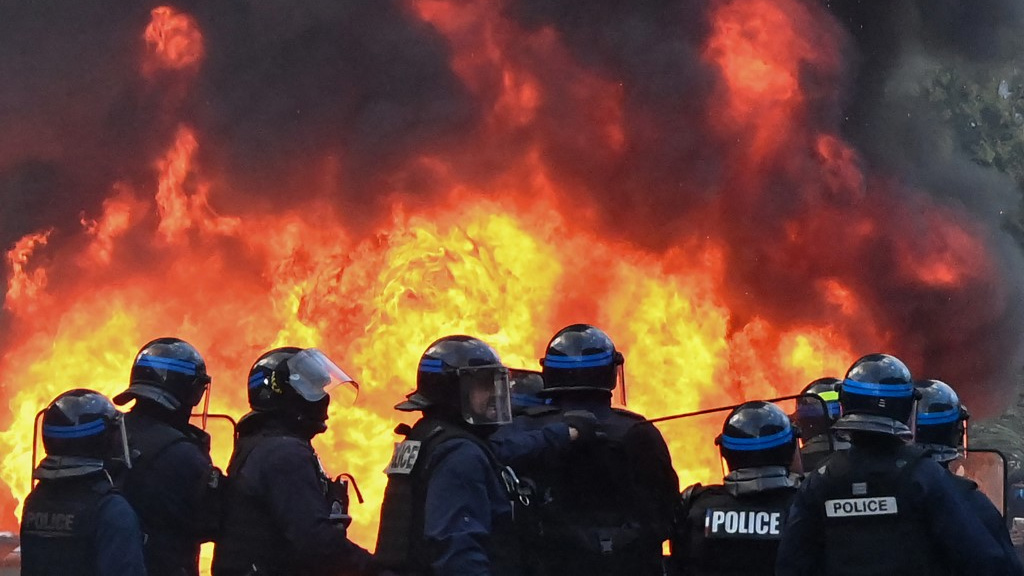
The uprising sweeping through Paris and cities across France this autumn, at times descending into violence, looting and destruction, has laid bare the depth of the crisis engulfing the country under President Emmanuel Macron. It is no passing outburst of anger. It is closer to May 1968, when a student revolt grew into a national upheaval whose legacy still shapes France today. If Macron’s presidency could be defined by a single word, it would be anger. From the Yellow Vests, to the strikes against pension reforms, to the riots in the suburbs and the demonstrations of today, France has lived in a state of almost perpetual agitation. Macron did not create all of the country’s ills, but he has aggravated them with his arrogance and condescension towards the French people, particularly citizens of North African and African descent, and even towards France’s African partners. The revolt is rooted in a suffocating domestic crisis: declining purchasing power, stagnant wages, rising prices and spreading poverty. Young people, along with the working and lower-middle classes, have borne the brunt, which is why protests have reached far beyond Paris. Macron’s neoliberal policies have widened inequality and hastened the decay of public services. New MEE newsletter: Jerusalem Dispatch Sign up to get the latest insights and analysis on Israel-Palestine, alongside Turkey Unpacked and other MEE newsletters But the crisis runs deeper than economics. French children are taught the sacred principles of liberty, equality and fraternity. The France they then encounter is one of injustice and discrimination. A young man named Mohammed or a young woman named Aisha may be French by birth, language and education - even third- or fourth-generation French - yet they still see applications for jobs, housing and services rejected. Integration has come to mean cultural and linguistic conformity, demanded as the price of belonging, and never quite paid in full. The result is generations of young citizens who speak no language but French, yet are made to feel like strangers in their own country. Narrative of the Muslim invader The young people who blockaded France’s high schools knew exactly what they were protesting: absent teachers, crumbling buildings, and a future poorer than their parents’ present. Yet no sooner had they taken to the streets, than others arrived to explain what they really meant. US President Donald Trump was first. “This isn’t about schools, this is about Islam wanting to take over a once great Country!” he declared on Truth Social. He offered no evidence, and in France, no link had been established between the student movement and any religious or identity-based demands. Trump kept going regardless. Outside the White House, he announced that “Paris is going to be a Muslim city very soon”. The man who presumed to diagnose the ailments of Islam now asks the Muslim world to help cure the ailments of France The method is simple. Protesters say what they are protesting, and Trump informs them they are protesting something else. Schools, wages and the cost of living vanish. In their place stands the oldest figure in the far-right repertoire: the Muslim invader at the gates. Then came Israeli Prime Minister Benjamin Netanyahu, who never misses an opportunity to turn Europe’s Muslims into a threat. On i24News, he declared that France had “succumbed to the invasion of extremist Islam” and warned that “they will devour France, they will devour Europe”. He then drew the connection that matters most to him: he claimed that after 7 October 2023, he had warned Macron that if Hamas were not eliminated in Gaza, Paris would have them too - and that this was exactly what was now happening. This was not an outburst. It was part of a strategy, and an old one. In 2017, standing beside Macron, Netanyahu warned that “political Islam seeks to destroy both Israel and European countries”. He has even described Britain as an “Islamic republic”. The formula never changes. Collapse Palestine, migration and Islam into a single menace. Cast Israel as the front line of a civilisational war. Then tell Europeans that the Muslims among them are the enemy within. Score to settle The purpose is plain. If French students marching for teachers can be rebranded as Hamas in Paris, then every Palestinian flag in a European street becomes a security threat, and every protest against the destruction of Gaza becomes evidence of invasion. Solidarity with Palestinians is recast as extremism, and Europe’s Muslim citizens become suspects in their own countries. Fear is not a byproduct of Netanyahu’s politics; it is the product. There is also a score to settle, and Netanyahu barely hid his glee. France has condemned the expansion of Israeli settlements in the occupied West Bank. Macron called Israel’s blockade of aid into Gaza “unacceptable” and “shameful”, and France recognised Palestinian statehood last year, infuriating Israel. Neither Trump nor Netanyahu was describing France. Both were campaigning. Trump was speaking to American voters ahead of the midterms, and Netanyahu gave his interview while campaigning ahead of Israel’s election. But their words land in a third campaign: France’s own presidential race, six months away. Their narrative is Marine Le Pen’s manifesto in another accent: immigration as invasion, Islam as threat, the banlieues as enemy territory. Rather than confronting the causes of the revolt, Macron’s prime minister pointed at the left. Sebastien Lecornu accused ultra-left groups of having organised the violence, and charged La France Insoumise (LFI) with fanning the flames of revolt and trying to throw the country into disorder months before the presidential election. The charge found an eager echo: Le Pen also accused LFI of allowing legitimate social demands to be hijacked, and of seeking chaos. The centre and the far right were reading from the same script. Nor does Macron need to blame immigrants this time. He spent years making that blame respectable. On immigration, Islam and national identity, he has too often been scarcely distinguishable from the right he claims to oppose. Different scapegoats, same purpose: to place responsibility anywhere but where it belongs. Declining middle power Muslims, migrants and the left all serve to spare the government the questions the students asked. Who let the schools decay? Who allowed purchasing power to erode? Who governed while a generation came to expect a poorer life than its parents? None of these questions is answered by Islam or LFI. All of them lead back to the Elysee. France’s crisis does not stop at its borders. A former empire, it has become a declining, crisis-ridden middle power. For decades after formal decolonisation, Paris preserved an extensive web of political, military, monetary and economic ties with its former colonies, particularly in Africa. This system, known as Francafrique, gave France influence far beyond what its population and economic size would otherwise have allowed. French student protests: A generation that sees no future is rising up Read More » That order is now unravelling. France has been forced to withdraw its forces from Mali, Niger, Chad and the Central African Republic, and its relations with Algeria, Senegal and others have grown increasingly strained. African governments are turning instead to China, Russia, Turkey and the Gulf. France’s crisis, in short, is not a temporary downturn. It is deep, structural and entrenched, and it will grow more severe if the far right wins the next election. And therein lies the final irony. In 2020, Macron declared that Islam was in crisis across the world. He spoke with an air of colonial superiority, casting himself as the physician who could treat its ailments, in the tradition of the 19th-century administrators who carried “civilisation” to peoples deemed incapable of finding their own way. Today, with France in turmoil, he has gone to the heart of the Muslim world in search of help. He spoke from Doha during a state visit to Qatar and the wider Gulf, aimed at securing France’s energy supplies amid a national cost-of-living crisis. The man who presumed to diagnose the ailments of Islam now asks the Muslim world to help cure the ailments of France. Perhaps the question was never who would cure Islam of its supposed crisis. It is who will cure France of its own. The views expressed in this article belong to the author and do not necessarily reflect the editorial policy of Middle East Eye.
Paris protests are not about Islam. They're about France
Full Article
Original Source
Read the full article at Middleeasteye →KhanList aggregates and links to publicly available news content. We do not host full articles from third-party sources. Always verify important information with original sources.