
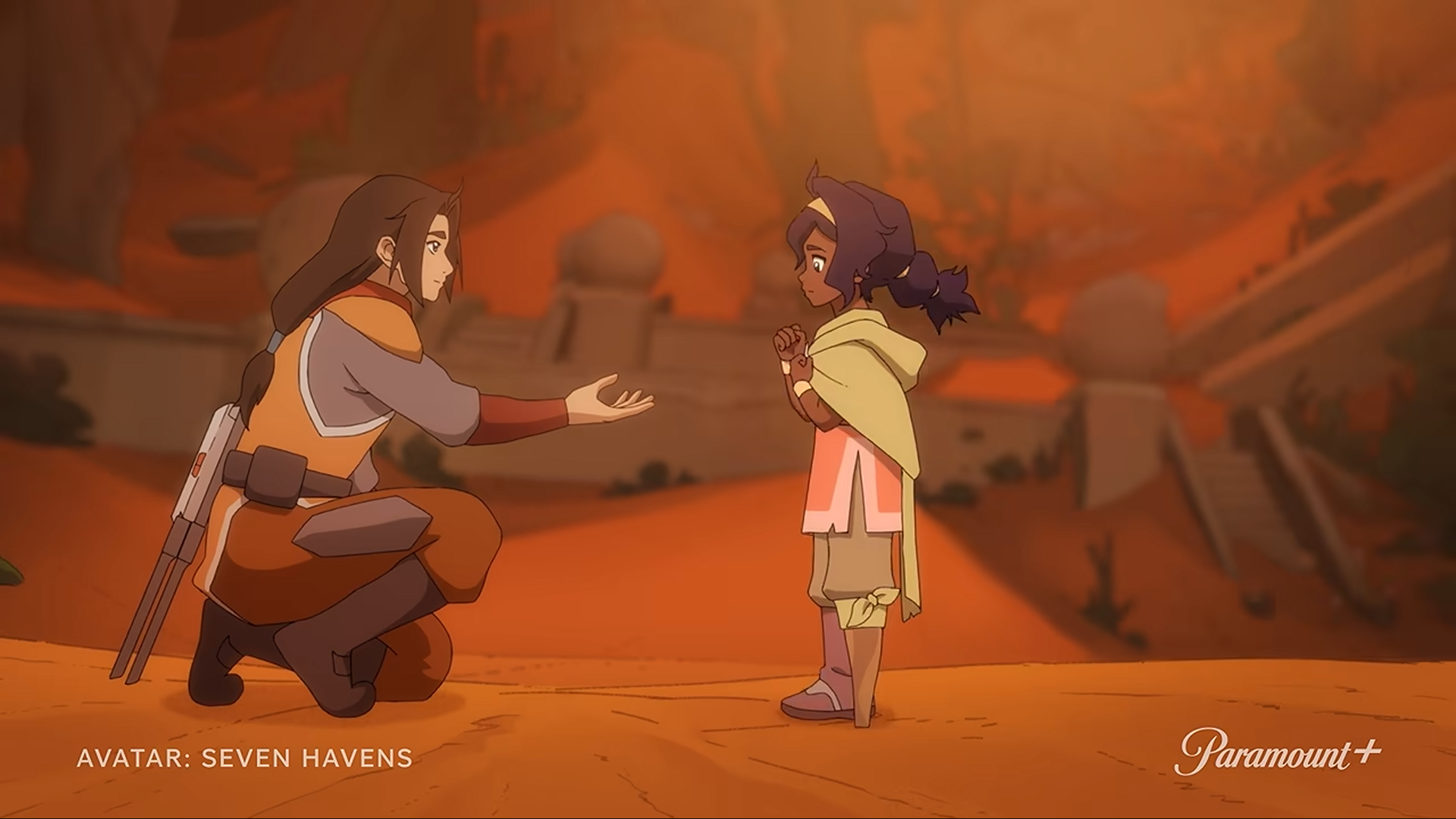
Forcing LGBT ideology onto children is not a new phenomenon for Hollywood. So, it wasn’t exactly surprising when Paramount’s latest show for kids attempted to do just that. On Friday, the company’s Paramount Plus streaming service debuted its new Avatar: Seven Havens series. Set within the Avatar universe, the animated show takes place in a post-apocalyptic world where the avatar — who can bend the elements of water, earth, fire, and air — is branded the enemy. The program follows the journey of Pavi and Nisha, twin sisters who discover that they’re twin avatars and must hide their abilities. Seven Havens is a sequel to The Legend of Korra (2012-2014), which followed the original (and beloved) Avatar: The Last Airbender series (2005-2008). Seven Havens and Korra are rated PG, while The Last Airbender is rated TV-Y7, according to IMDb. Seven Havens introduces viewers to a variety of new characters in its three-episode premiere. Among these is Jae, a male airbender who serves as a guardsman on the bending force tasked with protecting the city of Ellora, where the series takes place. The show’s LGBT indoctrination rears its head in the third episode, when viewers learn that Jae is dating his fellow guardsman Datu. In one scene, Jae is escorting Pavi and Nisha back to the city’s compound before he gets abruptly stopped and embraced by Datu. Seeking to protect the girls from potential harm, Jae quickly lies about their true identities before kissing Datu on the cheek as he leaves. The scene is hardly the first instance in which the Avatar creators have sought to force-feed LGBT ideology to kids. At the end of Legend of Korra, the avatar of the same name is heavily implied to be in a romantic relationship with her female friend Asami. This relationship was subsequently confirmed in a series of spinoff comics that followed the show’s characters after it ended. Both female characters had previously dated the same male character at different points throughout the series. The Avatar universe’s continued embrace of “woke” has also crossed into racial territory. As Douglas Blair reported in these pages, the studio’s most recent Avatar Aang: The Last Airbender movie, a sequel film to the original 2005 series, sidelined the original voice cast in favor of new actors who fit the industry’s “deliberate shift toward race-based casting standards.” “Studios adopting these standards are responding to narrow ideological pressure elevating identity over performance to the detriment of their products,” Blair wrote. “Established talent is sidelined, creative flexibility is reduced, and audiences are left with weaker performances in the name of a principle they never wanted.” Shawn Fleetwood is a staff writer for The Federalist and a graduate of the University of Mary Washington. He is a co-recipient of the 2025 Dao Prize for Excellence in Investigative Journalism. His work has been featured in numerous outlets, including RealClearPolitics and RealClearHealth. Follow him on Twitter @ShawnFleetwood
Paramount’s New Avatar Series Forces LGBT Ideology On Kids
Full Article
Original Source
Read the full article at Thefederalist →KhanList aggregates and links to publicly available news content. We do not host full articles from third-party sources. Always verify important information with original sources.