
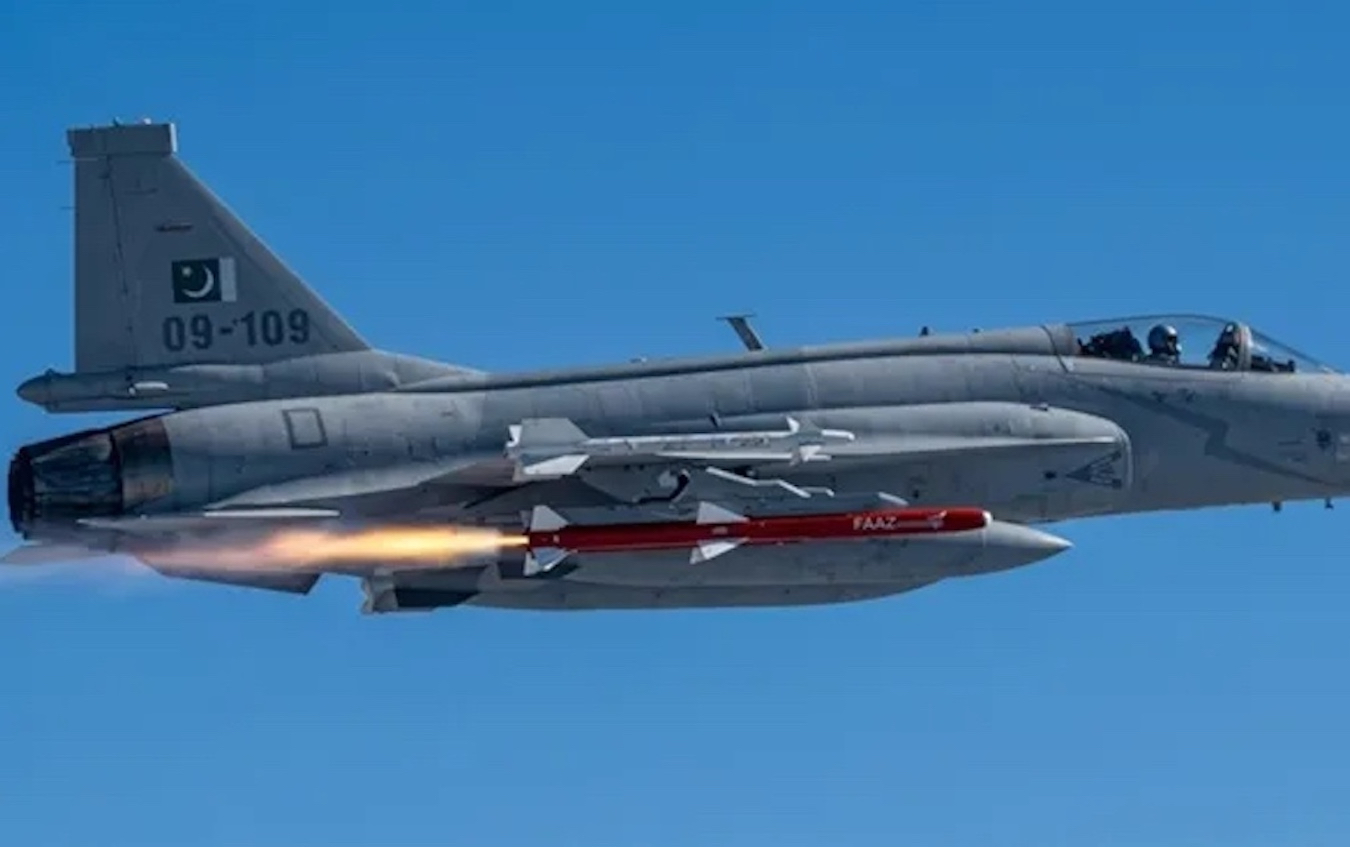
Pakistan’s recent maiden test of its indigenous Fa’az beyond-visual-range missile highlights an urgent push toward self-reliance in high-end air combat, driven by the operational imperatives of volatile border clashes with India and the strategic vulnerabilities of relying on foreign defense partners. Multiple media outlets reported that Pakistan’s military successfully conducted the maiden flight test of its first indigenously developed Fa’az beyond-visual-range (BVR) air-to-air missile, marking a pivotal step toward self-reliance in aerial munitions. The trial saw a JF-17 Thunder fighter jet launch the orange-painted Fa’az-IIR variant, which pairs an imaging infrared terminal seeker with midcourse inertial navigation and aircraft datalinks. Developed by the Air Weapons Complex under NESCOM and marketed by Global Industrial & Defense Solutions (GIDS), the Mach 3.5 weapon family is advertised with engagement ranges exceeding 100 kilometers. In addition to the infrared-homing model tested, the program encompasses the radar-guided Fa’az-RF, an extended-range Fa’az-2 targeting up to 180 kilometers, and a short-range surface-launched air-defense derivative. Pakistan is pursuing this domestic missile series to curb its reliance on foreign suppliers like China and the US, insulate frontline fighter squadrons from potential embargoes or wartime supply disruptions, and field an adaptable, dual-guidance complement to its existing inventory of Chinese PL-15E and US AIM-120 missiles. While recent aerial engagements and fleet limitations highlight the operational need for advanced BVR capabilities, vulnerabilities from relying on both Chinese systems and restricted US sustainment underscore the strategic imperative of domestic missile programs to preserve defense autonomy. The May 2025 aerial skirmishes over Kashmir between Pakistan and India underscored the decisive role of BVR missiles in modern air warfare. As noted by Farhat Hussain Khan in a September 2026 Strategic Thought article, fielding BVR missiles such as the Chinese PL-15E, which achieved surprise intercepts at 160 to 190 kilometers against opposing Indian aircraft, provides kinematic reach, first-shot capability, and seamless datalink integration, making them decisive against sophisticated Western aircraft and layered air defenses. Beyond missile hardware alone, Khan argues that BVR combat is won through compressed kill chains, electronic warfare, and sensor fusion rather than numerical superiority. Khan observes that the Pakistan Air Force demonstrated how integrating airborne early warning, ground command, and data-linked fighters can induce operational paralysis across an adversary’s ranks by consistently outpacing its decision cycle. However, Pakistan’s heavy dependence on a Chinese military ecosystem poses severe risks to its long-term strategic autonomy. March 2026 data from the Stockholm International Peace Research Institute (SIPRI) indicate that Pakistan was the largest buyer of Chinese defense exports from 2021 to 2025, accounting for 61% of China’s total sales. That dependence cuts two ways. Aishwaria Sonavane notes in a January 2026 Takshashila Institution report that reliance on Chinese military equipment forces Pakistan to adopt Chinese operational procedures, maintenance standards, and tactical frameworks. Sonavane adds that this alignment constrains independent procurement choices and leaves frontline readiness vulnerable to supply disruptions — particularly during external crises like a conflict over Taiwan — while China withholds sensitive source code to protect its proprietary technology. Reinforcing concerns over constrained procurement autonomy, Kriti Upadhyaya notes in an August 2026 Heritage Foundation report that Pakistan’s entrenched reliance on Chinese military equipment creates severe technology-leakage risks, ensuring any external security assistance indirectly subsidizes a China-equipped military and ultimately reduces Pakistan to a testing and proving ground for Chinese weapons. Concurrently, Pakistan’s legacy Western hardware offers diminishing operational utility. While Pakistan operates between 70 and 80 US F-16 fighter jets, Military Watch Magazine notes in an August 2026 article that the aging fleet faces severe operational limitations driven by outmatched BVR weaponry and escalating sustainment costs. According to Military Watch, the F-16 fleet is constrained by the roughly 100-kilometer reach and older, jam-vulnerable seekers of its principal AIM-120C-5 missiles, placing Pakistani fighters inside the engagement envelopes of advanced Indian fighters like the Su-30MKI before they can secure firing solutions. The report notes that this tactical deficit forced the Pakistan Air Force to withhold F-16s from high-threat sectors during the May 2025 aerial skirmishes over Kashmir. Military Watch observes that Pakistan’s F-16s lack active electronically scanned array radars and face significantly higher maintenance costs than newer Chinese-supplied fighters, pointing toward potential retirement by the mid-2030s. Although the US has approved upgrades for Pakistan’s aging F-16 inventory, these packages may prove insufficient to shift the regional airpower balance against India. Jane’s reported in December 2025 that the US agreed to sell Pakistan US$686 million worth of F-16 upgrades, including the Link 16 tactical datalink and six inert Mk-82 226-kilogram bomb bodies. Furthermore, Defense Security Asia reported in May 2026 that the US agreed to proceed with a USD 488 million sustainment package for Pakistan’s AN/APG-66 and AN/APG-68 radars, extending the operational lifespan of those legacy systems. Yet these upgrades remain subject to the shifting tides of US-India diplomacy. The US has historically calibrated such support to pressure India to curb its purchases of Russian energy and military hardware in favor of American defense equipment. The US may thus become reluctant to authorize subsequent military sales or technical upgrades to Pakistan if India steadily diversifies its energy and defense procurement away from Russia. In navigating these competing geopolitical pressures, Gleb Makarevich notes in a December 2023 article in the peer-reviewed journal USA & Canada: Economics, Politics, Culture that Pakistan’s defense industry strategically safeguards its autonomy by balancing across three distinct pillars: Chinese alignment, Western ties, and domestic production. Makarevich argues that China provides deep technological cooperation through joint programs such as the JF-17 fighter, while F-16 sustainment lines preserve vital Western diplomatic and technical channels, preventing total reliance on China. Makarevich adds that domestic production anchors both pillars, with indigenous manufacturing at state-owned facilities insulating frontline combat units from foreign embargoes, serving as a diplomatic lever through external munitions transfers, and bolstering overall strategic autonomy. Ultimately, Pakistan’s long-term ability to maintain credible deterrence against India while insulating itself from foreign geopolitical leverage will hinge on whether programs like the Fa’az missile can transition from successful prototypes into mass-fielded indigenous mainstays that effectively underpin its strategic autonomy.
Pakistan’s Fa’az missile aims to escape China, US arms traps
Full Article
Original Source
Read the full article at Asiatimes →KhanList aggregates and links to publicly available news content. We do not host full articles from third-party sources. Always verify important information with original sources.