
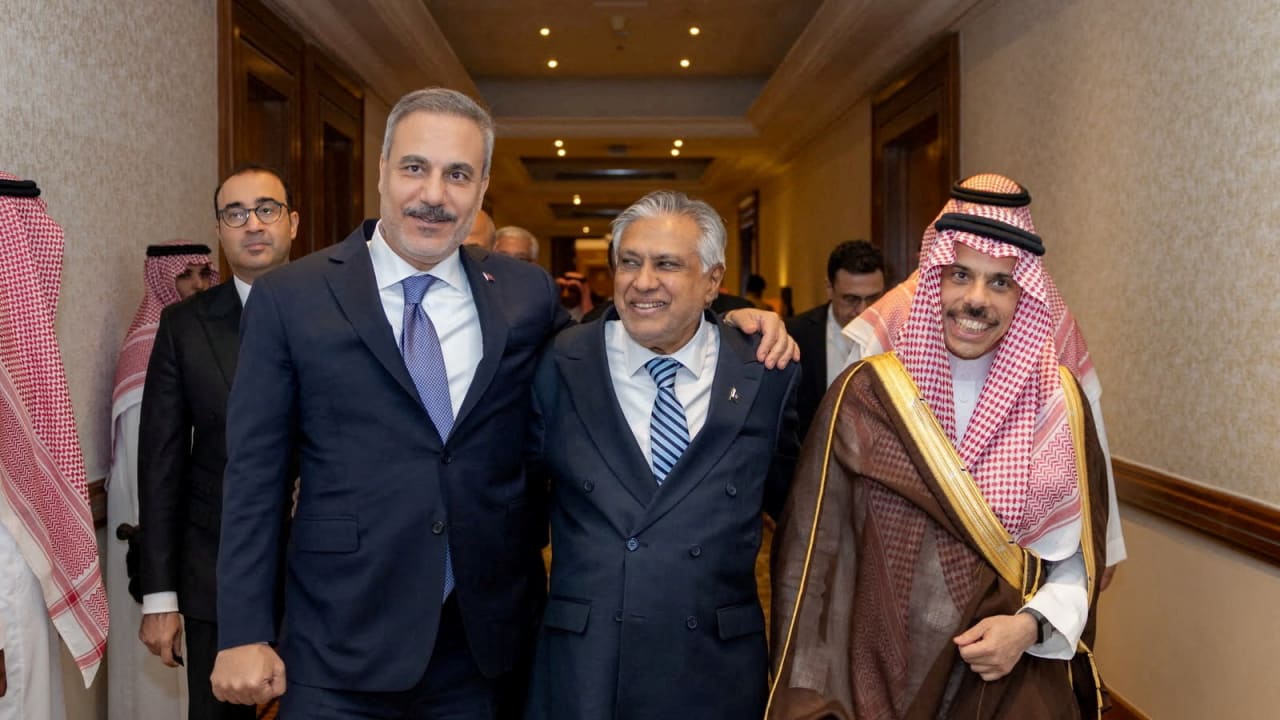
The emergence of the alliance is an example of how regional powers are increasingly taking the initiative in shaping the Middle East's security architecture rather than relying exclusively on the US.Follow us on GoogleTurkey's Foreign Minister Hakan Fidan, Pakistan's Deputy Prime Minister and Foreign Minister Mohammad Ishaq Dar and Saudi Arabia's Foreign Minister Prince Faisal bin Farhan Al Saud leave after a meeting of the Mecca defence pact in Riyadh, Saudi Arabia, October 5, 2026. (photo credit: Turkish Foreign Ministry/Handout via REUTERS)NOVEMBER 26, 2026 14:23Pakistan, Saudi Arabia and Turkey are seeking to strengthen their emerging defense alliance amid increasing instability in the Middle East.According to Reuters the three countries will hold a meeting in Islamabad on November 27 and 28 to discuss their mutual defense agreement.Reuters cited two Pakistani sources for the report. Arab News in Saudi Arabia did not appear to initially confirm the report. Even if the meeting does not take place, it is worth looking at why the report is important.Reuters reported that the foreign ministers of Saudi Arabia and Turkey are expected to attend the meeting. The three countries signed a joint defense agreement in Mecca in August amid concerns over the ongoing conflict involving Iran, Israel and the United States.New meetings between the three countries are particularly important because they come amid renewed fighting between Saudi Arabia and the Iranian-backed Houthis in Yemen.The Houthi attacks on Saudi Arabia have presented a challenge to the emerging alliance and raised questions about how the three countries intend to translate their agreement into action. The alliance is defensive in nature, borrowing its concepts from NATO. Saudi Arabia intervened in Yemen in 2015 and has been fighting the Houthis off-and-on for a decade.Turkish President Tayyip Erdogan, Saudi Crown Prince Mohammed bin Salman and Pakistan's Prime Minister Shehbaz Sharif chat after signing a joint defense agreement in Mecca, Saudi Arabia, August 7, 2026. (credit: Murat Cetinmuhurdar/Turkish Presidential Press Office/Handout via REUTERS)Mecca agreement modeled after NATO defense commitmentThe Mecca agreement was signed before the Houthis began their latest sustained campaign against Saudi Arabia. Under the terms of the agreement, an attack on one of the countries is considered an attack on all three.This is modeled in some respects on NATO's collective defense commitment. It’s unclear whether Turkey or Pakistan will become more involved in defending Riyadh.The alliance emerged in the context of the Iran war. These three regional powers are concerned about the Iran war and its aftermath. Pakistan has sought to mediate with the US.The Houthi attacks in September exposed some of the complexities involved in implementing the new alliance agreement. Pakistan, which has played an important role in mediating between the US and Iran, found itself in the difficult position of having to balance its diplomatic efforts with its commitments to Saudi Arabia."There is no such thing under discussion right now," Pakistani Foreign Ministry spokesperson Sajjad Haider Khan said on September 10, when asked about a potential military response under the agreement, Reuters reported.Turkey has also been cautious about becoming directly involved in the conflict in Yemen. In October, Reuters reported that Ankara was providing primarily defensive and technical assistance to Saudi Arabia.Turkey has sought to distinguish between helping defend the kingdom and participating in offensive operations against the Houthis.However, the assumption that the alliance would be tested solely on whether Turkey and Pakistan were prepared to go to war in Yemen may be a misreading of the goals of the agreement, as The Jerusalem Post noted on September 17. What is important is that the three countries continue to institutionalize their alliance despite the hurdles they have faced. These countries are looking to the future.Israel's rising power in the Middle EastThey may also be concerned about Israel’s rising power in the region. Turkey is very hostile to Israel. Saudi Arabia had once been on the fence about joining the Abraham Accords. It wants to see Israel take positive steps with regard to the Palestinians.The three countries agreed in early October to begin implementing collective defense commitments, including the possible deployment of agreed military capabilities to Saudi Arabia. Later that month, the text of the agreement became public as Turkey moved toward parliamentary ratification.The agreement envisions much more than mutual defense. It includes defense industry cooperation, joint military exercises, intelligence sharing, and the establishment of a permanent secretariat in Saudi Arabia. It also leaves the door open for other countries to join.The three countries have also sought to leverage their collective diplomatic weight. On October 26, senior officials from Saudi Arabia, Pakistan and Turkey held talks in Tehran aimed at reducing regional tensions. The alliance thus gives Riyadh another mechanism through which it can put pressure on Iran regarding the Houthi attacks.For Israel, the growing alliance has important ramifications. It brings together three significant regional powers. Pakistan has nuclear weapons, Turkey has a large military and a growing defense industry, and Saudi Arabia has the economic resources to support long-term military modernization.The emergence of the alliance is also an example of how regional powers are increasingly taking the initiative in shaping the Middle East's security architecture rather than relying exclusively on Washington.The region is witnessing the emergence of different models of cooperation. The Abraham Accords emphasized normalization, economic integration, and technological cooperation.The Mecca agreement emphasizes military ties and collective security. These two models are not necessarily incompatible. Israel and Saudi Arabia, for instance, have a shared interest in confronting the Houthi threat.The meeting in Islamabad, if it happens, will be another indication of whether an agreement that faced significant hurdles almost immediately after it was signed can evolve into an enduring regional alliance.The Houthis may have complicated the emergence of the alliance, but their attacks may also have provided its members with an impetus to accelerate cooperation.Follow us on Google
Pakistan, Saudi Arabia, Turkey seek to strengthen emerging defense alliance - analysis
Full Article
Original Source
Read the full article at Jpost →KhanList aggregates and links to publicly available news content. We do not host full articles from third-party sources. Always verify important information with original sources.