
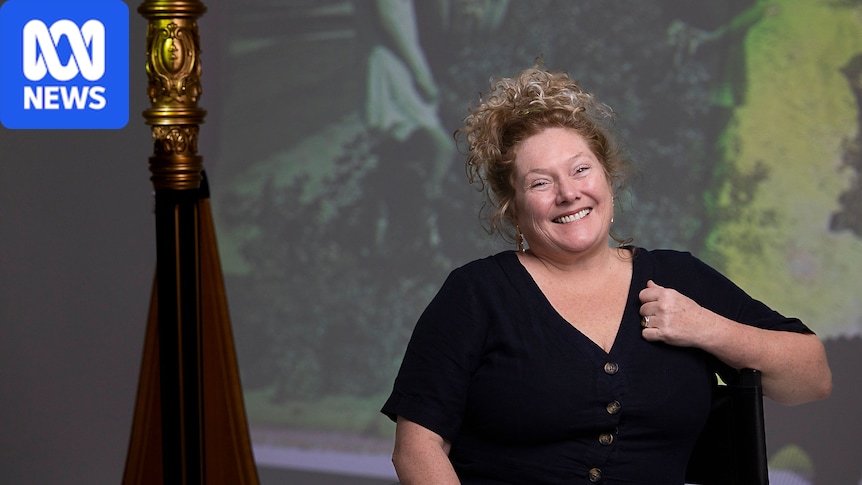
In 2024, artist Justene Williams started making "little poos" out of wet, pulped cardboard."It was as if I was a baker; I started rolling and they were like poos, but they were also quite beautiful, like little bread rolls," she says."They were simple, primordial shapes. I started to imagine them as little beings that were growing or something."Those "primordial shapes" are one of the inspirations for the title of her new exhibition: Once We Were Mudskippers at Queensland Art Gallery (QAG) in Brisbane, which pulls together works from the last 20 years of the artist's career.That career has seen Williams be collected by galleries including the UK's Tate and the National Gallery of Australia; collaborate with Sydney Chamber Opera on a restaging of Russian Futurist opera Victory Over the Sun; and be painted for an Archibald-winning portrait.This painting of Justene Williams and her "multiverse of artwork" by Julie Frager won the 2025 Archibald Prize. (Supplied: AGNSW/Jenni Carter)"Justene's interested in that moment when we crawled out of the primordial pond," curator Ellie Buttrose explains."But also, with everything that's going on, environmentally, politically, it feels like we're almost seeping back into it."Williams first made those "little poos" in Auckland, for an installation and live performance titled Making do rhymes with poo. Over a week in residence at the gallery, she would use discarded materials to perform menial tasks.A year later, she returned to the project in Hobart, but this time, she performed inside a handmade pond inside the gallery."Instead of just rolling with my hands like I'm a baker, I was in there and I had like a wetsuit on, and I was doing it with my feet," she says.Now, for Once We Were Mudskippers, Williams uses audio from the Hobart show in the installation Spirit Box, a collection of radios tuned to music, talkback and static.This sense of reuse, of using found objects — the kind of refuse she used to play with in her father's south-west Sydney wrecking yard — is central to Williams's practice.But it's about more than just recycling materials.Justene Williams's installation The Vertigoats draws upon her years working in retail and at bridal fairs. (Supplied: QAGOMA/N Harth)It's about radically transforming her own work, which is often bombastic and visually striking, riffing on everything from the Westfields where she spent much of her working life as a visual merchandiser to class politics and radical modernist art movements."I'll pull bits apart and then I can remake it," she says."The end of one thing is the beginning of another thing."Always moving, always workingWilliams didn't want Once We Were Mudskippers to be a survey or retrospective of her 30-year career.Instead, Williams wanted to make new work, including a series of Futurist-style works, drawing on the language of Fortnite, which she calls "emote sculptures".Justene Williams's emote sculptures, including Windmill floss, are installed in the gallery's water mall. (Supplied: QAGOMA)"Some of the sculptures are kind of falling down, or rising up, or they're running," she explains."I always like when a sculpture already feels like it's moving."At the same time, Williams has created a new opera, with neurodiverse musicians from Western Sydney's Club Weld, for the opening of Powerhouse Parramatta.They're just two examples of Williams's ambitiousness — an ambitiousness she is not ashamed of."Art is work; art is labour … Just don't stop working," she says."It's a compulsion — because you love it."There's some weird need; it's a death drive or something."Justene Williams's new opera A Magical Hotstart grew from visits to the Powerhouse's collection. (Supplied: ACE/Lyndal Irons)It all harks back to the do-it-yourself attitude Williams cultivated since the start of her career, in Sydney's 90s grunge scene.There, she found met and became friends with fellow artists like Hany Armanious, Mikala Dwyer and the late Adam Cullen.Williams and artists including David M Thomas and Suzanne Howard even started their own gallery in the city, called CBD.Justene Williams recreated the 1913 opera Victory Over the Sun for the Biennale of Sydney in 2016. (Supplied: NGA)"It was like going to church in a way," she says."We were going to all the openings [in Sydney]. It was pretty cool, but it was a bit full-on too."There were drugs around and people would come through your window at night, saying, 'I can't sleep.'"And we always used to say to each other, 'Who's going to give up first?'" Williams adds, with a laugh."I survived at least."Starting with the bodyWilliams's artworks often start with her own body, or with ideas around performance."I always wanted to perform in my own work," she admits.It's a desire that stems from her childhood, when she was an aspiring dancer, taking classes in jazz, tap and ballet, and later working as a dancer at a theatre restaurant."I knew I was never going to be a dancer, because I'm short and all that, so I went to art school," she says.In 1991, she graduated from the University of Western Sydney's now-defunct visual arts program, before going on to study at Sydney's College of the Arts.She soon picked up photography, creating staged, heavily stylised works, which were often blurry, suggesting pace and movement.In Santa Was a Psychopomp, Justene Williams talked to a clairvoyant about art, life and death. (Supplied: QAGOMA)But it wasn't until she moved to Boston, in 2005, that she started making videos in which she performed."It was really bleak over there," she says."I had no mates or anything … I had no money, and I just thought, 'F***, what do I know how to do?' I know how to dance and I love to sing."I started world-building with pizza boxes and newspaper and creating these costumes and whole worlds."In the videos, she was "almost camouflaged"."The background was the same as the body," she explains."I felt maybe that I was a bit invisible, but it was also very freeing, and it felt good."Some of Williams's video art features in Once We Were Mudskippers, but she and curator Ellie Buttrose decided to place them in conversation with other work, almost like "a flicker of screens"."I think they work en masse," Williams says.The video work, Santa was a Psychopomp, does have its own installation. The 2014 video features Williams talking to a clairvoyant who is trying to reach out to Williams's late father.They're together inside a giant snow dome set, before Williams breaks out into the song from Aladdin, A Whole New World, even dancing with a Christmas tree.There's a sense of magic and ostentatious scale in works like Santa was a Psychopomp, operas like Victory Over the Sun, and works like 2017's A Metal Cry, which Williams performed just two weeks after her daughter was born.A Metal Cry was performed as part of The National: New Australian Art, a biennial contemporary art showcase. (Supplied: Carriageworks/Ashley Barber)It features dancers in fluoro pink costumes like concertina fans, the costumes fitted with accordions and chimes, drawing upon ideas from the European avant-garde and Japanese dance-theatre Butoh."Why do I have to lose magic now that I'm older?" Williams asks. "Why can't I still keep making these other worlds when I'm older?"Justene Williams: Once We Were Mudskippers is at Queensland Art Gallery until March 7.A Magical Hotstart is at Powerhouse Parramatta from November 26-27.
Painted for the Archibald, collected by the Tate: Meet Justene Williams
Full Article
Original Source
Read the full article at Abc →KhanList aggregates and links to publicly available news content. We do not host full articles from third-party sources. Always verify important information with original sources.