
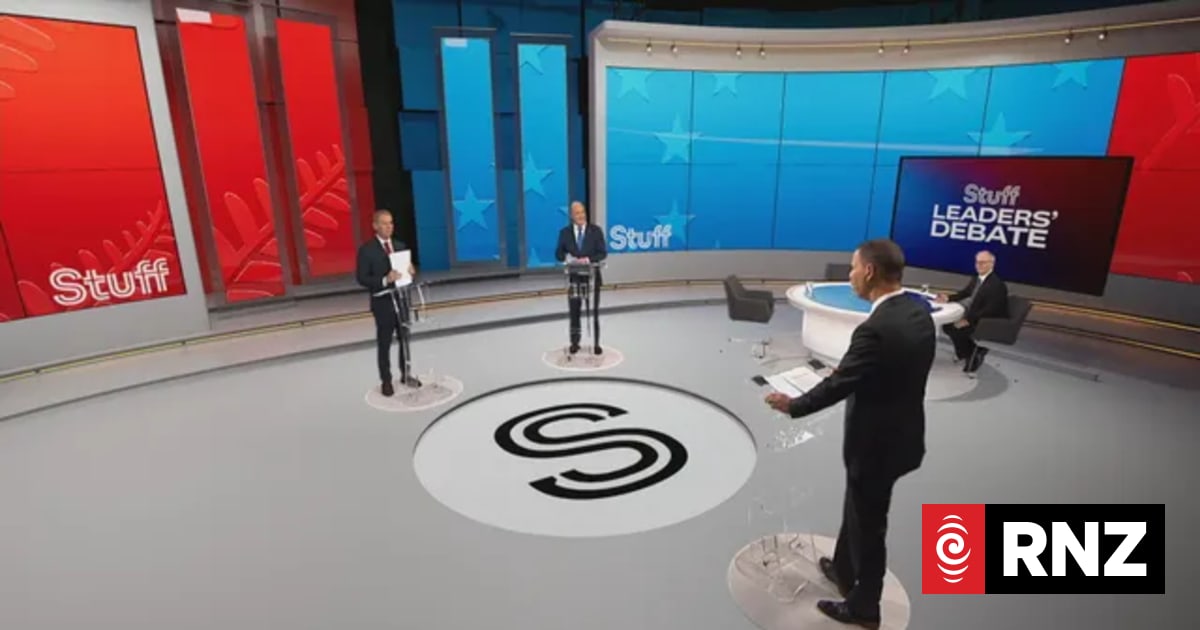
Analysis: "Last one" was heard as the two leaders of the largest political parties came together for a handshake ahead of their third and final head-to-head debate last night. Then, the two Chrises went at it.The Stuff debate was by far the most pugilistic of the three - moderator Paddy Gower promised a clash and he made room for exactly that with interruptions almost doubled on the prior debates. But there was also the return of what by now are familiar patterns: Luxon talks much more than Hipkins and he says "actually" an awful lot; Hipkins loves a one-word answer and is extremely keen to claim Luxon is not telling the truth.RNZ's data analysis of what was said shows how this debate broke down in detail.Who talked the most?In each of the three debates, Luxon has increased the number of words he's used to argue his corner. In the TVNZ debate he said 6031, at last week's NZ Herald debate it was 6255 and last night he topped 6360, giving him 44% of the total. Hipkins stuck with his 'less is more' approach taking 29% of the words on the night.What was surprisingly different about the Stuff debate was the role of the moderator. Gower promised at the outset to let viewers see a serious debate with "no silly questions". There were three "face-off" sections where the leaders were allowed to go head-to-head. Gower also shared moderation duties, handing the leaders off for two rounds with The Post's Luke Malpass.This all added up to a far less prominent role for Gower in this debate. In 2020 and 2023 when he moderated debates for Newshub, Gower topped the leaders both times in speaking 37% of the words. Last night, he spoke 22%. This was lower too than Ryan Bridge (39%) and Jack Tame (34%) in this year's other clashes. Even when accounting for Malpass's 4% contribution, the leaders got the floor for longer in last night's debate.Luxon also took more speaking turns than Hipkins. There were 156 instances of six or more words spoken by Luxon compared with 114 by Hipkins.The longest answer of the night was Luxon's on climate change adaptation. At 245 words it was his longest response to any question in all three debates and longer than Hipkins' longest answer of 208 words about education.Luxon's second longest answer was related to education, a topic he has spoken strongly about in all three debates.On average, Luxon said 32 words each time he spoke, compared to Hipkins' 26. This average has been consistent across the three debates.Towards the end of the debate, Gower showed a glimpse of his more animated former self, firing up to introduce the "quickfire" round.As in the NZ Herald debate, Hipkins embraced the format more than Luxon. He said "yes" to the idea of banning gambling ads next to sport (twice). He said "no" to the need to have a bill to define a man and a woman and "no" when asked if the Dame Julie Christie documentary on Tom Phillips should go ahead. He used the same approach elsewhere in the debate too, agreeing the health system was in crisis, promising to end "corridor care" in hospitals, and agreeing the war on Iran was a mistake.Luxon gave a single one word answer, saying "yes" to being willing to buy a Chinese-made electric vehicle.The final debate was the feistiest when it came to interruptions, with 114 instances of interruptions or cross-talk recorded, by far eclipsing the first debate's 59 and 27 in the second.Our analysis logged an interruption as when one leader cut in and the other stopped to respond. An attempted interruption, or cross-talk was counted when one leader spoke over the other, but the speaker ignored him and carried on.They talked over each other frequently, Hipkins talked over Luxon 64 times, causing him to pause or respond 10 times.One of the few audience laughs came from Hipkins' interjection when Luxon criticised school attendance under the Labour government and accused Labour of not tracking the number of students in class: "So if we didn't record attendance at schools, how is it that you're able to say it was so bad?"Luxon landed seven interruptions where he broke Hipkins' flow, and talked over him a further 43 times. While still less combative than Hipkins, this was a huge leap for Luxon from the 18 times he chimed in over Hipkins at the TVNZ debate and his four attempts at the NZ Herald debate.What was saidOnce again, the leaders have stuck to their habits when it comes to fallback words.Over all three debates Luxon has participated in this election, the word "actually" has been the one he said the most. The word can be used in a variety of ways, including as a way to push back on what somebody has said or correct the record, or it can be used to emphasise a point, or pivot to a different point. Often it can be a filler word, to give the speaker a moment to think mid sentence.Luxon used "actually" 77 times in last night's debate, up from 68 times in the first debate and 64 in the second.Hipkins' top word for the third debate in a row was "going".For the third debate in a row Luxon used variations of "challenging".Hipkins used "not true" six times. Four times in relation to the number of nurses Luxon said were employed under the National government's time, and twice in relation to Luxon saying Labour's fiscal plans were unfunded.The leaders addressed each other by their first names with Luxon doing it far more than Hipkins.Dodging the hard questionsA common tactic to avoid answering a question is to use what's referred to as a 'block and bridge'. The politician acknowledges the question using a 'block' and then uses a 'bridge' phrase to move the topic to something they are more comfortable with. Common bridging terms are "I would say", "what I can tell you", "the reality is". The bridge allows them to transition the conversation to their own talking points.Luxon used variations of the term "as I said" five times during the debate. Hipkins did not use any common bridging terms.What was the vibe?According to a language sentiment data dictionary, which rates words as either positive, neutral or negative, the leaders used the same percentage of positive words with Hipkins using a slightly higher percentage of negative words than Luxon.How we analysed the data: The debate was transcribed by Otter and then manually cleaned to improve accuracy. Cross-talk - where debate participants spoke over each other was removed where words were unintelligible. Interjections when intelligible were included. Text was analysed using R and the Quanteda package.
Paddy Gower was becalmed as the Luxon and doubled their interruptions in final head-to-head debate
Full Article
Original Source
Read the full article at Rnz →KhanList aggregates and links to publicly available news content. We do not host full articles from third-party sources. Always verify important information with original sources.