
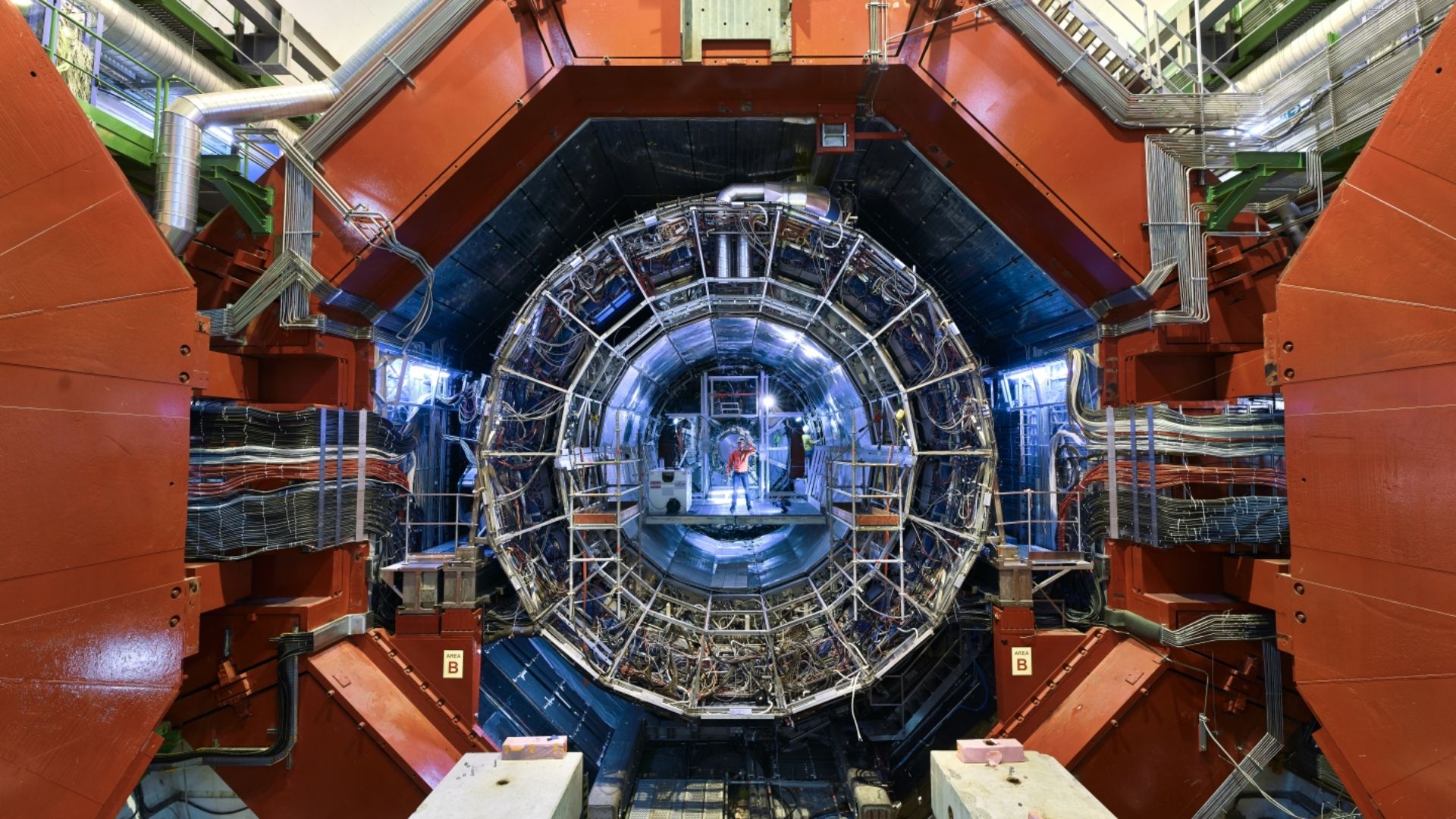
In a series of new experiments, scientists at the European Organization for Nuclear Research (CERN) have smashed oxygen atoms in the Large Hadron Collider (LHC) and observed parton energy loss or direct jet quenching, making it the smallest nuclear system studied so far to show this trait, and important in understanding what unfolded in the moments after the Big Bang. Although the experiments at the LHC are all meant to help us understand sub-atomic particles better and how the universe was probably created, this experiment did not actually attempt to recreate the Big Bang. Rather, scientists wanted to know what happened in the few microseconds after the Big Bang, when the temperatures were too high to make protons and neutrons and matter instead existed as a plasma of quarks and gluons. This quark-gluon plasma isn’t similar to the plasma used in nuclear fusion reactions, where the positively charged atoms and negatively charged electrons lie in a soup. Instead, the plasma is a mix of the constituents of hadrons and the nuclear force that binds them. Search for jet quenching Previous experiments suggest that a millionth of a second after the Big Bang, even as temperatures remained extremely high, matter did not behave like gas but instead like liquid with very low viscosity. To study quark-gluon plasma, CERN scientists have generated this plasma by colliding heavy nuclei such as lead. With a nucleus with 208 protons and neutrons, scientists were able to create plasma droplets, and the the violent collisions result in a high-energy quark or gluon being launched. Such particles are called partons, and while they do not reach a detector on their own, when they do leave the quark-gluon plasma, they fragment into a narrow spray of ordinary particles or a jet. This is called parton energy loss or jet quenching. Attempts to generate gluon-quark plasma through proton collisions have shown collective behavior in the particles but not a direct energy-loss signature. So, researchers at CERN began a new series of experiments in July last year to generate the plasma using oxygen-oxygen and neon-neon collisions. What did ALICE find? In results published on a preprint server, CERN researchers were seeking answers to the question of whether oxygen-oxygen collisions, though small, can create any energy that can be seen as a jet at all. Using the Large Ion Collider Experiment (ALICE), one of the nine detectors at the LHC, the researchers measured neutral pions that mediate the nuclear force inside the atomic nucleus and found their production suppressed in the oxygen-oxygen collisions, much in the same way as observed in lead-lead collisions. By comparing these to oxygen-proton collisions from the same run as a control, the researchers concluded that there was jet quenching or parton energy loss in these collisions. While these are the smallest nuclear systems on record to show these effects, they are not necessarily the smallest systems ever to display parton energy loss, even though proton-proton collisions did not display these effects. From their previous work, CERN researchers had assumed that quarks and gluons become deconfined at higher temperatures and densities, suggesting matter would likely behave like a thin gas. However, these measurements also show that subatomic particles retain strong collective motion, suggesting they behave more like a near-perfect liquid. The flow of the plasma can also serve as a complementary test. Collective flow could indicate parton energy loss in systems that have too little material to make jet quenching measurable. Additional data in this area could also demonstrate a continuous progression in which both effects become easily measurable as size and particle numbers increase. The research findings were published on arXiv.Get the latest in engineering, tech, space & science - delivered daily to your inbox.Ameya is a science writer based in Hyderabad, India. A Molecular Biologist at heart, he traded the micropipette to write about science during the pandemic and does not want to go back. He likes to write about genetics, microbes, technology, and public policy.
Oxygen collisions at CERN reveal clues about universe’s earliest moments
Full Article
Original Source
Read the full article at Interestingengineering →KhanList aggregates and links to publicly available news content. We do not host full articles from third-party sources. Always verify important information with original sources.