
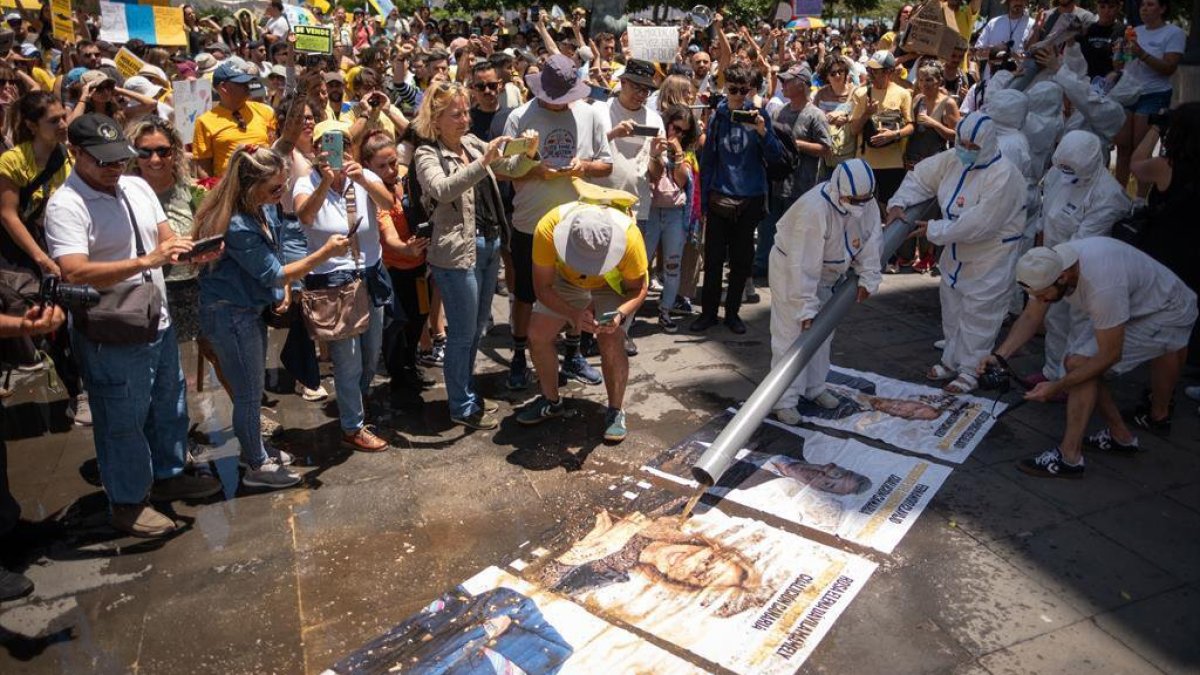
CANARY ISLANDS – Thousands of demonstrators are expected to fill the streets of Spain’s Canary Islands on Saturday, as part of major protests against overtourism. The demonstrators, who will march in Lanzarote, Fuerteventura, La Palma, Tenerife and Gran Canaria, are demanding action from the island’s authorities to relieve the strain on roads, airports and other infrastructure which they say are being overrun by millions of tourists from Britain, Germany and other North European countries every year. In the latest in a series of protests in the popular holiday destination, protesters plan to march on government buildings on the islands to demand action to improve wages and conditions in the tourist industry for residents, and better education and health care for the islanders. Shorts Water pistols will not be used to soak unsuspecting tourists, organisers said, as their anger is not directed at holidaymakers but at politicians. Long waits on crowded roads, sewage dumped into the seas and illegal building of tourist projects have infuriated locals in recent years, and campaigners say that amid a housing crisis and the rising cost of living, many Canary residents struggle with poorly paid jobs. “Last year, there were demonstrations against the excess of tourists in the islands which generates tension with local people. But despite this, the authorities have continued to develop tourist projects,” Raphael Marrero from Real Democracy, the organiser of the protest, tells The i Paper. “The government wants more tourists to come but we say that the islands are saturated,” he adds. Saturday’s demonstration follows similar protests in recent years against the “touristification” of the islands, and comes after a series of similar protests this summer in Barcelona, Malaga, Mallorca, Ibiza and Madrid. Anti-tourism protests and graffiti have become common in Palma de Mallorca in recent years (Photo: Andrey Rudakov/Bloomberg/Getty) As Spain expects to attract a record 100 million visitors this year, it is struggling to balance this with anger among residents at rising property prices and pressure on local amenities. Almost a third of the Canary Islands’ population of 2.2 million are classed as being at risk of poverty, according to NGO the European Anti-Poverty Network. Meanwhile, over 18.4 million tourists visited the islands last year. Marrero says that around 40 per cent of the territory is protected land, so developers cannot build there. “In the remaining land, the density of population is high. With 18 million tourists last year, this creates a great pressure on resources.” He says his group was named Real Democracy because members felt they had been let down by their elected officials. Michelle Holland, a British diver who lives in Tenerife, says that overtourism has made the pollution problem worse (Credit: Michelle Holland) Michelle Holland, a British diving instructor who lives in Tenerife, is planning to go to this weekend’s demonstrations. Holland, who moved from Lancashire to Tenerife 10 years ago, helps tourists see the underwater world, but also dives to collect rubbish from the ocean and has amassed 10,000kg since starting the project in 2023. “I dive every day to remove trash from the coastlines around the island to try to combat the direct environmental impacts of overtourism, overdevelopment and lack of sustainable development,” she tells The i Paper. Brian Harrison, a businessman who moved to Tenerife 36 years ago and is the general secretary of Salvar la Tejita, an ecological group that campaigns against illegal construction on the islands, claims residents live with “Third-World infrastructure”. “How can the political class boast about this so-called wealth generated by mass tourism, when classrooms reach 37°C and have no ventilators or air conditioning?” he says. “When the only public hospital in South Tenerife has taken 30 years to build and it’s still not fully operational because of budget issues?” A construction site near Tejita beach in Tenerife. Locals are unhappy with the lack of sustainable development (Photo: Stefano Nicoli/NurPhoto via Getty) Harrison says that over 200 unauthorised raw sewage outlets pump millions of litres of “filth” into the oceans every day, and that there is acute poverty and an unsustainable housing crisis on the islands. The message doesn’t seem to have got through. David Pérez, a tourism consultant who has worked in the sector for 30 years, says politicians had failed to take action to address problems of the islands’ infrastructure, the housing crisis and overtourism. “It is the lack of political responsibility which is at fault, not tourism,” he tells The i Paper. “There has been no public housing for 30 years, the infrastructure is overwhelmed… We must organise and build the infrastructure which is needed.” Pérez said some protesters had good reason to complain, but others were “anti-everything” and had demonstrated against changes to Tenerife airport, which would actually benefit residents and modernise the facilities. Even so, the mood of protest is growing. Fernando Clavijo, the Canary Islands regional president, celebrated the arrival of more than 18 million tourists in 2025 as a “success”, despite a series of protests in the islands against overtourism. But in January, he added: “Growth isn’t just about counting tourists; we must grow in terms of quality, spending and employment. All that economic potential must also serve the public.” The Canary Islands government declined to comment on the issues raised by protesters when contacted by The i Paper.
‘Overwhelmed’ by British tourists, the Canary Islands are fighting back
Full Article
Original Source
Read the full article at Inews →KhanList aggregates and links to publicly available news content. We do not host full articles from third-party sources. Always verify important information with original sources.