
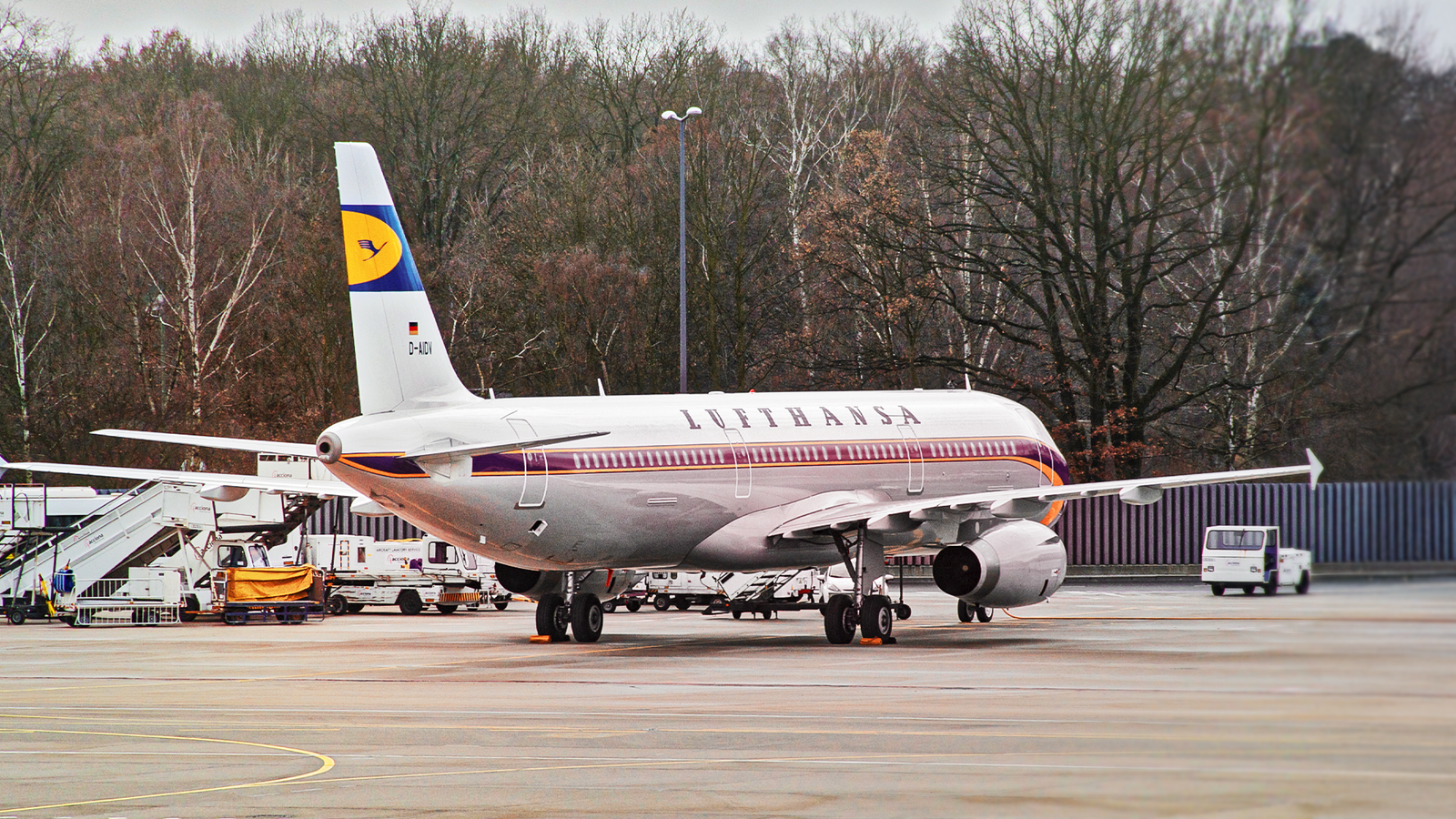
Published Oct 31, 2026, 4:00 AM EDT Luke Diaz is a freelance military writer with experience with active duty experience in the US Navy as well as defense and industrial engineering. He is a former Naval Flight Officer who performed tactical air control on the carrier-based E-2 Hawkeye. Lufthansa was not only the launch customer for the Airbus A321, the first aircraft to receive it, but it also turns up on the Frankfurt or Munich departure board today. Delivered in 1994, tail number D-AIRA 'Finkenwerder' and five other A321-100s of the same vintage have become the carrier's six oldest aircraft in active service. The veteran narrowbodies are almost a decade older than the Airbus A340 quadjets that Lufthansa retired from the flightline this October. Even as the airline sunsets its entire A340-600 fleet after 23 years of service, it is retaining 14 examples of A321-100 airframes that are all over 30 years old. The aircraft replacing those obsolete quadjets is itself an evolution of the enduring single-aisle, being kept on schedule. The Lufthansa group has 18 Airbus A321neo aircraft remaining on its firm order backlog, with deliveries expected through 2027. The most critical factor in this seemingly illogical fleet modernization is engine economics. The decision to discontinue and retire quad-engine giants like the Airbus A340, Airbus A380, and Boeing 747 while expanding the narrowbody A321 family boils down to operating costs. The evolution of twinjet technology has eliminated the need for so many redundant engines on long-haul flights, while the rising cost of fuel has made the quadjets difficult to justify in comparison, even with higher seat capacity per sortie. A Stretched A320 With Lufthansa's Name On It Credit: Bradley Caslin | Shutterstock The A321 saga began in 1988, when Airbus started developing the stretched narrowbody shortly after its smaller A320 entered service. According to Aerospace Testing International, the prototype first flew on March 11, 1993, from Hamburg Finkenwerder. Tail number F-WWIA flew for just over 4.5 hours over northern Germany and the North Sea on that day. The A321 would go on to be the first Airbus built on a final assembly line outside France, which tied it even more closely to Lufthansa and Germany. As the launch customer, Lufthansa took delivery of the first A321 on January 27, 1994. D-AIRA was named Finkenwerder after the Hamburg district that housed the new Airbus plant responsible for producing the new line of long-body jetliners. According to Lufthansa Flyer, the initial batch of 20 jets was delivered between 1994 and 1998, ending with D-AIRY on November 4, 1998. By 2015, there were 63 A321s on the Lufthansa flightline. The stretched fuselage was roughly 23 feet (6.9 m) longer than the A320, but because it shared the same fuel capacity, the jet would have a shorter range than its smaller predecessor. That trade shaped how airlines used it until later variants from Airbus added upgrades. Six Survivors From The First Wave Credit: Dirk Daniel Mann | Shutterstock Of the six surviving aircraft from Lufthansa's 1994 deliveries, four are listed in service. Two, D-AIRA and D-AIRC, are reportedly parked. The table below shows the three oldest survivors. The wear and tear on these planes shows up in the cycles more than in the hours they spend in the air. A cycle is one takeoff and landing, and all three jets have exceeded Airbus's original design goal of 48,000 cycles for the A320 family. Metric D-AIRH D-AIRA D-AIRC Aircraft Name Garmisch Partenkirchen Finkenwerder Erlangen Age 31.7 years 31.3 years 31.2 years Flight Hours 65,265 hours 64,898 hours 66,298 hours Flight Cycles 49,303 cycles 48,839 cycles 51,393 cycles The recently mothballed A340-600was also a stretched airframe like the A321. The core reason the A321 was successfully extended while the A340 was not comes down to how their foundational designs handled the airframe's scale and aerodynamics, as much as the fuel burn of each jet's powerplants. The A321 is a straightforward stretch of the basic A320, whereas the A340-600 was the longest airliner in the world when it debuted and demanded a far more complex redesign from its base model. To compete with the Boeing 777, Airbus stretched it into the A340-600 by 34 feet, 9 inches (10.6 meters) beyond the original airframe design. This extreme length created a severe technical penalty. The fuselage suffered from structural flexibility, bending and twisting in turbulence, requiring substantial structural beef-up that added immense weight. By contrast, Airbus originally designed the A320 family for a lifetime of 48,000 cycles and 60,000 flight hours. Since the airframe proved to be so robust, its ESG program legally extended the limits up to 60,000 cycles and 120,000 flight hours. Lufthansa kept its final A340s active until October as temporary capacity cushions because of post-pandemic demand spikes and delays in new plane deliveries. The old A321s have remained valuable because even though a newer A321neo burns roughly 20% less fuel, the savings of flying the older, fully paid-off airframes easily offset the higher fuel burn. Credit: Jan Hospodka | Shutterstock As long as the A321-100s lasted, Airbus began work on its successor quickly to offset the original plane's limitations. It kicked off the A321-200 program in 1995, adding a new fuel tank and raising the maximum takeoff weight. That gave the stretched single-aisle enough range to cross the US, coast to coast. The first example flew in 1996 and entered service with Monarch Airlines in 1997, three years after Lufthansa's first delivery. Over three decades, the MTOW of the A321 has grown about 20%. That growth turned a short-legged stretch into something nobody planned in 1994. The A321-100 was certified at 183,000 lb (83,000 kg), while the A321-200 reached 200,000 lb (93,000 kg). Today, the latest long-range version, the A321XLR, is cleared to 223,000 lb (101,000 kg) on takeoff, which gives it a range of up to 4,700 nautical miles (8,700 km) or about 11 hours of flying. Historically, Lufthansa was known for flying its massive, 300-seat long-haul A340-300s and A340-600s on high-density, relatively short regional routes. Thanks to the long list of upgrades it has received since the A321-100 rolled out, the A321neo has stepped in to entirely eliminate the need for an A340 on high-volume, medium-distance routes. Examples include high-density premium hops like Frankfurt to Cairo, Frankfurt to Amman in Jordan, or busy intra-European routes like Munich to Athens and Frankfurt to Rome. By packing 215 passengers into its ultra-efficient single-aisle twinjet rather than the fuel-guzzling 270-seat quad-jet, Lufthansa has sustained nearly identical seat demand during peak business hours. The massive savings in trip fuel and landing fees on a 3-to-4 hour route mean the A321neo yields drastically higher profit margins than an A340 ever could. That allowed Lufthansa to reorganize its fleet and finally bid farewell to the A340. The SWISS Connection: Lufthansa's A321 Sister Fleet Credit: Soos Jozsef | Shutterstock Swiss International Air Lines (SWISS) inherited several early-build A321-100s that originally flew for its predecessor, Swissair. Like its parent company Lufthansa, SWISS has relied on these classic A321-100s for decades. The most iconic of these frames was HB-IOC, a classic A321-100 built in 1995. Affectionately nicknamed the 'Olympic Plane' because of its 'IOC' registration marker, which mirrors the acronym for the International Olympic Committee. HB-IOC flew for over 27 years, racked up 73,000 flight hours, and completed 47,000 takeoff and landing cycles. The mighty narrowbody safely carried 7 million flyers all across Europe before retiring in 2023 to Castellón, Spain. Today, SWISS still has a handful of active -100 series airframes flying busy hub-to-hub routes. However, just like in Germany, the sun is rapidly setting on these 1990s narrowbodies in Switzerland due to the same exact pressures of European emissions taxes and fuel. The departure of the A321-100 is part of a massive narrowbody shakeup across SWISS's entire regional network. SWISS is progressively taking delivery of its own A321neos as well as the smaller A220-300 regional jet. What Replaces The First A321s As Lufthansa Evolves Credit: EQRoy | Shutterstock The transition plan and final trajectory for Lufthansa's remaining A321-100 workhorses point to a gradual, quiet phase-out. Lufthansa is still flying these 30-year-old, high-cycle Airbus A321-100s because of basic asset math: they are fully paid off and cost almost nothing to sit on the tarmac. However, Lufthansa has actively begun sending its oldest A321-100 airframes to jet graveyards like Teruel Airport (TEV) in Spain. Jet fuel costs have skyrocketed due to the Russian invasion of Ukraine and the US-Israeli conflict with Iran, severely impacting airline bottom lines. Europe also enforces some of the strictest aviation sustainability mandates in the world, heavily penalizing older jets for pollution. Under European law, airlines must pay for carbon allowances for every flight within the EU. As a result, flying a 'dirty' 1994-vintage narrowbody significantly increases Lufthansa's tax burden. These conditions hit older aircraft like the A321-100 particularly hard. Under the current conditions, the 20% greater fuel efficiency of the A321neo actually makes it a more economical choice despite the debt it carries as a new airframe purchase for Lufthansa. While these planes have proven to be masterpieces of longevity, the realities of modern European operating costs mean they can no longer compete. The remaining high-cycle A321-100s are now prime targets for grounding to curb costs amid rising fuel and maintenance expenses.
Over 30 Years Old: Lufthansa Is Still Flying Some Of The World's 1st Airbus A321s
Full Article
Original Source
Read the full article at Simpleflying →KhanList aggregates and links to publicly available news content. We do not host full articles from third-party sources. Always verify important information with original sources.