
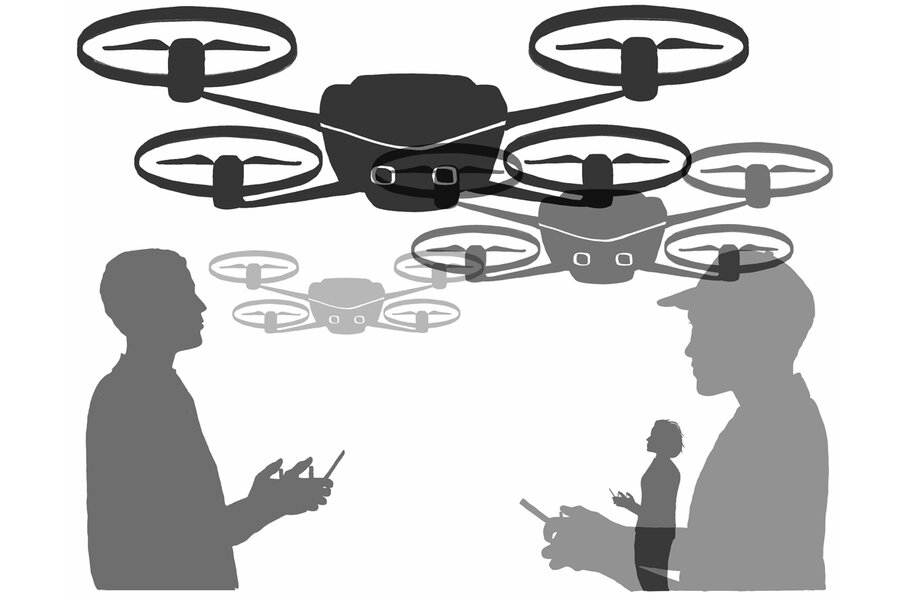
Drones 101: A new opportunity for Russian firmsAmid wartime headwinds and changing educational priorities, a Russian company recently paused its plans to make laptop computers and will produce drone-piloting simulators for schools instead. According to the independent Russian news outlet Meduza, LIGA Group, an electronics firm in Yekaterinburg, read the economic tea leaves and decided drone simulators would have a guaranteed market, especially after President Vladimir Putin ordered education officials to include drone-operating in school curricula. – Fred Weir “Anglosphere” colleges losing their edgeUniversities in “Anglosphere” countries – including the United States, Australia, Canada, and Britain – are facing stiffer competition when it comes to attracting foreign students. Higher-ed institutions in continental Europe are seeing more study-abroad applications. That’s due in part to restrictive immigration policies. Pedro Oliveira of the Nova School of Business and Economics in Portugal told the Financial Times, “I see the emergence of a more competitive European higher-education market.” A 2026 survey by the consulting group Studyportals found that enrollment across the English-speaking world has fallen. “Visa uncertainty, rising costs, and policy instability took a real toll,” it says. – Matthew Bell Panama Canal operator limiting traffic The Panama Canal Authority is reducing how many vessels can pass each day through the canal, a crucial human-made waterway connecting the Pacific and Atlantic oceans. As of Sept. 15, 32 ships will be able to pass through, compared with 36 previously. This isn’t the first time the authority has had to limit traffic as a water-saving measure, but with a severe El Niño climate pattern forecast for 2026-2027, likely bringing lower precipitation, the canal’s long-term sustainability is at risk. Rainfall was 34% below the historical average between May and August. – Whitney Eulich“I am thrilled to see the results ...”That’s Juliana Cumming, a researcher at Imperial College London, remarking on a project to develop the world’s first fully biodegradable party balloons. The project, inspired by concerns over the environmental impact of discarded balloons, uses a modified latex material. “Every celebration leaves something behind, and for balloons, that has meant micro-plastic, which outlives the party by decades,” says Charlotte Melia, whose party business partly funded the research. The balloons are designed to biodegrade within nine months. – Tim Backshall Deepen your worldviewwith Monitor Highlights.Politics with respectGet political stories with respectful analysis.There‘s a world of new ideas in everyBooks newsletter.There‘s more to life, enrich yours withCulture & Learning weekly.Follow humanity‘s discoveries withScience & Nature stories in your inbox.Gain a spiritual perspectivefrom the stories in your inbox.Want to understand the deeper impact of critical events? Learn the Monitor‘s insight.Already a subscriber? Log in to hide ads. ALREADY A SUBSCRIBER? LoginReal news can be honest, hopeful, credible, constructive.The Christian Science Monitor was founded in 1908 to lift the standard of journalism and uplift humanity. We aim to “speak the truth in love.” Our goal is not to tell you what to think, but to give you the essential knowledge and understanding to come to your own intelligent conclusions. Join us in this mission by subscribing.
Our world: The week of Sept. 28, 2026
Full Article
Original Source
Read the full article at Csmonitor →KhanList aggregates and links to publicly available news content. We do not host full articles from third-party sources. Always verify important information with original sources.