
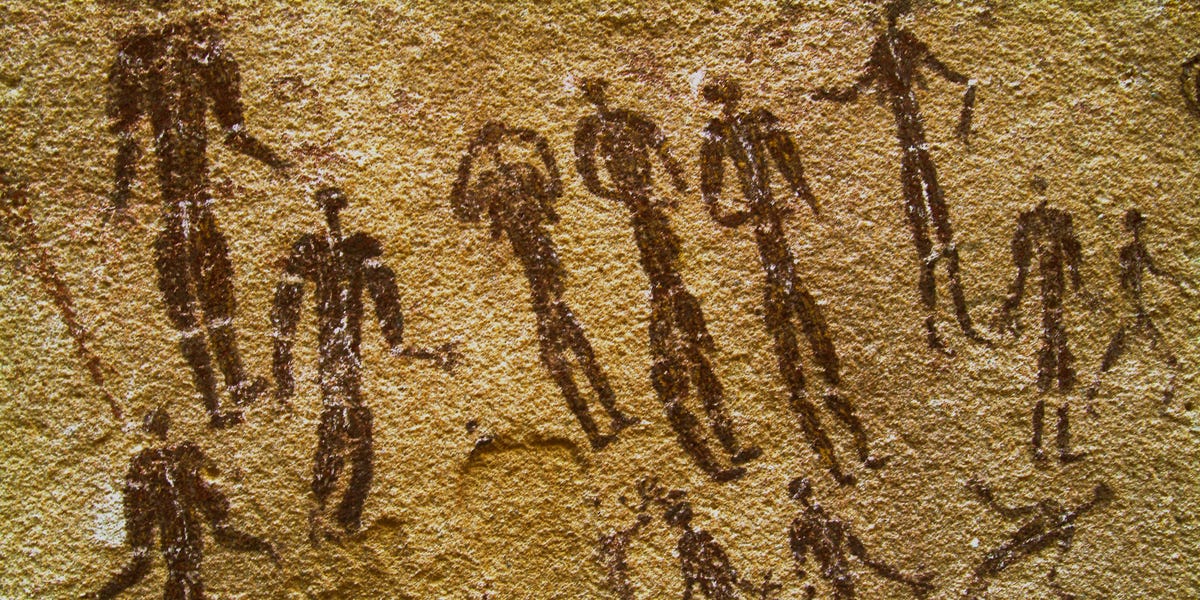
Modern life has made movement optional like never before. ASICS research found that respondents around the world reported spending 86 percent of their waking day not moving. Yet our bodies were shaped by a very different world, where walking, carrying, and running were part of everyday survival.Around two million years ago, our ancestors began developing a body equipped for endurance running. These adaptations helped them keep moving over long distances. We inherited that capacity, but modern life gives many of us little reason to use it.A marathon puts that evolutionary inheritance to the test, with modern training, nutrition, and technology helping runners explore their limits. So how would we perform lined up against the ancestors who helped shape us? Could a recreational marathoner outrun Homo erectus?Evolution Toward EnduranceUnlike other mammals, “humans aren’t especially good sprinters, but we are highly effective endurance athletes,” says David Raichlen, an evolutionary biologist at the University of Southern California.Some two million years ago, our ancestors Homo erectus lived as hunter-gatherers, spending long periods walking, tracking, and chasing food. “Around the same time, they began to develop some anatomical features that improved their ability to run for long periods,” Raichlen says. “These features include long legs, relatively short toes, long Achilles tendons, a large gluteus maximus, and other traits that help to stabilize the head and trunk while running.”Our ability to sweat profusely may also have given early humans an advantage in hot conditions, allowing them to cool down and keep moving while other animals overheated.One popular explanation is persistence hunting: chasing prey over hours until it collapses from heat exhaustion. Professor Lewis Halsey, of the University of Roehampton, says the evidence has become more nuanced. His own research comparing humans and horses supports a human heat-endurance advantage. Humans are less adversely affected by rising temperatures than horses, although horses remain faster. Human success, he suggests, may have come from combining a modest heat advantage with pacing, tracking, cooperation, and a large brain for tactics.The Marathon QuestionSome internet speculations suggest Homo erectus could run a marathon in around 3 to 4 hours. If the estimate were taken at face value, even its slower end would beat today’s average marathon time of around 4:30 (4:17:00 for men and 4:43:00 for women, according to Running USA’s Industry Insights report from 2023). But where did the Homo erectus marathon time come from?It remains unclear. One study, focused on time rather than speed and published in the 2020 Journal of Human Evolution, offers a different measure of endurance: its model estimated that Homo erectus would reach a dehydration limit after 5.5-5.7 hours of persistence hunting without drinking, under the conditions examined.Raichlen cautions against putting a time on possible speed. “I would not say that we know Homo erectus ‘could run a 3:30 marathon’,” he says. “The stronger conclusion is that around two million years ago, humans had evolved a body capable of surprisingly impressive endurance running.”Halsey is blunter. “Inferring a marathon time from some bones is pushing it,” he says. Many adaptations associated with running are also useful for walking, and they tell us nothing about VO2 max or lactate threshold—key determinants of distance-running performance.Mac Cassin, Principal Sports Scientist at Wahoo, says the modern comparison needs similar care. “It’s highly unlikely that an ancient human ever set out to run 26.2 miles aiming for a new PB,” he says.The Sedentary ShiftHere’s the real story: we haven’t become biologically weaker, but we have removed the need to move. “The difference between ancient and modern humans really comes down to what is done on a daily basis,” Cassin says. “Overall, human endurance potential hasn’t changed from ancient times to now. What has changed are the physical demands of daily life.”Hunter-gatherers did not exercise constantly, Raichlen says. Rest was always part of human life. The difference is that movement was embedded in it.“Acquiring food, travelling between locations, carrying things and performing other daily tasks required physical activity,” he says. “Whereas now modern humans can work, shop, travel, eat, socialize and entertain themselves without needing to move very much at all. The ability to largely remove movement from daily life is a very new concept.”The consequences extend beyond fitness. Low physical activity is linked to poorer cardiovascular and metabolic health, Raichlen says, while movement also supports mood, cognitive function and long-term brain health.An Inheritance Worth UtilizingWe may never know whether you could beat Homo erectus over 26.2 miles; what we do know is that our endurance has deep evolutionary roots, and we have our ancestors to thank for the ability to line up at a marathon starting line.The more useful question is how much of the endurance capacity you inherited you are putting to use. “The more interesting comparison is that modern humans retain an impressive endurance capacity that evolved in a world where regular movement was unavoidable,” Raichlen says. “Today we have largely the same biological capacity, but we live in environments where movement can be almost entirely optional.”Cassin believes many recreational runners underestimate what consistent movement can achieve over years. “With the correct training, our body is remarkably adaptable,” he says. “The caveat is that adaptation takes time.”Raichlen advises runners not to treat running as the only movement that counts. “Walk places where you can, take the stairs, get outside, carry things and find reasons to move between workouts,” he says. “A 45-minute run is great, but it doesn’t mean the other 15 waking hours are irrelevant.”
Our Prehistoric Ancestors Were Built for Endurance. In Today’s Increasingly Sedentary World, Could You Outrun Them?
Full Article
Original Source
Read the full article at Runnersworld →KhanList aggregates and links to publicly available news content. We do not host full articles from third-party sources. Always verify important information with original sources.