
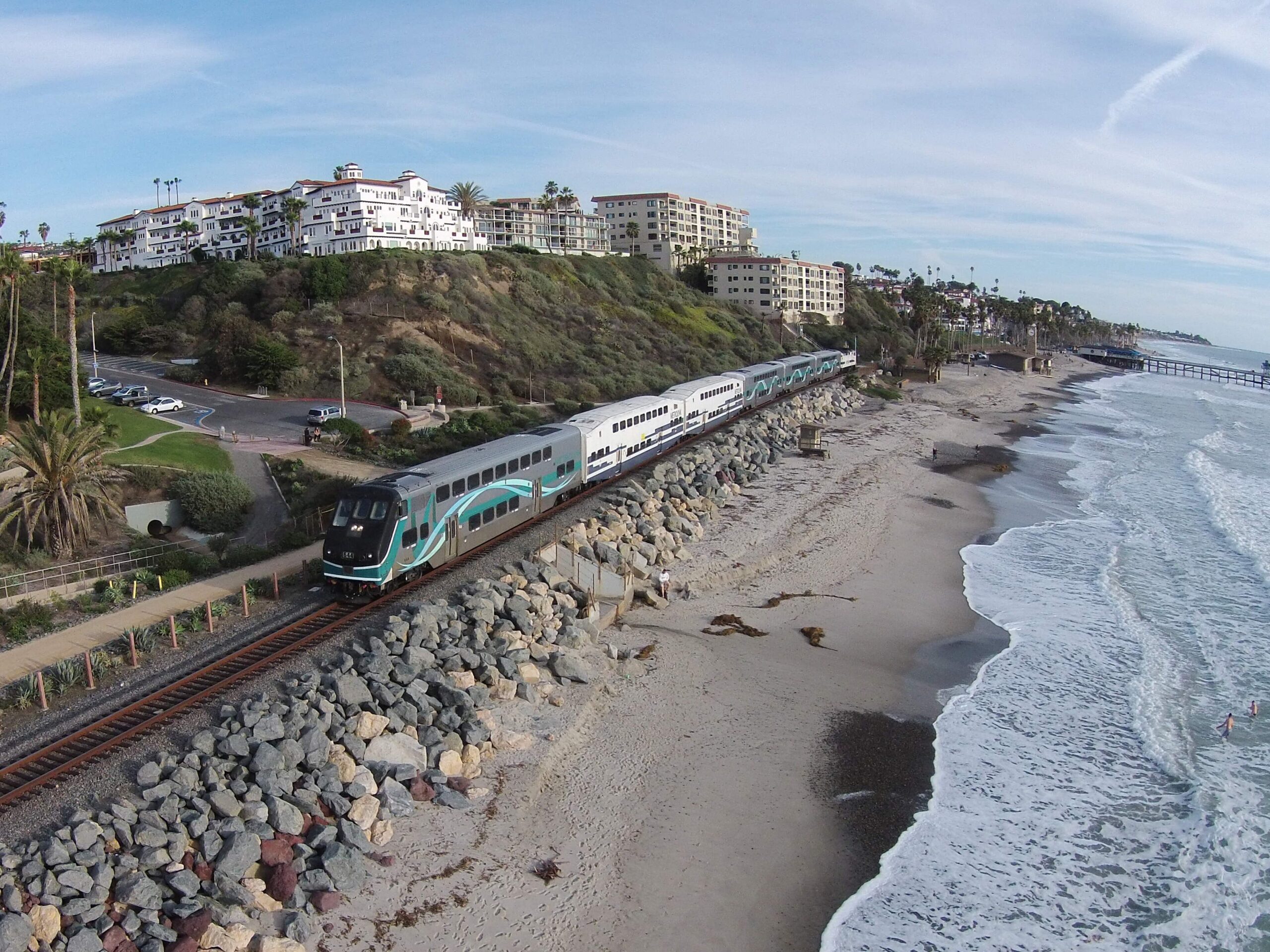
San Clemente residents and beach advocates say shoreline riprap meant to protect a key railroad is contributing to beach loss and restricting public access.OCEANSIDE, Calif. (CN) — Beachgoers and residents of Orange County, California, demanded answers from the California Coastal Commission Wednesday over the continued emergency permitting of shoreline armoring in San Clemente that they say prioritizes an aging railroad track over beach access.Residents told commissioners that the armoring has been a Band-Aid solution that has only resulted in the loss of more shoreline as sandy beaches become inaccessible due to riprap — large angular stones that are used to prevent coastal erosion.They say what’s needed is sand, but the Orange County Transit Authority and Southern California Regional Rail Authority have failed to provide it.“Four years ago, they told us, ‘We are studying how to get sand down,’” Save Our Beaches San Clemente Chairman Gary Walsh told commissioners. “Now, in that length of time, SpaceX has managed to build a rocket and send astronauts around the moon.”The California Coastal Commission’s Executive Director Kate Hucklebridge issued the coastal development permit at the end of last month for emergency maintenance along a nearly one-mile section just south of scenic San Clemente State Beach, a popular tourist destination.Prompted by high tide events in September and a potentially disastrous El Niño season during the next few months, the permit allows the local rail authorities to protect the railroad tracks by installing and maintaining thousands of tons of riprap.“OCTA has promised over two years that they would incorporate sand into the project, but the only preparations they’ve made were to stage riprap in the yard a few miles away and arrange contracts to get more,” Walsh said. “You have the enforcement capabilities. For the sake of everyone, do not let them get away with eliminating a beach during your watch.”The dispute highlights the growing tension between competing public interests along California’s beaches, as climate change and coastal erosion continue to shrink the state’s shoreline.Walsh was joined by almost two dozen other public commenters who voiced similar frustrations over the loss of beach access.“Surfrider is dismayed and alarmed to see over 30 emergency permits for armoring across Orange County,” said Mitch Silverstein, California policy coordinator for Surfrider Foundation. “Altogether, it’ll likely add around 30,000 tons of boulders across public beaches for their exacerbating permanent beach loss while offering, at best, temporary protection for private properties and public infrastructure, like the rail corridor through San Clemente, and it’s not even winter yet.”Commissioner Raymond Jackson was sympathetic with public commenters.“At what point does the word emergency become an indefinite, permitting mechanism for something that’s foreseeable, and has been studied for years?” Jackson, of Hermosa Beach, California, asked during the meeting. “If we know it’s coming, we’ve been talking about it for five years, it’s foreseeable, how is it an emergency?”Sand placement will be discussed during a commission meeting next month, which the commissioners are expected to vote on.A spokesperson for the Orange County rail authority said that the agency understands the community’s frustration and is working.“Sand placement is a major priority for OCTA, and we are working to expedite plans to place up to 690,000 cubic yards of sand along San Clemente’s beaches,” OCTA spokesman Joel Zlotnik wrote in an email. “This is a significant undertaking that requires coordination on permitting, sand sources and specialized dredging equipment. In the meantime, we must also address immediate threats to the railroad to keep service operating safely.”The railroad serves as the only passenger rail service between Los Angeles and San Diego and also, notably, carries military equipment and assets up and down the corridor.“We understand that placing additional rock along the shoreline raises concerns, but in locations where waves are directly threatening the railroad and little or no beach remains, immediate stabilization is necessary while we continue pursuing sand placement and longer-term solutions,” Zlotnik said.The permit allows the rail authorities to add up to 15,000 tons of new riprap and ballast necessary to protect the railroad, generally within about 50 feet of the rail and with a maximum of 300 tons per 100 linear feet until July of next year.The project is part of the rail authorities’ larger effortto bolster railroad infrastructure along the coast against increasingly severe ocean waves and coastal erosion, Zlotnik said. OCTA has secured more than $300 million for such projects.Zlotnik said that OCTA is working with various state and federal agencies to coordinate and add sand to the beach.Initially, the rail authority was looking at late 2028 to begin work, but hopes to speed that up, in part due to Governor Gavin Newsom’s El Niño emergency declaration.Subscribe to our free newslettersOur weekly newsletter Closing Arguments offers the latest about ongoing trials, major litigation and rulings in courthouses around the U.S. and the world, while the monthly Under the Lights dishes the legal dirt from Hollywood, sports, Big Tech and the arts.Additional Reads
Orange County residents blast emergency shoreline armoring
Full Article
Original Source
Read the full article at Courthousenews →KhanList aggregates and links to publicly available news content. We do not host full articles from third-party sources. Always verify important information with original sources.