
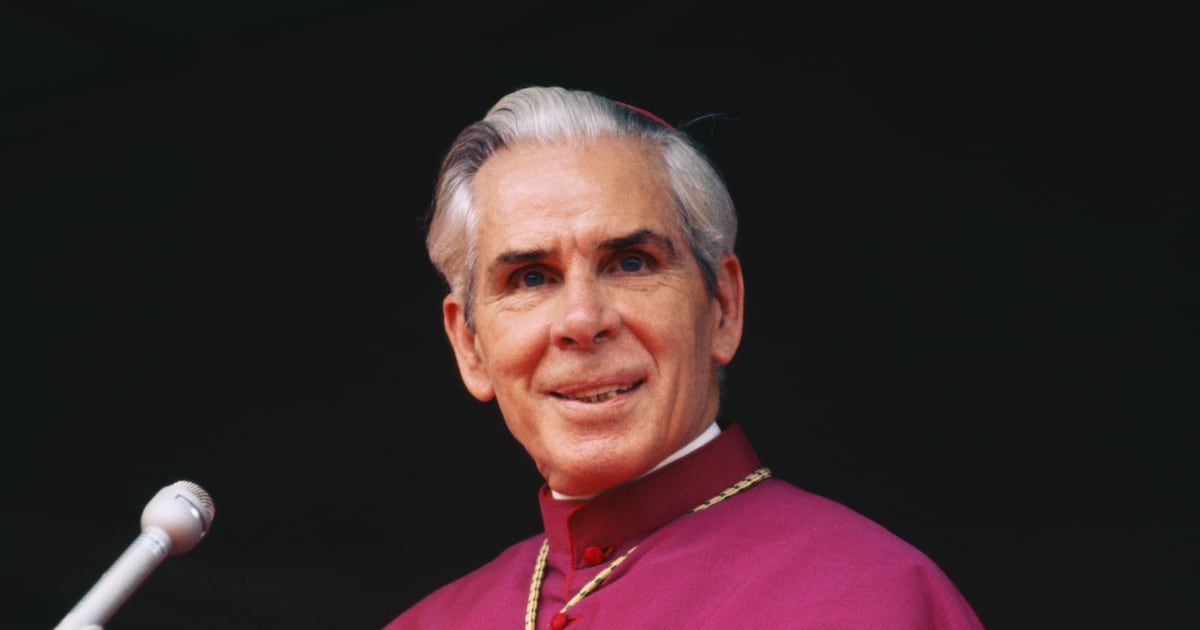
At 8pm on February 12th, 1952, a strangely clad figure walked across the stage of the Adelphia Theater in New York City and into thousands of American livingrooms. Dressed in full episcopal regalia, complete with a purple cape, a zucchetto skullcap, and a pectoral cross given to him by the pope, Bishop Fulton Sheen proceeded to hold forth extemporaneously for the next half-hour. Behind him, conspicuously placed within the camera shot, was a statue of the Virgin Mary that would soon be known as “Our Lady of Television”. Sheen’s show, Life is Worth Living, featured a one-way conversation in which the host cited ancient philosophers and medieval intellectuals to assuage the fears of contemporary American listeners.READ MOREWhether addressing the threat of Stalinist communism or home-grown concerns about the rise of “teen culture”, the charismatic Sheen offered the reaffirming message encapsulated in his programme’s title.Despite being assigned to the daunting Tuesday-night slot in direct competition against “Mr Television”, Milton Berle, and a young crooner named Frank Sinatra, Sheen soon became a national celebrity, winning an Emmy Award in his first year.An invitation to dinner at the White House followed, along with profiles by Life and Time magazines, and regular appearances on the Gallup poll’s list of “the 10 most influential men in America”.Born to second-generation Irish parents and raised in rural Illinois, young Sheen displayed theatrical talent along with extraordinary intellectual gifts. During his graduate studies, he became the first American winner of the infrequently awarded Cardinal Mercer dissertation prize at the prestigious University of Louvain in Belgium.Sheen’s public career began during the late 1920s with the advent of wireless radio in the US. As national networks filled their programming with religious material, Sheen joined another broadcasting Catholic cleric, Fr Charles Coughlin, whose weekly programme would draw 30 million listeners. But while sharing Coughlin’s strident anti-communism, Sheen’s style diverged from “the Radio Priest”. The fiery Coughlin eventually spiralled into conspiratorial anti-Semitism and proto-fascism, while Sheen helped to form ecumenical links. In 1934, he joined the National Conference of Christians and Jews, and was later recognised as an “outstanding protector of human rights” from the New York Chapter of B’nai B’rith.Sheen’s biggest break came in 1952 with a move to the new medium of television. This transition brought a changed approach as well, as he reached beyond his nearly exclusively Catholic audiences. As American Catholicism came of age in the early postwar era, the televised Fulton Sheen turned from proselytising to providing a reassuring message for Americans of all faiths. It was here that his references to his Irish background broke the ice, with playful, self-deprecating wit alongside an unabashed sentimentality that defused the image of the church as a cold, authoritarian institution. Introducing each episode with a lighthearted anecdote or droll observation, he would often invoke charming stock images of “the old country”, or a whimsical disputation, such as his differentiation between the guileless Irish practice of “blarney” in contrast to self-serving “baloney” of the contemporary American “rat race”.Sheen’s programme also provided him with an opportunity to defuse potential tensions with non-Catholic viewers. After forging earlier friendships with a number of Jewish writers and performers, he relayed amusing tales of humorous points of contact between the two groups.In one episode, he talked about an older Jewish woman who had asked a clerk in a New York bookstore if they carried anything by “that nice young Rabbi Sheen”. On another show, he told of receiving a letter from a disappointed young Jewish boy who couldn’t seem to find a purple yarmulke like the skullcap worn by Sheen. (Sheen sent him a purple zucchetto for the boy’s bar mitzvah.) Even his friendly rival, Milton Berle – or “Uncle Miltie” – was in on the joke, as Sheen playfully introduced himself as “Uncle Fultie” one week, while Berle would attribute his competitor’s success to Sheen’s writers, “Matthew, Mark, Luke and John”. Sheen also took great pride in his multireligious appeal, proudly citing the disproportionately large numbers of letters that he received from Protestant and Jewish correspondents.These inroads proved foundational for the new postwar generation of Irish-American leaders. Making no concessions with his own Catholic stylings, Sheen’s bright-eyed optimism challenged the rougher, embittered image of figures like Coughlin and Senator Joseph McCarthy. In short, the Irish ethnic charms of “Life is Worth Living” would lead the way to the enchantment of John F Kennedy’s “Camelot” presidency. Ironically, as we look forward to Sheen’s beatification next Thursday, his engaging pluralism sometimes seems to be under fire. Faced with reductionist notions of Christian nationalism and the disparagement of cultural heritage carried by recent arrivals, it is clear that Uncle Fultie’s work is not yet complete.Dr Matthew O’Brien is a professor of history at the Franciscan University of Steubenville, Ohio, in the United States
Opinion: Meet the Irish-American TV star bishop who is about to be beatified
Full Article
Original Source
Read the full article at Irishtimes →KhanList aggregates and links to publicly available news content. We do not host full articles from third-party sources. Always verify important information with original sources.