
In the last couple of months, I had the great opportunity to moderate three conversations about trade in international forums. The first was with Kate Kalutkiewicz, who served as Special Assistant to President Donald Trump and Senior Director for International Trade at the National Economic Council. The second, with Daniel Watson, who until very recently was Assistant U.S. Trade Representative for the Western Hemisphere (USTR). The third, with Michael Pettis, professor at Peking University and co-author of the well-known book Trade Wars Are Class Wars. I won’t disclose what any of them said specifically. I will, however, share some of the ideas we discussed and my conclusions in the following lines. AmCham CEO Pedro Casas participates in a fireside chat with Michael Pettis, during the AmCham’s October 2026 Economic Forum in Mexico City. (Courtesy photo) Let me start with a few “stylized facts”. First, the new era in trade policy is built on economic security. The free movement of goods and services is no longer the guiding principle. The easiest way to understand this new dynamic is as a managed trade system that limits non-aligned countries (read: enemies) from accessing the supply chains of critical industries and favors local production, or at least production among allies, of those goods and services. In plain English: separating as much as physically possible from China and its allies, and from their exports of steel, aluminum, critical minerals, energy, vehicles, and technology, while bringing that production back to the neighborhood. Which leads me to the second stylized fact: China is the enemy of the United States. Every conversation about trade comes down to how, when, and who is going to decouple from China, and what they can do to support re-industrialization and job creation in the United States. That is, of course, if your interest is to stay close to the Americans. The third and last one is tariffs. They’re not the answer. Tariffs on countries such as Mexico and Canada have the immediate effect of increasing the overall deficit the United States absorbs. They have even become unpopular among American voters and will most likely play a significant role against Republicans in the upcoming midterm elections. As a tool to reach the first two objectives, economic security and decoupling from China, tariffs are, besides being erratic, a misguided policy. When we look at the numbers, China isn’t as strong as some might think. Its debt-to-GDP ratio is above 300%, and debt continues to grow at more than 10% per year. Its unemployment rate is in the double digits (the exact number is hard to know), wages are suppressed, productivity is artificially boosted by subsidies, and the country lacks the capacity to consume what it produces. So the excess supply gets shipped at very low prices all over the world. That’s basically their growth model. But when the biggest consumer market in the world and its allies are looking for ways not to buy China’s excess production, the conditions for a collapse get closer, and fast. This is a serious threat to China and to the world’s economy. We’ve all relied on this system for the past three decades. The sirens are on, and it’s up to the rest of us to get ready. So, how do we get ready? Each country has to do its part, and there are two sides to it: one international and another national. On the international front, it’s about picking sides and coordinating. This is not a party where two superpowers “fight” while the rest of the world sits and watches. Everyone plays a part. This is a continental battle. The U.S. and its allies should present a united front to bring the production of semiconductors, medical devices, drugs, critical minerals, energy, data centers, ships, and vehicles back to “safe harbor.” Just to state the obvious: the opposite is happening. At the national level, at least in Mexico, the opportunity is to be ready for the hit. Let me put it less dramatically and more as an opportunity. When China collapses, if it does and as it does (it won’t be overnight), Mexico should have the installed capacity to absorb part of the production China will no longer be able to deliver. Mexico must focus on domestic policies that would enable it to welcome a tsunami of investment: sufficient energy, first-class infrastructure, a trained workforce, and a seamless, trustworthy bureaucracy. The United States should match this with its own industrial policy, ideally twinned with or planned alongside Mexico and its other allies. That way, those policies get reinforced and multiplied with resources from its partners. I’ll say it one more time: you don’t win a trade war alone, and even less by beating your allies and friends. The way forward is together, or it simply isn’t. Pedro Casas Alatriste is the Executive Vice President and CEO of the American Chamber of Commerce of Mexico (AmCham). Previously, he has been the Director of Research and Public Policy at the US-Mexico Foundation in Washington, D.C. and the Coordinator of International Affairs at the Business Coordinating Council (CCE). He has also served as a consultant to the Inter-American Development Bank. Follow his Substack here.
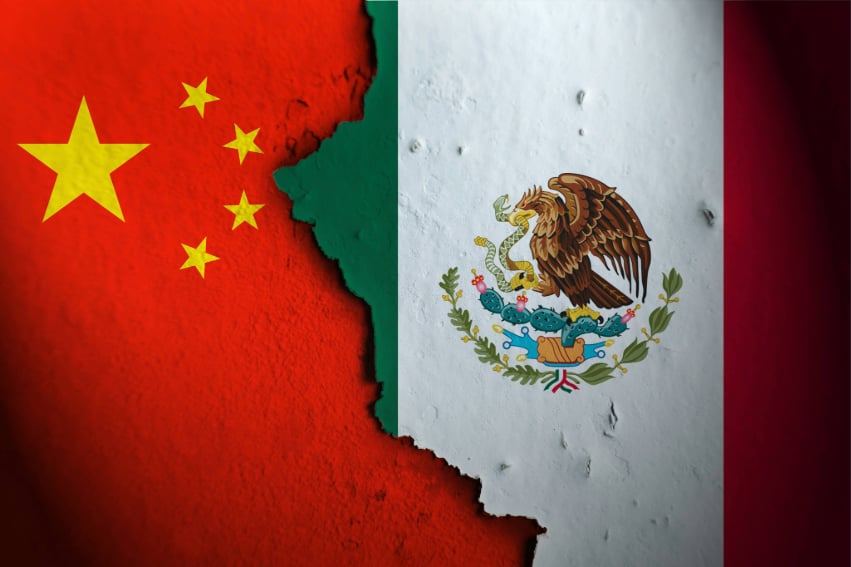
Opinion: China’s model is cracking and Mexico (and the world) should get ready now
Full Article
Original Source
Read the full article at Mexiconewsdaily →KhanList aggregates and links to publicly available news content. We do not host full articles from third-party sources. Always verify important information with original sources.