
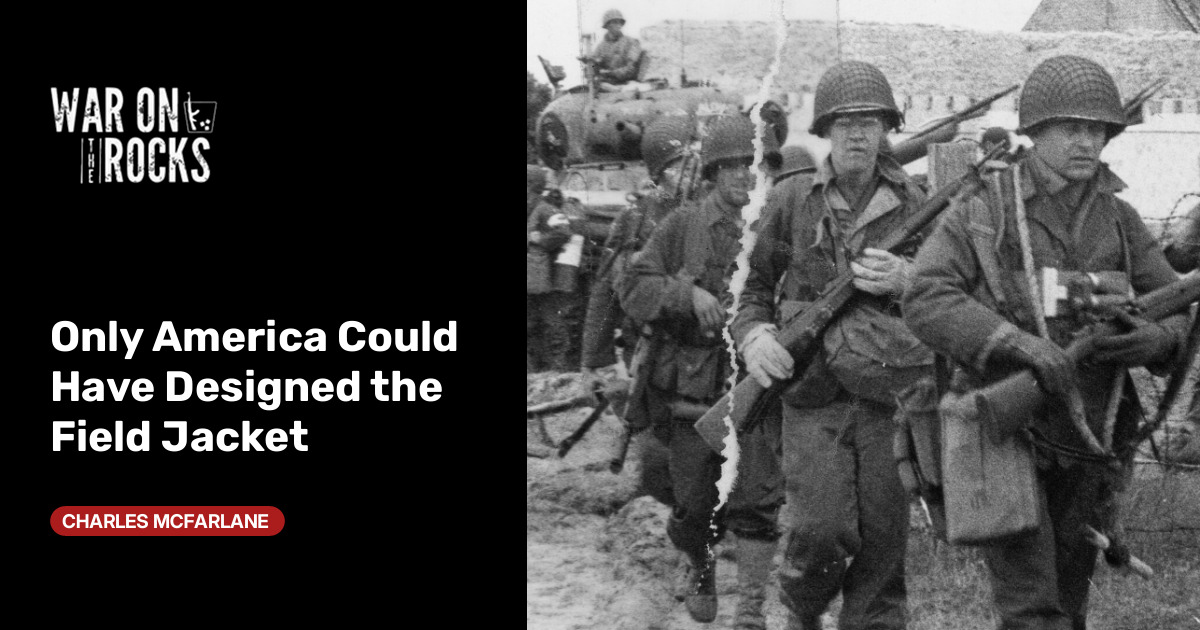
When the M-1943 field jacket was introduced at the height of World War II, it was a revolutionary garment. The jacket was the result of rigorous testing, input from an astonishingly diverse group of experts, and was produced by the most advanced textile and garment industry in the world at the time. But the essence of the M-1943 field jacket, and what made it so unique, was the very simple question it was trying to answer: “What does the soldier want?”The success of the field jacket highlights how a diversity of thought, a mastery of logistics, and a concern for the well-being of the common soldier were foundational to America’s citizen army and the essence of a democracy’s fight against fascism.Uniforms are often overlooked in discussions of military technological advancements or force multipliers. It is easy to understand that the ability to put an M1 Garand rifle in the hands of every infantryman in World War II was a massive industrial undertaking that only the United States could have accomplished, and the firepower it gave a U.S. Army infantry platoon shaped tactical outcomes. The same can be said for uniforms, whose design and quality had an appreciable effect.The M-1943 field jacket and the modular layering system designed to work with it kept U.S. soldiers warmer and drier, reducing cold-weather casualties that could seriously undercut the combat effectiveness of units without it. Similarly, for much of the history of warfare, the winter months meant an end to campaigning, with both sides hunkering down to winter quarters and waiting for the spring fighting season. Just as night-vision technology enabled American dominance of the dark on 21st-century battlefields, the field jacket allowed U.S. troops to own the cold. The impact of U.S. Army uniform development is as important to the story of the United States in World War II as the M1 Garand.Much of this essay is based on archival research conducted at either the National Archives in College Park, Maryland, or the Quartermaster Corps Museum at Fort Lee, Virginia. Many of the quoted documents, memos, and histories are, unfortunately, unavailable online. A key source, quoted throughout, is Designed for Combat: The Army’s Field Jackets by Norman E. Roberts, an internal history of the Army’s wartime field jacket development and production commissioned by the Philadelphia Quartermaster Depot in 1946. Another is Clothing the Soldier of World War II, published by the Quartermaster Corps as part of their postwar historical series, by Dr. Erna Risch, a prolific historian who would eventually become the chief of the Historical Section of the Quartermaster General.The development of the first military field jacket began in late 1939 when the War Department Uniform Board was directed to develop “some type of windbreaker or lumberjacket for field service.” The job of designing such a jacket was taken up by Maj. Gen. J. K. Parsons. Parsons envisioned that instead of soldiers going to war in their service coats — woolen jackets with brass buttons, better suited for dress but customarily worn in the field as well — they should wear a jacket specifically for field use. He settled on a lightweight cotton jacket with a wool shirt lining, about waist-length, based largely on golf jackets. The result was what would become the M-1941 field jacket.It was unprecedented for a modern army to march into battle not in a wool coat in temperate climates (considered the norm by more armies at the time, where temperate uniforms were standard and cold and tropical weather uniforms were specialized). But it was clear a new field jacket had to be developed to more appropriately meet the rigors of a global war being fought in different climates — from Alaskan islands and Asian jungles to North Africa and Europe — and stand the test of combat. As it is put in Designed for Combat, “The battlefronts of the world were expanding, and a garment was required that could be worn in more widely varying climates than had been previously anticipated.” By the end of the war, U.S. troops would be stationed on all continents save Antarctica.While subsequent jackets developed by the U.S. Army largely discarded the M-1941, its role remains important as the first field jacket worn by the U.S. Army — or any army. Even though the design was undoubtedly flawed, it was responsible for a paradigm shift in military uniforms towards greater utility and comfort that is still evident today. As noted in Designed for Combat, Parsons had “develop[ed] what millions of GI Joes the world over now know as the field jacket. It is doubtful if World War II produced any single addition to the American soldier’s uniform which was more important or valuable than this particular garment.”With the U.S. entrance into World War II in late 1941, the U.S. military no longer faced the budgetary restrictions of the 1920s and 1930s. The U.S. government and economy were fully mobilized for a global war. And a global conflict also meant a need to develop uniforms for any and all climatic conditions that U.S. troops could face. The U.S. Army was developing numerous other uniforms for specialized soldiers. Paratroopers, armored and mechanized, ski troops, and arctic warfare troops received specialized uniforms in 1942. Producing such a wide variety of clothing from various fabrics and hardware put a strain on the Quartermaster Corps and government contractors.This sentiment was echoed in the postwar history of U.S. field jackets, written by the Philadelphia Quartermaster Depot, which stated, “During the first year of the war, the Army had exhibited a dangerous tendency to produce an individual jacket for every unit which seemed to require some different type of protection.” By 1942, the Army recognized the need for a new field jacket to streamline logistics and replace all specialized jackets. The U.S. Quartermaster Corps began to develop what would become the M-1943.The design and development of the M-1943 field jacket was shared by multiple branches of the Quartermaster Corps, from the Research and Development branch to the Textile section. The Quartermaster Corps Military Planning Division, headed by Georges Doriot, played a crucial role in organizing the development and how the jacket would be issued overseas. A French immigrant, World War I veteran, and economics professor from Harvard, Doriot brought an outsider’s perspective desperately needed in the Quartermaster Corps. He not only solicited the outdoor clothing industry for advice but also conducted the first scientific testing of the garments to reduce bias and other problems endemic to earlier uniform designs.The U.S. Quartermaster Corps was now approaching design and development in a much more organized and scientific manner. Expert outdoorsmen and alpinists were consulted; standardized tests of textiles and climatic chambers were used. Field tests were also rigorously conducted. “When the [Quartermaster Corps] Board first embarked on its field-testing program, it was entering an almost virgin field,” wrote W.H. Snyder in the July/August 1947 Issue of The Quartermaster Review, a trade-like publication for the Quartermaster Corps.As a 1944 Quartermaster Corps publication titled Outfitting the Soldier prepared by the Quartermaster Technical Training Service at then-Camp Lee, Virginia, put it, “immediately upon enactment of the first conscription law, almost the entire roster of American scientists, explorers, and manufacturers were called upon to cooperate with the Office of the Quartermaster General in development of clothing and equipment.” Now these scientists, explorers, and manufacturers worked to develop the M-1943 field jacket.Scientists from the National Academy of Sciences, the National Research Council, and the Office of Scientific Research and Development helped bring the scientific method to the Quartermaster Corps. Explorers and alpinists like H. Bradford Washburn Jr., the director of the New England Museum of Natural History, joined the Quartermaster Corps and even took part in a cold-weather expedition to Mount McKinley, Alaska to test garments and equipment. Robert H. Bates, a fellow explorer and seasoned mountaineer, became the head of the Quartermaster Corps Research and Development branch.In a postwar history of U.S. Quartermaster uniform development, the authors heralded the research done by the branch alongside the garment industry and university laboratories as having “contributed directly to his [soldier] physical and mental wellbeing. Upon the latter depends the efficiency of the soldier, and clothing makes a greater contribution to this end than is generally appreciated.”The M-1943 field jacket was not a stand-alone garment but part of a more extensive series of garments that comprised the Army’s new combat uniform. By 1944, the Army was working with at least four university laboratories, including the John B. Pierce Laboratory at Yale, focusing on how the human body reacted to different clothes; the physiological laboratory at the University of Indiana, testing textiles for tropical climates; and a University of Pennsylvania laboratory for studying clothing for cold, wet climates.This series of garments that made up the new combat uniform used what is called the “layering principle.” This approach to warmth, well known today to most casual campers and soldiers, is the understanding that warmth comes from trapping body heat close to the body through a series of tighter-to-looser layers, with an outer garment made of a wind-resistant material. This idea was essentially brand new to the average person in the 1940s, so much so that the M-1943 field jacket included an instruction label for how to properly layer it, along with a field manual and lectures given to soldiers by the Quartermaster Corps. This kept the soldier superiorly warm in cold climates and allowed it to be worn in more temperate climates — the key to creating a jacket that could replace the myriad of specialized jackets made for U.S. soldiers.Designed by Israel Freedman, Max Udell, and Lou Weitz — all of the Office of the Quartermaster General and former garment manufacturers — the M-1943 was made from a nine-ounce olive drab sateen shell with a five-ounce poplin lining. The jacket was meant to fit loosely, allowing multiple layers to be worn below, and featured a drawstring waist that could be cinched or loosened depending on the layers and weather. It reached down to the hip and featured four large pockets. The two chest pockets were bellowed and designed to hold rations and hand grenades. The lower pockets, below the waist, were internal, much larger, and had internal suspension, meant to store ammunition and other personal items. The jacket featured a button-front closure and pocket flaps, all covered to prevent snagging.Of course, in designing a garment purely for field use, utility was a major consideration, but there was form as well as function. The new jacket reflected both the American soldier as a citizen and a consumer. As an inspection manual for the jacket put it, “The American man, accustomed to decently fitting clothes in civilian life, should definitely be happier wearing a jacket styled in light of his sense of what looks right as well as its ability to take punishment.”The jacket’s design reflected an American attitude towards combat and clothing. “Killing is a dirty business, and to me, it seemed immoral for professional killers to look too clean,” recounted infantryman Warren Wightman of the 90th Infantry Division in his postwar memoir ‘44 Foxholes in France. Like that other bastion of American style — blue jeans — the field jacket was designed as workwear.The military that wore the field jacket was just as diverse as the team that designed it and the workers who produced it into the millions. Production of the field jacket was contracted to firms across the United States, but as with many of the Army’s uniforms, manufacturing was largely centered in the Northeast. Companies like Sigmund Eisner Co. Inc. (Red Bank, New Jersey), The Navytone Co. (Philadelphia, Pennsylvania), The Monarch Coat Co. Inc. (Boston, Massachusetts), and many others produced almost 17.5 million field jackets between 1943 and 1945.The development and ultimate success of the M-1943 field jacket embodied the core strengths of the American way of war, a method that mastered practicality and logistics on a scale that no other combatant nation ever rivaled. At the same time, Britain’s soldiers were clad almost entirely as they had been when the war began, and German forces were equipped in a logistically haphazard manner, with uniforms repurposed from defeated foes or produced by slave labor.By stressing function over form and results over tradition, the United States achieved the most meaningful developments in military garments in recent history simply by asking, “What does the soldier want?” Made all the more impressive by being perhaps the only time in military history that a standard issue garment was made more complicated, not less, by the end of the war, compared to the beginning.Designed with the soldier’s well-being at the forefront — a habit made into policy by Army Chief of Staff Gen. George C. Marshall — the jacket was available in a truly astonishing array of sizes for Americans of all shapes. An egalitarian military based on democratic principles that saw its soldiers not as simply drafted cannon fodder, but as valued citizens. Defeated Nazis were struck by how American soldiers looked. “The impression GIs have made on Germans is naturally mixed,” Julian Bach wrote in his 1946 book, America’s Germany: An Account of the Occupation.The passage recounts that some staunch Nazis pointed out the “sloppiness” of Americans with their hands in their pockets and baggy field jackets left unbuttoned. Others were impressed “that the officers’ field uniform is identical to that of the men.” The casual hard-wearing field jacket stood in stark contrast to the tailored uniforms of the aesthetic-obsessed fascists. As one German is quoted as saying, “the American soldier is sloppy. The German soldier is very stiff. But the American soldier, he seems to always win.”After World War II, the field jacket would become the standard outerwear for nearly all armies worldwide. It changed the way countries developed and designed uniforms for decades to come. The layering principle would become common practice. At home, the field jacket would become a pillar of American vernacular style. A definitional American garment, as American as jeans. The United States would update the design, eventually landing on the M-1965. It would remain in service until 2009, making it one of the longest-issued pieces of uniform in American history.The field jacket was the mantle of American victory over fascism. A symbol of many of the democratic ideals the country strives for. A jacket that combined the industrial and technical might of the United States with the constant push for innovation and diversity of thought championed by a liberal democracy. A jacket worn by all ranks, with the well-being of the common GI top of mind, the M-1943 embodies the very idea of the citizen-soldier. It completely changed the silhouette of the American fighting man, making it a modern, casual garment that was thoroughly American.Charles McFarlane is a fashion historian and researcher focusing on military uniforms and popular fashion. His writing has appeared in The New York Times, GQ, and New Lines Magazine. He writes the newsletter Combat Threads. He holds a Master of Arts in costume studies from New York University. This essay is based on research from his master’s thesis, “Combat Threads: How WWII Changed Uniforms and the Way We Dress.”Image: National Archives
Only America Could Have Designed the Field Jacket
Full Article
Original Source
Read the full article at Warontherocks →KhanList aggregates and links to publicly available news content. We do not host full articles from third-party sources. Always verify important information with original sources.