
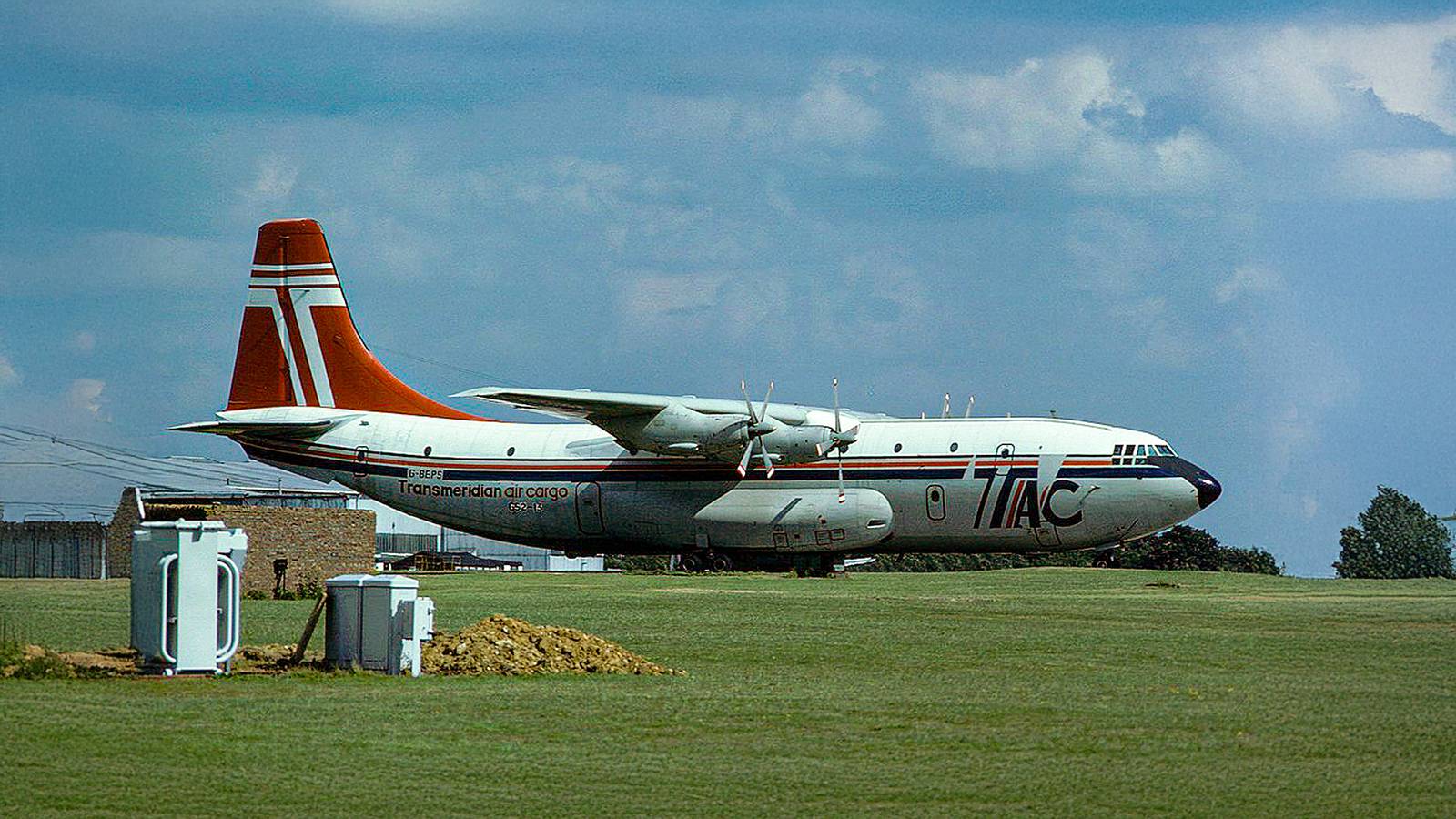
Published Oct 8, 2026, 1:00 AM EDT Luke Diaz is a freelance military writer with experience with active duty experience in the US Navy as well as defense and industrial engineering. He is a former Naval Flight Officer who performed tactical air control on the carrier-based E-2 Hawkeye. The last Short Belfast with any realistic prospect of flying again has sat on an apron at Cairns Airport (CNS) in Far North Queensland since January 2009. Only ten of these massive turboprops were ever manufactured because the sheer, unsustainable cost of their specialized operations forced the Royal Air Force (RAF) to retire the fleet early. Recent restoration efforts suggest its return to flight as a massive strategic airlifter remains a possibility to this day. The Belfast featured a cargo bay larger than any Western turboprop of its era. Measuring 136 feet (41.45 meters) long with a towering 158-foot (48.16 meters) wingspan, the Short Belfast is roughly twice the size of its competitor that ultimately proved victorious, the legendary Lockheed C-130 Hercules. Despite being retired by the RAF in 1976, five of the ten Belfasts were chartered by civilian operator TAC Heavylift to support the 1982 Falklands conflict. One complete aircraft, XR371 'Enceladus,' is beautifully preserved and on display at the RAF Museum Midlands in Cosford, England. Meanwhile, in August 2023, the owner of the only potentially flyable survivor, nicknamed Hector, listed the plane on the US civil register to begin an airworthiness overhaul. Updates have been scarce over the years. While there was a surge of optimism regarding a restoration, a major environmental setback and the sheer logistics of the project have cast a heavy cloud over its future. A Legal Fight And A New Registration In late 2023, Hector caught the attention of aviation enthusiasts around the world when it unexpectedly changed ownership and was officially placed on the US civil register as N1819S, as Vintage Aviation News reported. The new owners launched an ambitious restoration project with the goal of returning the aircraft to airworthiness within two years. Initial progress was highly encouraging, but the revival project suffered a devastating blow in December of that same year when Cyclone Jasper struck Queensland. The storm triggered historic, catastrophic flooding that completely inundated Cairns International. Hector, parked in the general aviation section of the tarmac, sustained significant water damage from the floodwaters. For an aircraft of this age, having its complex wiring, landing gear, and lower fuselage submerged in floodwater added an immense layer of costly, labor-intensive repairs to an already difficult restoration. Before the storm struck, engineers successfully overhauled the flight deck and generators, serviced the rare Rolls-Royce Tyne turboprop engines, and even successfully performed engine test runs on the tarmac. While aviation enthusiasts and plane spotters continue to photograph Hector on the Cairns tarmac, no public reports have noted further engine runs or other major milestones. Its return is blocked by the problem of finding spare parts, which means fabricating them from scratch or scavenging a shrinking pool of vintage spares. What The Flood Changed The Aviation Safety Network records that water submerged the Belfast up to its lower fuselage, and lists the extent of the damage as unknown. The Copernicus flood service reported that Cairns Airport received 12.1 inches (307 millimeters) of rain in the 24 hours to early on December 18 and was closed temporarily. No published damage assessments, active test flight records, or formal airworthiness approvals have surfaced for the airframe since the storm. Despite the silence, much speculation remains that Hector could be restored and eventually fly again, offering customers a less costly alternative to Jet freighters. Much speculation has been put forth that the owner of the plane hopes to get Belfast back in the air to serve humanitarian aid missions as its primary role. If the plane was to return to airworthiness, it would in fact be a perfect platform given its origin as a plus-sized military airlifter. There are very few aircraft in the world capable of moving massive, non-standard cargo into tight spaces, especially with the global shortage and destruction of several Antonov aircraft in recent years. Thus, a restored Short Belfast could theoretically command very lucrative charter rates. Yet, upgrading the 1960s analog engineering to meet modern global airspace requirements is an astronomical expense. Why The RAF Wanted A Hold So Large Named for the city in Northern Ireland that contributed much to its production, the Belfast began as a private design study at Short Brothers in the mid-1950s. To save time and money, the company originally tried to base the aircraft on the Bristol Britannia airliner, keeping its wings, tail, and landing gear while swapping in a massive new fuselage. This wide-body design was wide enough to hold a 12-foot (3.6 meters) wide load, large enough to transport heavy radar units and ballistic missiles. The Royal Air Force turned this concept into a formal requirement in late 1957, demanding a heavy freighter that could move artillery, helicopters, and over 200 troops. Meeting these strict military targets forced engineers to completely abandon the airliner blueprint. They added a new center section that stretched the wingspan by 16 feet, adopted more powerful Rolls-Royce Tyne turboprops, and had Canadair redesign the entire wing structure to store fuel directly inside it. In December 1960, the British government purchased a small production run of ten aircraft. Before entering service, the prototype underwent an 850-hour flight test program after its first 55-minute flight in January 1964. This newly designed airframe's enormous interior cargo space and sheer size raise the obvious issue of how its actual physical dimensions compare to the widely used C-130 Hercules. How The Belfast Compares With Hercules The Short Belfast is twice as big as a C-130 Hercules, according to aviation jargon, but the facts tell a more complex story. Since the Belfast weighs about half as much as the C-130H, the real difference lies in internal fuselage volume and raw lifting capacity rather than overall aircraft weight. Inside the airframe, the gap gets much wider. Two buses can fit in Belfast's pressurized, 16-foot-wide fuselage with ample room for forklifts to operate in the hold. A Chieftain main battle tank, armored vehicles, helicopters, and a company of soldiers could never be transported by a Hercules, as it simply lacks that kind of capacity. Specification Short Belfast Lockheed C-130H Hercules Length 136 feet (41.6 meters) 98 feet (29.8 meters) Wingspan 159 feet (48.4 meters) 132 feet (40.4 meters) Max Takeoff Weight 230,000 pounds (104,326 kg) 155,000 pounds (69,750 kg) Cargo Hold Length 84 feet (26 meters) 41 feet (12.5 meters) Engine Horsepower (per engine) 5,730 shp 4,591 shp The Belfast was also highly advanced for its era, serving as the first aircraft designed from the outset with a fully automatic landing system, auto-throttle, and head-up display. Four massive Rolls-Royce Tyne engines gave the Belfast superior power over the C-130H, enabling it to haul its colossal payload on specialized strategic missions. However, carrying these heavy, oversized loads came with a steep penalty in range. Short's gargantuan airlifter boasted an impressive 5,300-mile (8,540 kilometers) empty ferry range, according to Aero Corner. Its operational reach plummeted to just 1,000 miles (1,609 kilometers) when loaded to maximum capacity. In comparison, a C-130H can travel 1,208 miles (1,944 kilometers) with its standard payload. The Belfast ultimately traded distance at maximum load for a unique heavy-lift capability, raising the question of why a machine this advanced was retired after barely a decade of service. A Short Career Ended By Budgets The British government had to cut the final production run because of severe financial constraints, even though the Royal Air Force had originally planned to buy over ten Short Belfasts. Because Short Brothers had invested in full production jigs based on a break-even threshold of 30 aircraft, this move immediately caused an economic catastrophe for the factory. This permanently clouded the aircraft's long-term financial viability by preventing the program from reaching the critical mass required to recoup its high development expenditures. When Belfast entered frontline duty with 53 Squadron at RAF Brize Norton in January 1966, it proved remarkably successful despite these industrial challenges. The heavy lifter quickly demonstrated its value to the military, setting an operational service record in 1968 by airlifting over 70,000 pounds of medical supplies directly to Saigon on a single flight. The aircraft’s military career ended not with mechanical failure, but with a series of aggressive defense reviews. The creation of RAF Strike Command triggered a massive structural reorganization, leading to the rapid phase-out of the Britannia and Comet fleets, followed by the complete withdrawal of all ten Belfasts by September 14, 1976. While modern rumors often claim the Belfast cost four times as much to operate as a C-130 Hercules, contemporary research reveals no historical record of this metric. The 53 Squadron was permanently disbanded due to the severe political budget slash. Several defense analysts harshly condemned the retirement as a costly, nearsighted mistake. The British government was compelled to charter commercial Belfasts at outrageous rates in order to handle excess cargo during the Falklands War. According to historians, the cost of these emergency charters eventually surpassed the cost of keeping the entire military fleet operational until the 1990s. Which individual airframes survived depended on how the fleet was sold off after the aircraft were transported to RAF Kemble for storage.
Only 10 Were Built: The British Cold War Heavy-Lifter Twice The Size Of A C-130 Is Waking Up In Queensland
Full Article
Original Source
Read the full article at Simpleflying →KhanList aggregates and links to publicly available news content. We do not host full articles from third-party sources. Always verify important information with original sources.