
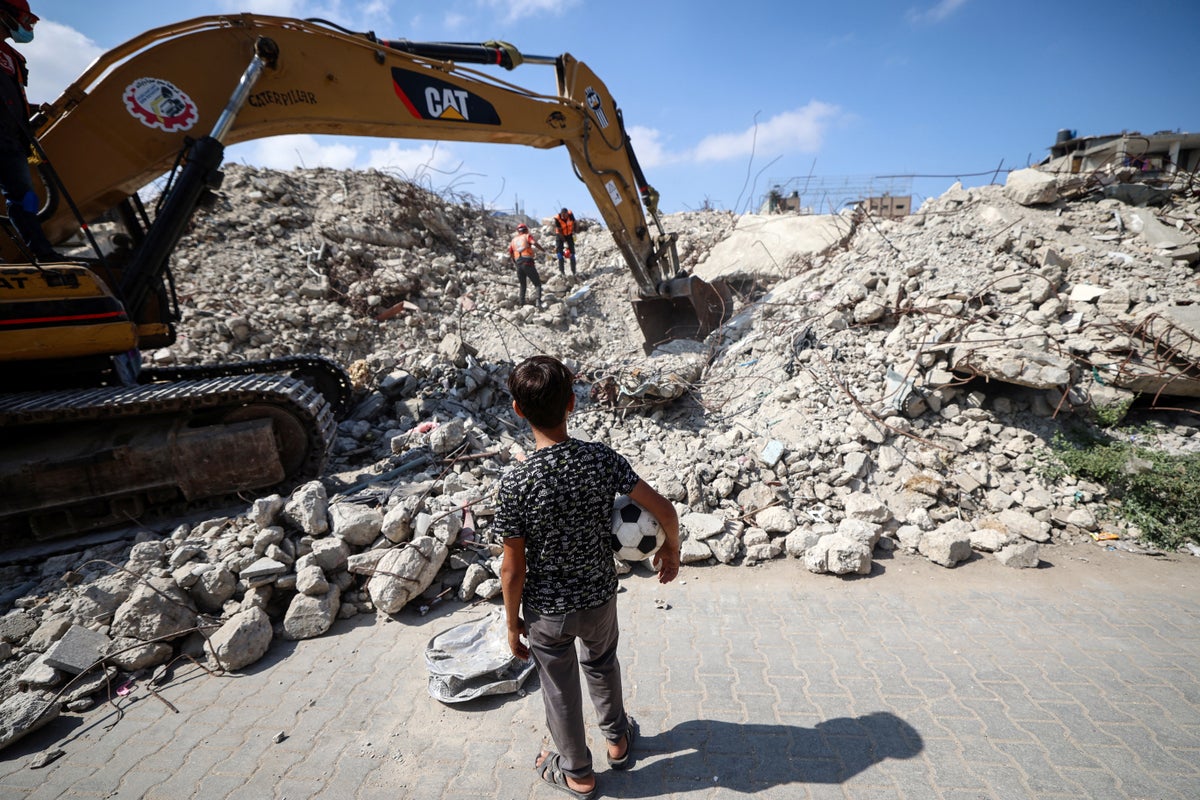
Three-hundred-and-sixty-five days have passed since a long-awaited ceasefire was signed in Gaza, designed to bring peace and safety for Palestinians after two years of devastating Israeli invasion.The reality of the past 12 months, however, is a far cry from Donald Trump’s promise of “peace for all eternity” last autumn.Nearly 1,400 Palestinians have died in Israeli strikes since the ceasefire came into place and more than 74,000, according to the Palestinian authorities, since the bloody October 7 attacks three years ago in which 1,200 Israelis were killed and 251 taken hostage.The Israeli military has continued creeping forward in Gaza, squeezing Palestinians into increasingly smaller territory, and has not allowed a free flow of humanitarian and medical aid into the strip. Hamas is still armed, and five Israeli soldiers have been killed in combat. “Everybody is living in fear,” Musallam Abukhalil, a 32-year-old doctor from Nuseirat in central Gaza, tells The Independent. “There are still people living in torn tents with no proper sewage, looking for opportunities to have a livelihood. (AFP/Getty)“Everybody in Gaza is asking: what happens if I go to a place where the Israeli army targets for some reason? We have heard so many stories about people being at the wrong place at the wrong time, being killed or injured with irreversible or disabling injuries, because there were no warnings.”Dr Abukhalil, founder of the United for Dignity Alliance who also does clinical work in Nasser Hospital, paints a bleak picture of the humanitarian situation. The medical sector, he says, is suffering the consequences of three years of Israeli bombardment, with just 19 of the 36 hospitals partially functioning while many Palestinians are unable to access drinking water or sufficient food. The October 2025 ceasefire was met with much fanfare. Trump said his newly-created Board of Peace - complete with himself as chairman-for-life and former UK prime minister Tony Blair as an executive board member - possessed “unlimited potential”. The board, which contains several heads of state accused of presiding over human rights abuses, would, the president said, kick off an “age of faith and hope and of God" in Gaza.Phase one of the truce saw Hamas release the remaining living hostages and the bodies of those that had been killed, while Israel partially withdrew within the strip and released hundreds of Palestinian prisoners. But during the initial months of the truce Israel continued its attacks, failed to allow the free flow of aid into the strip, and encroached beyond the so-called ‘Yellow Line’, behind which it was supposed to position its forces. The government media office in Gaza said Israel has carried out more than 5,100 ceasefire violations since 10 October. Israel refutes the allegations, and says it has abided by the terms of the ceasefire, describing victims of its attacks as suspected terrorists.“Claims that Israel is violating the ceasefire agreement disregard the continued military activity and military buildup of terror organizations in the Gaza Strip, their plans to carry out attacks against Israel, as well as Hamas’s refusal to disarm, which are contrary to the agreement,” the IDF said in a statement. “The IDF remains committed to the ceasefire agreement and continues to operate in a focused manner, solely to remove threats and protect Israeli civilians and IDF troops, in accordance with the agreement.”Smoke and fire rises after a house was targeted by an Israeli strike in Khan Yunis, southern Gaza Strip, in September (AFP/Getty)Food sources are still insufficient - and extremely expensive (AFP/Getty)But Yossi Mekelberg, a senior fellow at Chatham House’s Middle East programme, says Israeli incursions are damaging the peace process.“The constant violations of the ceasefire and the fact that so many hundreds of Palestinians have been killed, and at the same time Israel is extending its occupation in Gaza, and the slow progress on the humanitarian issue, makes the situation always worse as a result,” he says.The question of what comes next lingers. The second phase of the truce, supposed to involve Hamas’ disarmament and Israel’s full withdrawal from the Gaza Strip, is yet to kick into action, with the Board of Peace so-far failing failed to force progress in negotiations. It comes amid the backdrop of spiralling violence in the West Bank, where more than 1,100 Palestinians have been killed by Israeli settlers or troops since 7 October, according to local authorities.Settler attacks, more common than ever, are carried out largely with impunity, prompting several of Israel’s allies in Europe and beyond - including the UK - to impose unprecedented trade sanctions on the settlements. International pressure on Israel has been mounting in recent months. In June, a UN commission of inquiry found that Israeli authorities and security forces have committed genocide and war crimes by intentionally targeting Palestinian children. The pressure on Netanyahu’s hard-right government also comes from within Israel, with elections later this month that could see him ousted from the role for the third time - and have a direct knock-on effect on Gaza.Palestinian children built a makeshift volleyball court made of rubble in Gaze City (AFP/Getty)“The election is crucial, and the internal dynamics within the Palestinian society, almost equally crucial,” says Mr Mekelberg. “And the [actions of the] international community. The UK and EU have started showing - and rightly so - impatience with certain behaviours. The question is will they keep doing that.”But as diplomatic wrangling stalls and high-level talks trudge on, the humanitarian picture on the ground is becoming increasingly bleak. A joint call to action from Australia, Denmark, Egypt, Jordan, Kuwait, Qatar, Saudi Arabia and the UK last month said Israel’s aid restrictions were the “biggest barrier to a functioning health service”, and called on the government to “allow and facilitate rapid and unimpeded humanitarian access throughout Gaza”.Around 94 per cent of Gaza’s population need shelter assistance, the UN says. Around 1.4 million people, which is two thirds of the population, are expected to suffer food insecurity between July and December this year, up from 1.2 million people between April and June, according to the Integrated Food Security Phase Classification (IPC).Nine in 10 people face high levels of water insecurity, and more than half of households have drinking water access which is below the daily minimum of 6 litres-per-person, according to Swiss non-profit WASH Cluster. At least 20 people, including five children, were killed when this building collapsed in mid_September, having been damaged by an Israeli airstrike earlier in the invasion (Reuters)Mourners attend a mass funeral for Palestinians whose bodies were recovered from the rubble of a residential building hit in an Israeli strike in October 2023, according to the Civil Defence, in Gaza City October 1 (Reuters)But Israel nonetheless insists that it imposes no limits on the quantity of humanitarian aid entering Gaza. The IDF says the accusations are “biased and recycled claims that are echoed and disseminated by Hamas”.It adds: “Throughout the ceasefire, humanitarian aid has entered the Gaza Strip in quantities significantly exceeding international humanitarian requirements, contributing to significant improvements in food security, the medical response, and WASH infrastructure.”Doctors on the ground share a very different picture. Healthcare in particular has suffered catastrophically, and there has been no meaningful rebuild of Gaza’s health system. In fact, it remains under attack, with the World Health Organisation recording 56 attacks on healthcare this year, killing 10 people and injuring 49.Neonatal care has faced the brunt of the desperate medical situation, with the number of newborns and babies who require intensive care having “significantly increased” in recent months, a doctor working in neonatal care said in a testimony to Medical Aid for Palestinians (MAP). Palestinian children are seen here walking to school through the destroyed neighbourhood of Bureij in the central Gaza strip (AFP/Getty)“During the worst periods of the war, our immediate problem was just huge numbers of trauma patients arriving at hospitals,” says Dr Abukhalil. “But now, we are dealing with the consequences of the three years of destruction.”The rebuild of the strip is yet to begin in earnest. Across the strip, around 82 per cent of all structures have been destroyed or damaged, UN figures show. The scale of the destruction was recently aid bare when Google Earth updated its satellite images, showing a barren land reduced to rubble. Trump’s promise to rebuild Gaza is only just kicking into action, after the Board of Peace proposed a six-month, $2.45 billion plan to start restoring basic services across 66 projects during a meeting at the UN General Assembly. But given forecasts by the UN, EU and World Bank that the full rebuilt will cost an estimated $71.4 billion over the next 10 ten years, the pace appears slow. For Palestinians in Gaza, the word ‘ceasefire’ is only synonymous with death, poverty and insecurity. Peace and safety remain little more than a distant dream.
One year on from the Gaza ‘ceasefire’, Trump’s promise of peace is a distant dream as Israeli attacks continue
Full Article
Original Source
Read the full article at Independent →KhanList aggregates and links to publicly available news content. We do not host full articles from third-party sources. Always verify important information with original sources.