
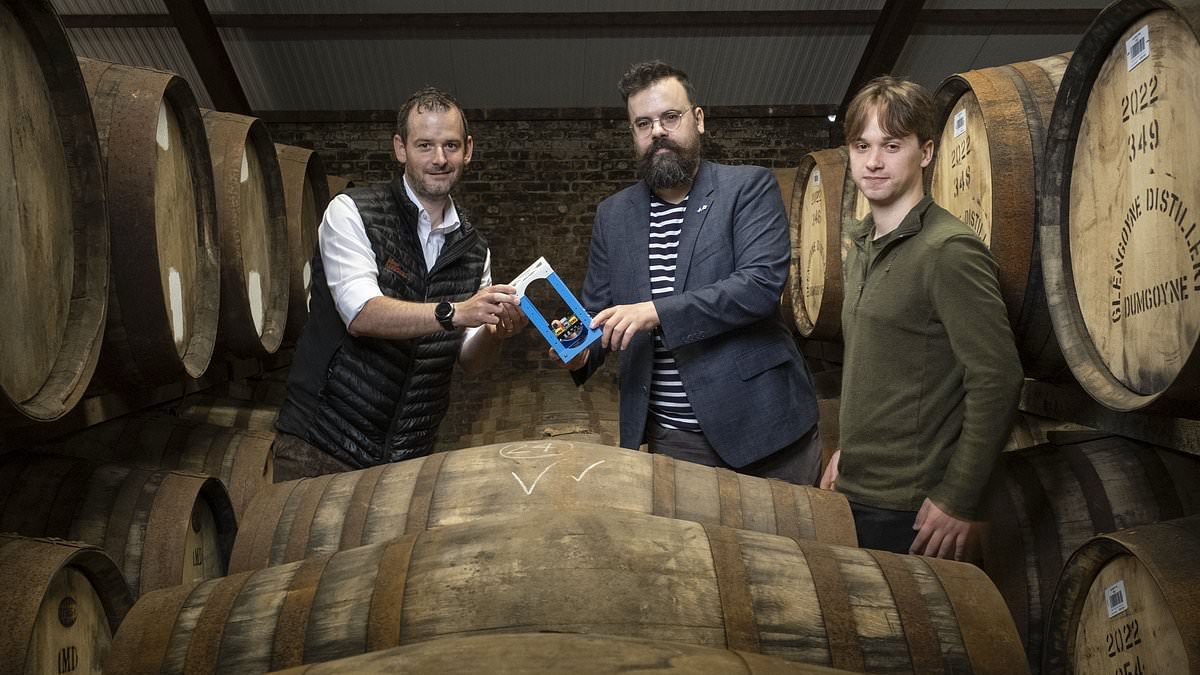
Published: 06:49 EDT, 5 October 2026 | Updated: 06:52 EDT, 5 October 2026 For centuries, whisky makers have relied on time, patience and oak casks to craft the perfect dram.Now scientists want to speed things up by doing something no distiller has ever attempted before – ageing Scotch in space.Scotland’s national drink will be aged in orbit for the first time as part of an experiment which will also measure how the spirit develops in the harsh environment beyond the Earth's atmosphere.Engineers in Scotland and Japan are planning to put Scotch on a rocket in 2028, sending a satellite containing samples of whisky and its base ingredients on a five-year mission to orbit the Earth.It is hoped the frequent changes between extreme heat and freezing cold experienced by the whisky as it circles the planet every 90 minutes could speed up the maturation process.This could potentially open the door to future production of space-aged whisky, which scientists say could have ‘very bold’ flavours as a result of its unusual journey. Researchers from the University of Glasgow (pictured) want to send whisky into space to see if it can improve the flavour of Scotland's national drinkWhile space-aged whisky would command astronomical prices due to the cost of launching and recovering the liquid, collectors are already known to pay hundreds of thousands for some of the rarest bottles.Dr Gilles Bailet, from the University of Glasgow, said a number of students have travelled from Scotland to Japan to help to co-design the ‘cubesat’ which will contain the tiny whisky samples and ingredients.‘We want to see what the effect of a space environment is on the aging of the whisky,’ he said.‘We’ve got the best people here in Scotland to be able to inform that, with centuries of experience, so we can bring this whisky experience into space.’The current plan for the whisky experiment – nicknamed ‘Space Puffin’ – is to launch the cubesat in 2028 on a SpaceX supply mission to the International Space Station (ISS), before deploying it into orbit from the Japanese module of the space station.The science around the process of whisky ‘breathing’ as it ages in wooden casks is not well understood, Dr Bailet said, but the cycles could happen much faster in space – where temperatures can quickly vary between minus 150°C to 200°C.‘We build our spacecraft to be able to get an environment which is better for the whisky, but this wood will breathe faster than on Earth,’ he explained.‘And so we are hoping that we’ll be able to accelerate the ageing to be able to get something more interesting.’ Engineers are planning to put Scotch on a rocket in 2028, sending a satellite containing samples of whisky and its base ingredients on a five-year mission to orbit the Earth The current plan for the whisky experiment – nicknamed ‘Space Puffin’ – is to launch the cubesat (pictured) in 2028 on a SpaceX supply mission to the International Space Station, before deploying it into orbit from the Japanese module of the space stationOn Earth, whisky is produced by mixing barley with water and yeast. Yeast breaks down the sugars in the barley, creating ethanol as a by-product.The whisky on the cubesat will be monitored while it is in space, feeding data on its colour and chemical composition back to scientists on the ground.While the cubesat will not be recovered at the end of its five-year mission, Dr Bailet said he is keen to scale up whisky maturation in space and develop a system for launching Scotch into space and landing it on Earth after maturation.He said: ‘We are really keen to be able to actually fly a full whisky-making system, with a full cask, if we’re able to collaborate with investors or other people interested about it.‘But it’s totally in the realm of possible to bring back something like a litre of whisky within the next three to five years.’He hopes this process would produce ‘really bold whiskies’ with ‘extremely complex flavour profiles’.While whisky has previously been into space as part of an experiment to understand flavour, it did not leave the temperature-controlled confines of the ISS.Different distilleries in Scotland and Japan are expected to contribute the whisky, though these have not been chosen yet.
One small sip for man: Scientists plan to blast Scotch whisky into space for five years to create a 'bolder' flavour
Full Article
Original Source
Read the full article at Dailymail →KhanList aggregates and links to publicly available news content. We do not host full articles from third-party sources. Always verify important information with original sources.