
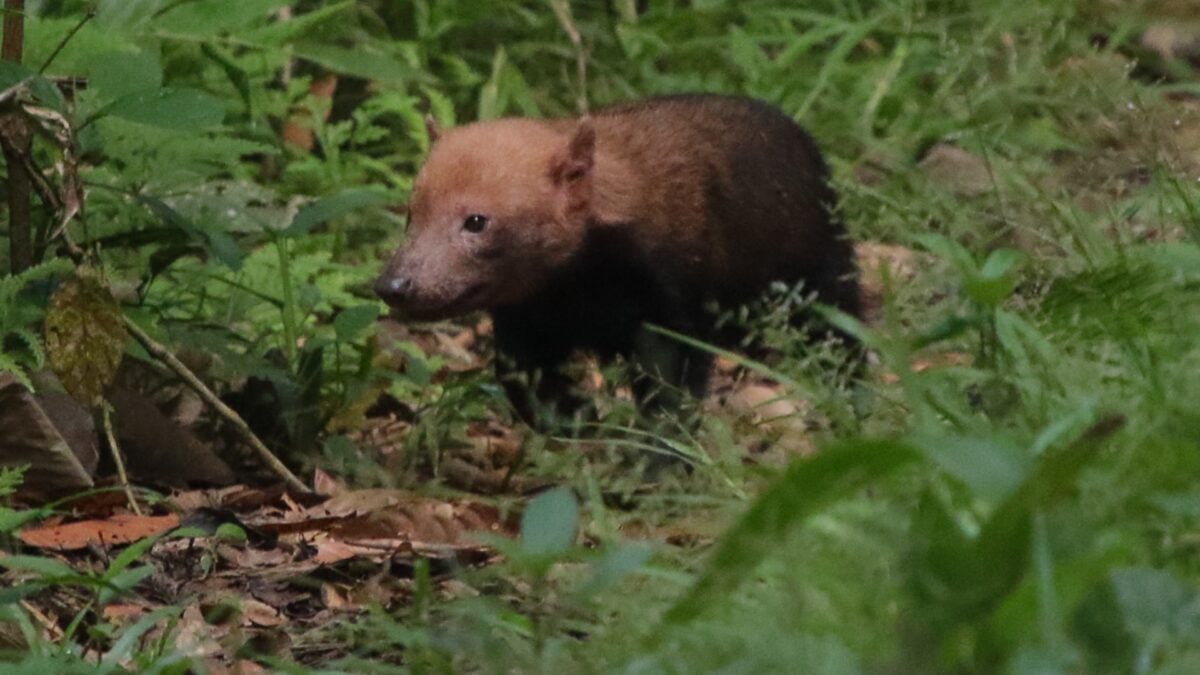
South and Central America’s bush dog (Speothos venaticus) is almost cryptid-level rare. Sightings are so rare, in fact, that the man who first identified the bush dog from the bones he uncovered inside Brazilian caves, 19th century Danish paleontologist Peter Wilhelm Lund, simply presumed that he’d found the fossils of a new extinct canine. Now—thanks to 25 years’ worth of camera-trap data recorded at 97 sites across seven different South American countries—wildlife biologists have a better sense of just how exceedingly rare the endearing, roughly 15-pound (7-kilogram) little bush dog really is. The answer is incredibly rare. Across over 2.1 million photographs snapped over 611,159 local “camera-trap nights,” according to researchers with the international Wildlife Conservation Society (WCS), the pint-sized S. venaticus appeared on just 12 occasions at 12 sites. That curious lack of on-site repeats speaks to the bush dog’s sprawling range, from Costa Rica down to the northeastern reaches of Argentina. Robert Wallace, a senior conservation scientist at WCS, and his colleagues said that they compared the bush dog sightings to other images from these camera-traps that recorded other similarly “widely distributed” South American carnivores for better context. “Relative abundance indices for bush dogs were approximately 50 times lower than those of the short-eared dog Atelocynus microtis, 100 times lower than those of jaguar Panthera onca, and nearly 280 times lower than those of ocelot Leopardus pardalis,” Wallace’s team wrote in the journal Canid Biology & Conservation. You are 50 times more likely to see A. microtis, in other words, a wild dog so rare it’s been dubbed the “ghost dog,” than to catch a glimpse of a bush dog in the wild. A night vision image of the ultra-rare bush dog, Speothos venaticus, from one of the 97 camera-trap sites examined by conservationists for the new study. Credit: Guido Ayala and Maria E. Viscarra / WCS Roving in packs One of the funny things about the bush dog is that, despite its arcane obscurity, it’s surprisingly mild-mannered. One 1996 study described them as “compulsively sociable,” sharing food between one another with “minimal aggression,” sleeping in close contact, and traveling together in orderly single file. And the rare captive bush dogs seem pretty happy in zoos. Based on Wallace and his colleagues’ calculations, bush dogs likely occur at well below one individual per 39 square miles (100 square kilometers) across much of their range. But that combination of rarity and cozy pack dynamics, they fear, are key factors putting the animal at risk. “No detections were obtained in Paraguay, Peru, or Venezuela despite substantial sampling effort,” according to the study. Another of the dozen camera-trap images of the rare bush dog. Credit: Guido Ayala and Maria E. Viscarra / WCS Sick as a dog The bush dog has merely been listed as “near threatened” on the IUCN Red List since it was first assessed by the international group in 2011. But Wallace and his WCS coauthors argue that their new evidence “helps support reassessment of the species’ conservation status.” Small intimate bands of bush dogs, they noted, are at a “particularly high risk in landscapes increasingly influenced by roads, human settlements, hunting camps, and extractive activities” across the Amazon. Domestic dogs (Canis familiaris) brought into these settings by hunters, loggers, or really anyone else, could transmit diseases like canine distemper virus, parvovirus, or rabies that could then quickly spread amongst the pack. “Even sporadic exposure could lead to local population collapse in small, isolated, or fragmented populations,” the researchers warned. So, frankly, it’d be nice if these bush dogs were protected and if Peter Lund’s old educated guess back in 1839 that the dog was extinct stays incorrect for as long as humanly possible.
One of the World’s Rarest Wild Dogs Is Even Rarer Than Scientists Thought
Full Article
Original Source
Read the full article at Gizmodo →KhanList aggregates and links to publicly available news content. We do not host full articles from third-party sources. Always verify important information with original sources.