
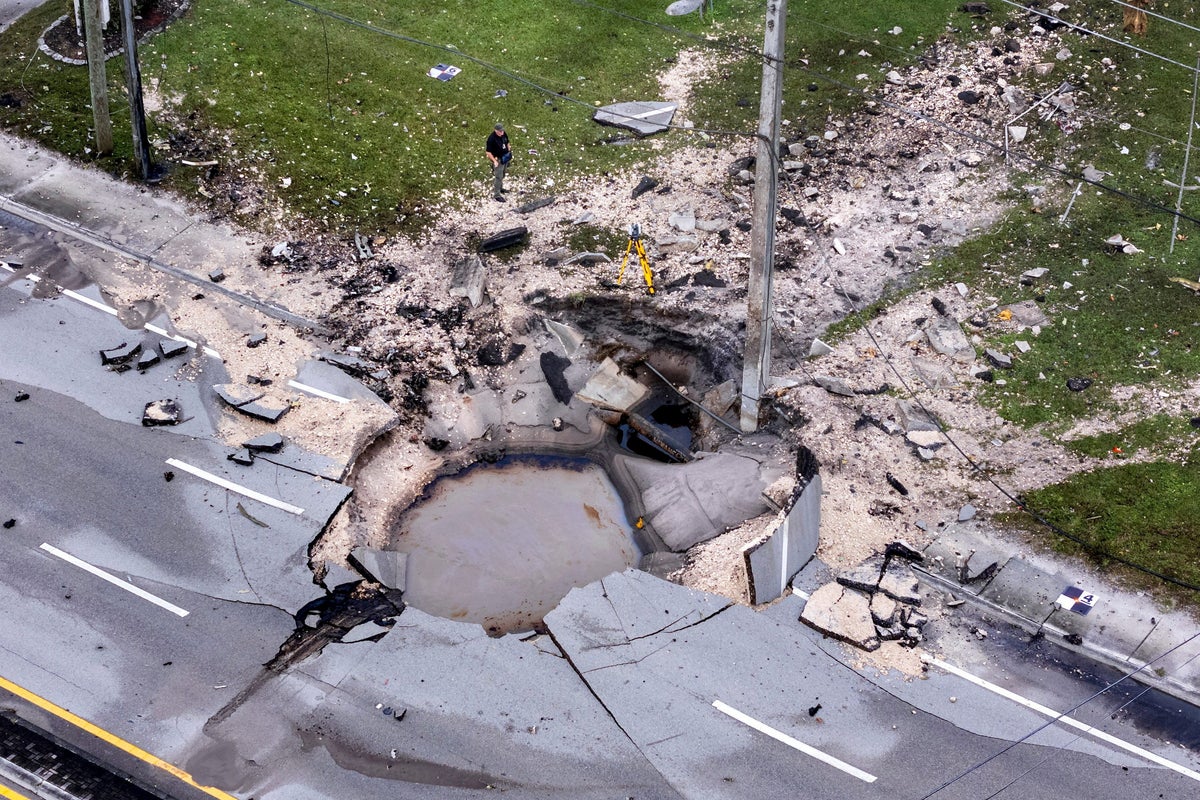
It will likely take more than a year to determine the exact cause of the Learjet 60 that plummeted from the sky in Florida and killed nine people. The business plane, which was heading to the Bahamas, crashed on Sunday 1 November at approximately 12.50pm local time after encountering a thunderstorm. It slammed into the ground with such force it created a crater and shattered the aircraft – with parts being found up to 3.8 miles away from the site. Dramatic videos from witnesses, and chilling radio transmissions, will provide important clues for investigators who are just at the beginning of determining exactly what happened.“Our mission is to understand not just what happened, but why it happened, and to recommend changes to prevent it from happening again,” said Tom Chapman, a member of the National Transportation Safety Board, which is leading the investigation.The crash caused a huge crater in the ground (Reuters)An NTSB team will spend days collecting every piece of the plane they can find surrounding the crash site. Investigators said Tuesday that pieces of a key part of the tail called the elevator that controls the angle of the nose were found more than a mile away from the main crater. This supports the theory that the plane had started to break apart before impact.Investigators are also searching for the Learjet’s cockpit voice recorder as it could provide useful details about what the pilots were talking about as they lost control of the plane after it encountered turbulence and ice started to build up on the wings.“That will be very important data,” Chapman said. “Without it, our folks are very, very good. We’re still able to do some incredible detective work and determine how things transpired.”The co-pilot told air traffic controllers that the plane was being thrown up and down more than 213 metres as she asked them for a better route through the area. It is not yet clear why the pilots hadn’t chosen to fly around the storms.Florida’s rain weather is making the investigation even more challenging (Reuters)Torrential rains over the state in recent weeks are making the investigation even more difficult. The crater was filling with rainwater that likely left some pieces of the plane submerged, and a utility pole had to be removed.The initial NTSB investigation will take around a month. During this time, experts will develop a preliminary report describing what happened.This is no easy feat as a fire caused from the crash destroyed much of the plane.Investigators will be trying to clarify whether pilots knew that the storm was happening, and what the plane’s weather radar showed.The weather will be a key early focus of the investigation, and will see NTSB work with the National Weather Service and Federal Aviation Administration to get a better idea of what the plane encountered as it was cruising at 35,000 feet.Investigations on this scale can take more than 18 months (Reuters)Maintenance records of the plane will also be reviewed to check whether the aircraft had any previous issues. Officials at the Upper Jets company that operated the flight as well as air traffic controllers and people who work at the Texas airport the plane took off from will be interviewed.In certain high-profile crashes, the NTSB may also hold several days of investigative hearings where investigators can question key people involved to learn more and share details with the public as they did after last year's UPS plane crash.However, it generally takes 12-18 months for the NTSB to complete a crash investigation – meaning it will be a while until the mystery is solved. This process can take longer in complicated casesFinal reports will include details about what happened and explain probable causes, alongside recommendations to prevent similar crashes and improve safety.
One missing clue that could help investigators determine cause of Florida Learjet crash that killed 9
Full Article
Original Source
Read the full article at Independent →KhanList aggregates and links to publicly available news content. We do not host full articles from third-party sources. Always verify important information with original sources.