
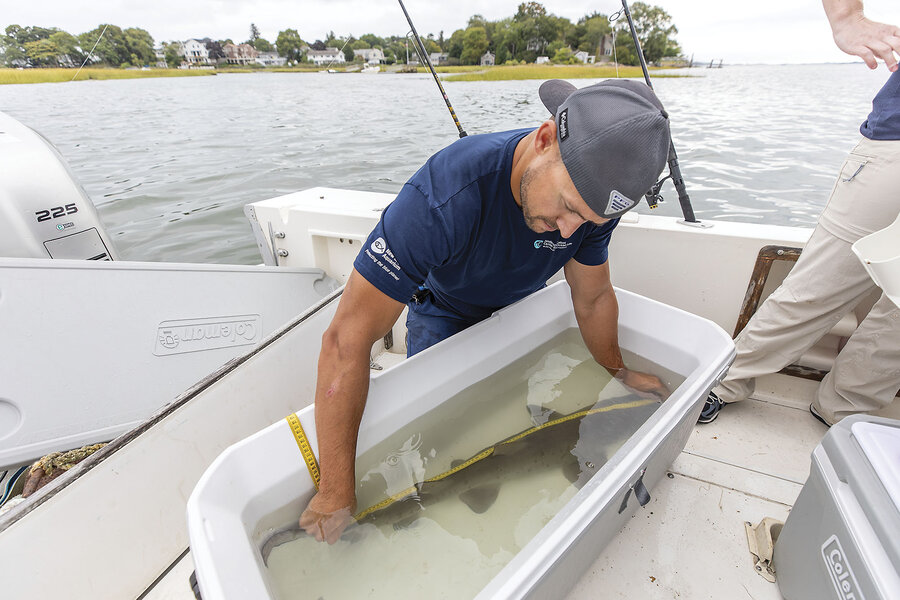
Quincy, Mass. | Oct. 20, 2026, 12:08 p.m. ET | 5 min read It’s a warm September day, one of summer’s last gasps, when Ryan Knotek drops anchor in a quiet inlet of Quincy Bay. The New England Aquarium research scientist cuts up frozen Atlantic menhaden, known locally as pogies, secures them to circle hooks attached to several fishing rods, and casts them into the shallow water. Now, it’s time to wait. The catch? Juvenile sand tiger sharks.Once fished to the brink of extinction globally, sand tiger sharks, that iconic aquarium shark with a jaw of protruding, jagged teeth that only a mother could love, have been increasing in the Boston Harbor over the last decade. Here, sand tigers up to 4 years old and measuring between 3 and 5 feet long summer from July to September.It’s a remarkable success story, both for the species and the city. Not too long ago, Boston Harbor was condemned as the “dirtiest harbor in America,” with its shallowest areas widely considered ecologically dead. That was due to the hundreds of millions of gallons of raw sewage and industrial waste that were dumped into its waters every day for over a century. Today, after a lawsuit, decades of work, and a $4.5 billion cleanup effort, Boston Harbor has transformed into a flourishing ecosystem. “It’s not just sand tigers that are here more frequently,” adds Dr. Knotek. “It’s smooth dogfish, striped bass, bluefish, and winter flounder, too.” Scientists believe that warming ocean temperatures, an abundance of prey, and natural protection from predators have led the species to use the harbor as a nursery area. In the spring, the sharks travel north from their wintering and birthplace grounds in Florida and the Carolinas, arriving in the Boston Harbor around mid-July. As summer wraps up and fall creeps in, the sharks return south. Researchers at the aquarium have been tracking and tagging sand tigers in the area since 2016. The project hit a snag in 2020 with the COVID-19 pandemic, and was formally relaunched with additional fieldwork in 2023. That’s when Dr. Knotek and his colleague Emily Jones, both scientists at the aquarium’s Anderson Cabot Center for Ocean Life, took over. In the last decade, 39 juvenile sand tigers have been caught and tagged. Courtesy of Emily Jones/New England AquariumRyan Knotek (left) and Rachel Wieck reel in a juvenile sand tiger shark in Boston Harbor, Sept. 6, 2023. Despite appearances, sand tiger sharks are a placid species that don’t pose a threat to humans. While the adults aren’t much to look at, the young ones are quite beautiful, says Ms. Jones, who is also the director of scientific operations at the center. Their light brown or gray bodies are dusted with large freckles, presumably for camouflaging, and their fins are edged in black, as if nature took a Sharpie to outline them. “The juveniles are really handsome. I think the adults look kind of gnarly,” she says, laughing.The sharks can be found in coastal waters around the world, but in the United States, they’re concentrated along the Atlantic and Gulf coasts. Between the 1970s and 1990s, the species was intensely overfished by both commercial and recreational fisheries. This decimated between 70% and 90% of their population, says Dr. Knotek. To further complicate matters, sand tiger sharks also have one of the lowest reproductive rates among sharks, with females typically only producing one or two pups every few years.While the species is listed globally as critically endangered by the International Union for Conservation of Nature, “that’s certainly not the case in the northeast U.S.,” says Ms. Jones. The species has been rebounding, in part, thanks to federal protections enacted in 1997 by the National Oceanic and Atmospheric Administration (NOAA), which make it illegal to catch, sell, or purchase the species in U.S. Atlantic waters. Massachusetts followed suit at the state level in 2009. “Historically, they were noted up here, but they weren’t ever considered common,” says Dr. Knotek. “It’s a conservation success story. We’re actually seeing the results of proper management.” Asia London PalombaRyan Knotek, a research scientist at the New England Aquarium’s Anderson Cabot Center for Ocean Life, displays on his cellphone the underwater receivers spread across Boston Harbor, in Quincy Bay, Massachusetts, Sept. 16, 2026. Still, the trudge toward population recovery is slow. The species is expected to be recovering at a rate of about 1% to 2% per year. “Their unique biology sort of limits their ability to rebound,” adds Dr. Knotek. And while the species can’t legally be harvested anymore, they’re still occasionally swept up in gill nets and trawls, which could be contributing to their slow recovery.That’s why the work to tag the summering population of sand tigers in Boston Harbor is so important. The inlet in Quincy Bay is, as Dr. Knotek puts it, the “sand tiger sweet spot.” The area, sheltered and abundant in prey, is perhaps the most “Boston” location you can find.Viewed from the water close to shore, the Squantum Marshes stretch to the right, the city’s skyline rising behind them in the distance. Directly ahead is an outcrop of rocks where the chief of the Moswetuset tribe held meetings in the 17th century, and behind it on shore is a Dunkin’ Donuts.Data shows that the sharks spend 70% of their time in this corner of the harbor. Sometimes, individual sharks will return to the same spot, year after year. One specific shark has been returning every year since it was first tagged in 2023.“The fact that it left the harbor, went back to South Carolina or Florida, came back, and did that twice and found the exact same spot, is insane,” explains Dr. Knotek. Waiting for a shark to nibble on the line can be an hourslong affair. Ms. Jones and Dr. Knotek pass the time by chatting, snacking, and listening to Taylor Swift and KPop Demon Hunters blare over a hand-held speaker. They’re both adamant that music improves their chances of catching a sand tiger.Once a shark is hooked, the team brings it on deck and places it in a large cooler filled with seawater. Then the scientists flip the shark onto its back and tag it with a black acoustic transmitter. This allows them to track the shark for the next five years, collecting data on it every time it swims close to one of the several underwater receivers they have placed across the harbor and along the Eastern Seaboard. The shark is then released back into the water. The entire process typically takes less than 10 minutes.The scientists are aiming to collect enough data to identify patterns in the sharks’ movements as they navigate potential environmental impacts of summering in a busy metropolitan area. Deepen your worldviewwith Monitor Highlights.Politics with respectGet political stories with respectful analysis.There‘s a world of new ideas in everyBooks newsletter.There‘s more to life, enrich yours withCulture & Learning weekly.Follow humanity‘s discoveries withScience & Nature stories in your inbox.Gain a spiritual perspectivefrom the stories in your inbox.Want to understand the deeper impact of critical events? Learn the Monitor‘s insight.Already a subscriber? Log in to hide ads. The ultimate goal, however, is to accumulate enough data to present to NOAA so that Boston Harbor is designated as an essential fish habitat for the species. “Our hope is that it’s recognized as this important nursery ground,” adds Dr. Knotek.For now, the team will continue venturing out to Quincy Bay every summer, ready to welcome old and new generations of sand tiger sharks to Boston Harbor. ALREADY A SUBSCRIBER? LoginReal news can be honest, hopeful, credible, constructive.The Christian Science Monitor was founded in 1908 to lift the standard of journalism and uplift humanity. We aim to “speak the truth in love.” Our goal is not to tell you what to think, but to give you the essential knowledge and understanding to come to your own intelligent conclusions. Join us in this mission by subscribing.
Once on the brink of extinction, sand tiger sharks are rebounding in Boston Harbor
Full Article
Original Source
Read the full article at Csmonitor →KhanList aggregates and links to publicly available news content. We do not host full articles from third-party sources. Always verify important information with original sources.