
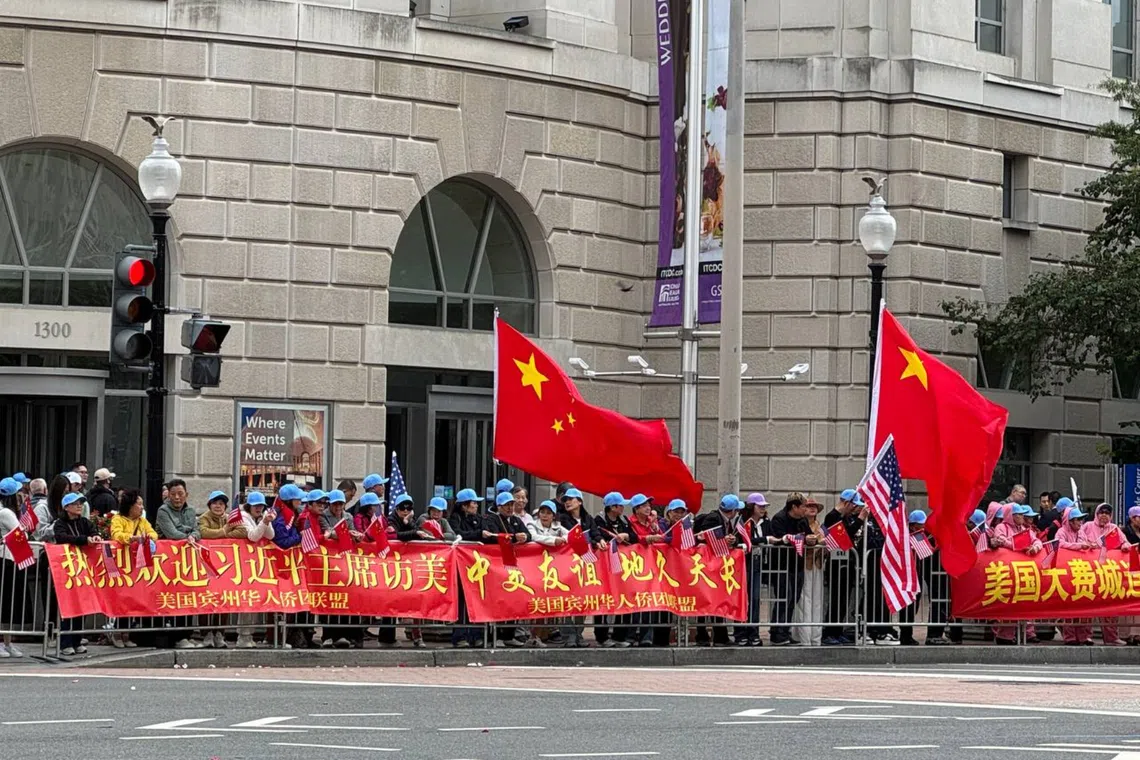
WASHINGTON – Supporters cheering and waving Chinese and American flags lined the streets near the Waldorf Astoria on Sept 23 evening (Washington time), as Chinese President Xi Jinping arrived in the US capital for a closely watched summit with US President Donald Trump. Earlier in the day, groups of Chinese supporters had gathered in cafes and sidewalks around the hotel where Xi is staying, carrying stacks of flags and banners as they waited for Xi’s arrival. Among the supporters was He Xiuzhu, 55, a nurse who travelled to the US capital with a group of supporters from New York City where they departed at 6am. “I have an American green card now but I’m a Chinese so of course I’m very excited to see Xi Da Da,” said He, using a term that means “Daddy Xi” to refer to the Chinese President. She said her group will stay till Sept 25 to see Xi off. American retired wealth manager Larry Van Laningham, 75, who was on vacation with his wife, was taking photos of the supporters. “China is a competitor to us and we’re a competitor to them. But at least today, the Chinese have got the Chinese and American flags side by side and talking about friendship with the US so that’s a positive thing,” he said. Protesters were also out in force, turning parts of downtown Washington into competing displays of support and opposition after two days of relatively subdued days in the run-up to the visit. Xi is in the US from Sept 23 to 25 for his second state visit after 11 years and his second summit with Trump this year following their meeting in Beijing in May. On Sept 23, Trump personally greeted Xi and his wife Peng Liyuan at Joint Base Andrews, just outside Washington, marking a rare departure from diplomatic protocol. Sitting US presidents typically receive visiting heads of state at the White House rather than welcoming them at the military airfield. It is also an upgrade from the reception Trump received in China when he arrived in Beijing in May, when Air Force One was greeted not by Xi but by Vice-President Han Zheng, who ranks eighth in the party hierarchy.The Trump-Xi summit will take place at the White House on Sept 24, followed by a state dinner attended by prominent US tech and finance chiefs including Nvidia’s Jensen Huang, Tesla’s Elon Musk and Apple’s Tim Cook. It remains unclear whether any Chinese business leaders will attend the dinner. Just as Xi arrived in the US capital, US Treasury Scott Bessent said that Washington and Beijing have agreed to a two-month extension of the trade truce which was due to expire on Nov 10. The two leaders are expected to discuss a wide range of issues including artificial intelligence, Taiwan and Iran, although expectations for concrete deliverables remain low. On Sept 25, Trump and First Lady Melania Trump will host Xi and his wife for tea before visiting the National Archives, where they will view US founding documents as the US celebrates the 250th anniversary of its independence. Xi and his wife will then depart the US later that day. The two leaders could meet again two more times later this year at the Asia-Pacific Economic Cooperation (APEC) summit in Shenzhen in November and the G20 summit in Miami in December. Yet amid the competing chants and flags and tightened security in Washington, conversations with ordinary Americans and members of the Chinese diaspora paint a more complicated picture of attitudes towards China, ranging from curiosity and pragmatism to anxiety over how worsening ties between the world’s two largest economies could affect their everyday lives. Michael Haines, a 22-year-old valet working in Washington’s Chinatown, told The Straits Times he was not aware that Xi was visiting the capital but his curiosity about Chinese technology and Chinamaxxing had piqued from the videos on his social media feed. He was particularly amused by videos of China’s humanoid robots running during the “humanoid Olympics” games in Beijing.“But you know, it’s all fun and games until these robots become advanced enough to be used in warfare, then we’re in big trouble,” he said.He said his impression of China was mixed: “I’m not fundamentally opposed to using Chinese technology or buying Chinese goods from Temu, but I’ve also heard of child labour practices and pollution, so I’m not too sure about supporting that.”His relatively open view of China is more common among younger Americans than older generations, according to a Pew Research Center survey conducted from Sept 14 to 20 and published on Sept 23. The survey found that younger Americans rate China more warmly than older Americans. However, younger Americans are still more likely to view China negatively than positively, but the gap was narrower with 47 per cent of under-50s giving China a “cold” rating, compared with 61 per cent of older Americans.Overall, Americans’ views of China have also warmed from a low point in 2021, although they remain more negative than positive.Bobby Criss, a street vendor selling Make America Great Again hats for $15 (S$19) each, told ST he had specifically picked the days around Xi’s visit to hawk his goods to tourists and curious bystanders near the White House. He had already made $100 in the first hour after setting up shop, he said. A group of Vietnamese tourists bought the hats when ST was interviewing him, saying that it was for souvenir purposes and not because they support Trump. “I don’t know what’s going to happen when they meet but I’m confident Trump is going to get a deal. He always gets a deal,” said Criss, 60, who described himself as a long-time Trump supporter. “We ain’t going to worry about China; they’re not our adversary, not even close. Half the country is still riding a bicycle. We’re Americans, we don’t worry about nobody,” he said. For Chinese-born Yu Miao, owner of bilingual bookstore JF Books in Washington’s Dupoint Circle, changes in the US-China relationship carry a more personal concern that tensions between the two countries might lead to greater suspicion of Chinese people living in America. Yu previously ran Jifeng Bookstore in Shanghai, which closed in 2018 after years of increasing government pressure and restrictions on the space.He chalked it up to the bookstore’s hosting of public discussions on topics such as exploring life and death through philosophy and religion, which were deemed inappropriate or sensitive by the Chinese authorities.“Even though our own experience shows that we left China because we were yearning for freedom, if the broader policy and social environment in the US becomes more wary of Chinese people, that creates an invisible pressure on us,” he said.“You cannot explain your values to every person you meet. So we worry that if government policies or the wider environment become unfavourable towards minorities, including Chinese people, there could be unpredictable consequences for our everyday work and lives,” he said. While Xi and Trump discuss a trade truce extension, AI and how to maintain what both sides have termed “constructive strategic stability”, at least one long-time Chinese American immigrant in Washington’s Chinatown has a more immediate hope: that the presidential visit brings more diners through the door. For Alex Wong, 60, a Chinese Malaysian-born American who has lived in Washington for more than two decades, the summit is less about grand strategy than about whether it will give a boost to a Chinatown he has watched steadily hollow out.“There are hardly any Chinese people in Chinatown now. Even the Chinese restaurants along the street have become fewer,” said Wong, who works in a newly opened Vietnamese-Chinese restaurant in Chinatown. He said the Chinese residents in the Washington area are now scattered across the wider metropolitan region, but they will be back in downtown DC for at least the three days that Xi is in the capital. “Whether they’re here to support or to protest, they still need to eat so there’s more hope for business, right?” he said.
On the ground in Washington, Americans ask what Trump-Xi summit means for everyday life
Full Article
Original Source
Read the full article at Straitstimes →KhanList aggregates and links to publicly available news content. We do not host full articles from third-party sources. Always verify important information with original sources.