
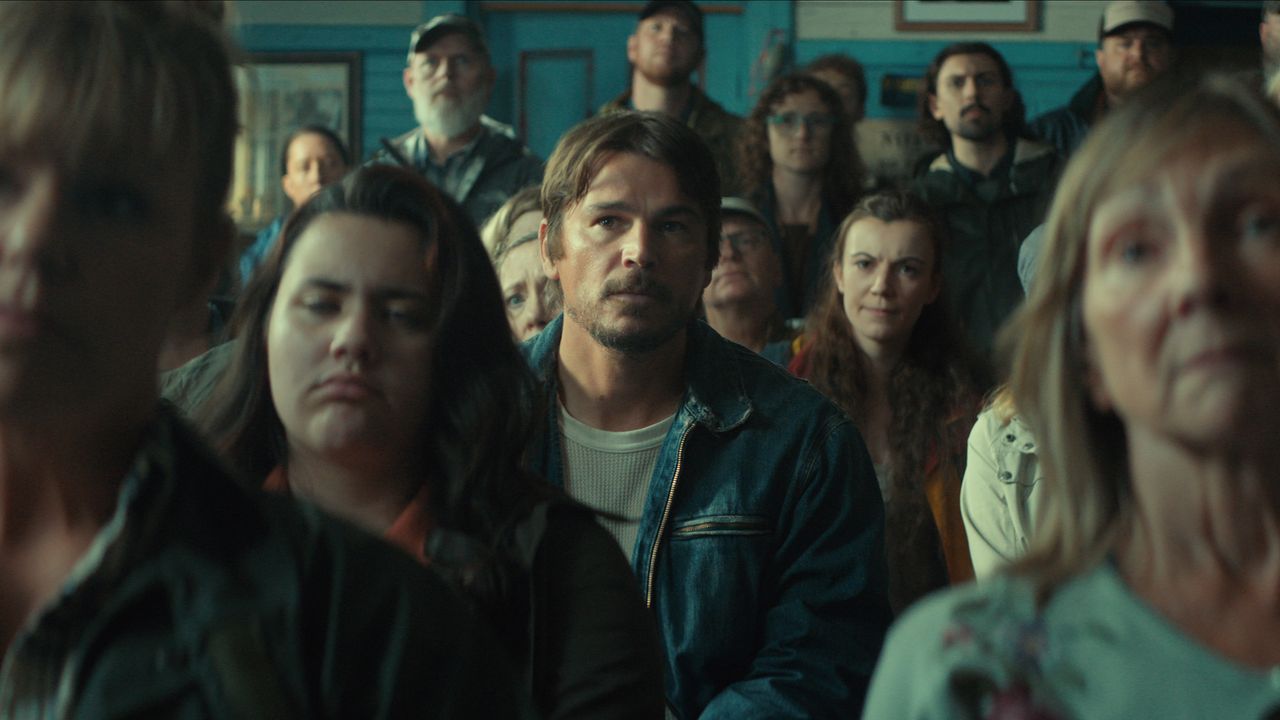
A mysterious sea creature is captivating audiences on Netflix as the Josh Hartnett-led series Below remains the No. 1 show in Netflix’s global rankings. The six-episode thriller paints an eerie image of small-town life in Newfoundland, and viewers are intrigued by the mystique of the striking Canadian backdrop.Despite the fictional giant squid terrorizing Snook’s Arm, the show pulls on elements of reality, from climate change affecting the Atlantic Canadian sea life to the government-run resettling of remote fishing towns, which started in 1954 and continues to this day. It’s that history that drew production designer Emmanuel Fréchette into the project.“When I found out that more than 300 towns in Newfoundland had been resettled, I was amazed,” he tells Traveler. “The script is very interesting, mixing that reality with the mundane life in Newfoundland—and this creature!” After all, creator Jesse McKeown (The Umbrella Academy) had frequented the region for years, inspired to bring an authentic depiction of its culture to the screen.BELOW. Charlie Heaton as Wade in episode 101 of Below. Cr. Jan Thijs/Netflix© 2025Jan ThijsThat started behind the scenes as the cast and crew engaged in Newfoundland and Labrador’s most famous tradition. Visitors, who they called CFAs (or Come from Aways—this is also where Broadway hit musical draws its name), get “screeched in” by kissing a cod to become honorary citizens. So they all went to St. John’s Christian’s Pub to pucker up. “The guy there is such a great character, and he has a routine and speech that’s very entertaining," Fréchette says.When it came to filming locations, the remote regions posed practical challenges, so the majority of the sets were built by production, a joy for Fréchette, who was trained as an architect. “I was stunned by the humble architecture, built by boat owners and builders,” he says of the homes’ low ceilings. “The structures are very endearing and make you think of a boat, so I wanted to follow that thread.”That’s also what helped root the fantastical storyline into reality. “This was vernacular architecture—architecture without architects—just following the needs of the people out of survival, and I found that so beautiful,” he says. “So I really tried to mimic what I was seeing all around me that survived the decades.”And it’s clearly had an effect on audiences. According to data provided by Booking.com, not only have searches for the province’s capital of St. John’s risen 16.9% by Americans on the platform compared to last year, but the coastal town of Twillingate, home to the floating icebergs, has skyrocketed 123.7%.Here, Fréchette shares the filming locations from the popular Netflix series Below.BELOW. Willow Kean as Ruth in episode 104 of Below. Cr. Courtesy of Netflix© 2026Courtesy of NetflixBrigus SouthThe show is set in the actual resettled town of Snook’s Arm, which had a population of 10 when it was approved for resettlement in 2017, according to the CBC. But its remote location would have been difficult to film in with such a big crew, so Brigus South—a town with a population of about 700 at last count in 2021—stood in.“We picked that place because it had a connection with the water,” Fréchette says of the inlet going deep into the land. “Lots of the characters are dragged into the water, so it was great to have this presence for the eeriness.”But to get the cozy town ready for its close-up took work, as the crew designed and built about 80% of what appears in the series, including the fish plant, Fishermen’s Hall, and wharf. The Penneys home was an existing home they covered, and the church was also a house that they retrofitted, adding the bell tower.Courtesy of NetflixTwillingateWhen Fréchette was scouting locations, he stayed in a hostel by the sea in Twillingate, about 275 miles northwest of the capital. “We’d be having a coffee with the window open, and suddenly we were freezing,” he recalls of a sudden drop in temperature from 68 degrees Fahrenheit to 50 degrees Fahrenheit. That’s when they’d look up and see an iceberg floating their way. “It lowers the temperature all around the bay—it’s such an amazing phenomenon.”As it turns out, the Atlantic town sits along Iceberg Alley, where from late April through July, the remnants of broken glaciers glide down the coast. Many of the shots of Calvin (Hartnett) harvesting icebergs were actual footage from these massive blocks of ice naturally floating along.BELOW. (L to R) Josh Hartnett as Calvin and Mackenzie Davis as Fonda in episode 101 of Below. Cr. Courtesy of Netflix© 2026Courtesy of NetflixSt. John’sThe capital served as the home base for the cast and crew, who were spread out across hotels and home rentals during filming. But its Ocean Sciences Centre, about 30 minutes north of downtown, found the spotlight as one of the most striking structures in the series, the marine research center where Dr. Fonda Howander (Mackenzie Davis) worked.While Fréchette admits it took some work to convince the operating facility to shoot there, he’s excited it worked out because “it really adds production value and is a great location.” After all, the circular wooden structure reflects that government building architect of the 1960s and early 1970s, “at a time we were dreaming and imagining things beyond what was possible to build today.” Reminiscent of designs by Canadian architects like Arthur Erikson, he adds that “it was ambitious, but it had a vision—and is fantastic!”BELOW. (L to R) Rohan Campbell as Jay Penney, Ruby Stokes as Mary, Willow Kean as Ruth and Mackenzie Davis as Fonda Lee in episode 105 of Below. Cr. Courtesy of Netflix© 2026Courtesy of NetflixPouch CoveAbout 20 miles north of St. John’s at the top of the Avalon Peninsula sits Pouch Cove, a town of about 2,000 residents. The art director told Fréchette about the Pouch Cove Heritage Society, a historical building that was closed since they were fundraising to preserve it, so one weekend, they went up to visit. “The floor was sunken in and it was structurally unsafe,” he says.The show’s head carpenter and engineer got to work, fixing it up, temporarily transforming it into the interior of Below’s Fisherman’s Hall, while permanently restoring it for the community. “It was a win-win because they were happy to get the money from the location, but also the work we did on it was helpful for them.”Biscayne CoveWhen Calvin returns to his abandoned childhood town of Little Pot Rock, that dilapidated setting was an actual resettled town, about a 30-minute drive down from Pouch Cove on a dirt road that the production had to grade in order to shoot there.“It was quite tricky, but just stunning—really wild and rugged,” Fréchette says, calling it “the most amazing location.” All that was there was one tiny house, about 12 by 20 feet, but it never showed up on camera. Instead, the production custom built all of the Budgell family’s dwellings. But the area can be visited as part of a 4.3-mile hike along the East Coast Trail.BELOW. Charlie Heaton as Wade in episode 101 of Below. Cr. Courtesy of Netflix© 2026Courtesy of NetflixBay BullsThe fishing village of Bay Bulls is home to North America’s largest Atlantic puffin colony, as well as a prime whale watching destination. But for Below, it was all about the functional purpose of its Pennecon Marine Base. Though it never shows up on screen, its industrial harbor was essential in order to dock the boat used as the research vessel since it had a draft (depth) of nearly 10 feet, and they needed an appropriate spot that the cast and crew could board. Also shot here were the exterior scenes of the submersible, which was hung from the boat by a crane and lifted onto the dock.BrigusPittman’s fish farm played an integral part of the plot, as Calvin confirmed that the sea creature was real—but it turns out the location was landlocked. “It was very complicated to do this on the sea because we’d have to deal with tides and storms, so we decided to cheat it on a lake in Brigus,” he says of the town that’s actually about 60 miles northwest from Brigus South. There was no actual fish farm there, so they custom-built the floating dock and cabin.BELOW. (L to R) Rohan Campbell as Jay Penney, Kaleb Horn as Noah, and Ruby Stokes as Mary in episode 101 of Below. Cr. Jan Thijs/Netflix© 2025Jan ThijsHarbour MainWhile the outside of Linda’s Bar was filmed using a retrofitted Brigus South home, the interior was actually the Rising Tide Convenience shop in the town of Harbour Main, about 33 miles southwest of St. John’s. The local business, best known for its homemade ice cream, “looked great inside, so we dressed it up,” Fréchette says, taking extra care to ensure the exterior entrance they built flowed seamlessly between cuts. As for Noah (Kaleb Horn)’s on-screen screech-in? That was a prop, but an actual frozen fish to ensure the fish kiss was genuine.
On Location: How Coastal Newfoundland Set the Scene for Netflix's No. 1 Series ‘Below’
Full Article
Original Source
Read the full article at Cntraveler →KhanList aggregates and links to publicly available news content. We do not host full articles from third-party sources. Always verify important information with original sources.