
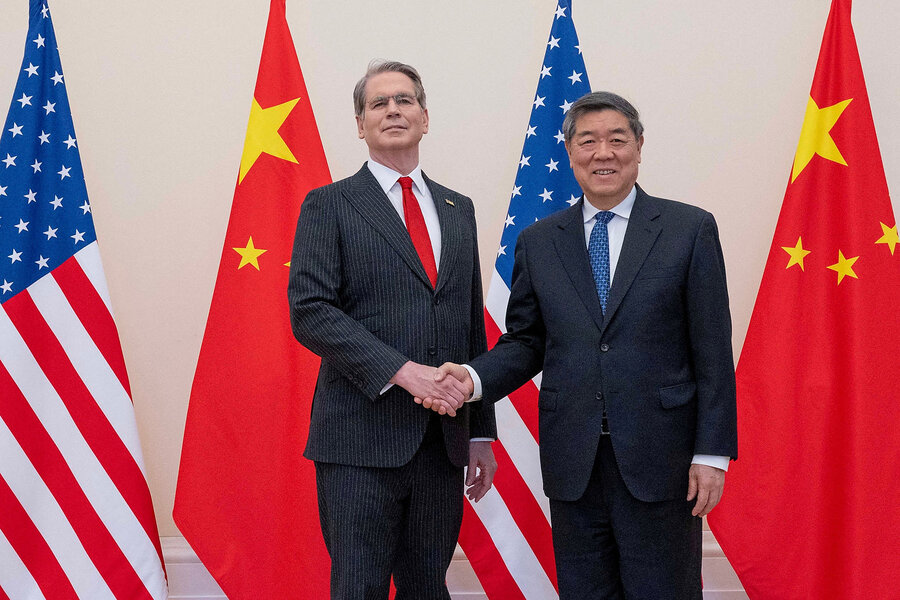
Since long before he became president, Donald Trump has been all about “winning” – in business, on TV, in politics. Today, in his second White House tour, President Trump’s focus is on economic supremacy as he touts the United States’ status as No. 1 in the world.Enter the artificial intelligence revolution, and China’s rapidly rising capabilities as the globe’s No. 2 economic superpower. When Mr. Trump meets with Chinese leader Xi Jinping in Washington this week, AI will be a top focus amid warnings of its potential existential threat to humanity and growing calls for regulation.To that end, Mr. Trump announced Saturday the formation of an “AI Force,” modeled after the Space Force, and plans to appoint an “AI Czar,” who will oversee the growing sector. But the president also repeated his staunch opposition to government regulation of AI or a slowdown of its development – calling U.S. dominance in AI an economic imperative. “AI is the next Industrial Revolution, or Internet, but will be even larger and more impactful, possibly as much as 25% of our Country’s GDP,” the president wrote Saturday on Truth Social. “We are leading China, and the rest of the World, and I intend to keep it that way!”According to a recent United Nations report, the U.S. controls 75% of global computing power among the world’s top 500 AI supercomputers. China accounts for 15%.Mr. Trump’s resistance to using the power of government to place limits on AI has placed the U.S. at odds with most Western democracies, which have passed laws to protect rights and liberties. The European Union’s AI Act went into effect in 2024. Japan and South Korea are among the other advanced nations to impose regulatory frameworks. AI safety advocates also say state and federal officials have failed to enforce existing U.S. laws designed to protect the public. “Cyber attacks and many of the other current AI harms are already clearly against the law,” Arati Prabhakar, assistant to the president for science and technology under Joe Biden, posted on LinkedIn. “The humans and companies behind them must be held accountable.”In practice, the Trump administration’s approach to China is more nuanced, and it has long been amenable to dialogue. On Sunday, Treasury Secretary Scott Bessent and U.S. Trade Representative Jamieson Greer met with Chinese Vice Premier He Lifeng in New York City to discuss a range of issues, including AI, trade, rare earth minerals, and economic issues.Secretary Bessent told reporters after the meeting that the U.S. proposed a “notification mechanism” for AI incidents that could affect national security, according to the Associated Press.Still, potential for a comprehensive agreement with China on AI out of Thursday’s summit, or anytime soon, remains low, U.S.-China watchers say. More likely would be a joint Trump-Xi statement indicating they’re working together to address concerns about AI safety.“Over the very long term, you do need a deal,” says Chris McGuire, a senior fellow for China and emerging technologies at the Council on Foreign Relations. “The question is how you get [there].” Mr. McGuire, a former National Security Council official in the Biden administration, isn’t seeing the kind of behind-the-scenes work that would be needed for anything “big and substantive.” But he adds it’s important to have this dialogue.“You want to get to a deal that really makes sure the Chinese impose the kind of safety regulations that we think are necessary, and also one that doesn’t undercut U.S. leadership,” Mr. McGuire says. Evelyn Hockstein/ReutersPresident Donald Trump speaks during a meeting with travel executives, in the Oval Office, Sept. 2, 2026. Mr. Trump will meet with Chinese leader Xi Jinping this week. When Mr. Xi hosted Mr. Trump in Beijing in May – the first visit to China by a U.S. president in nearly a decade – no breakthroughs were announced. But Secretary Bessent, who accompanied the president on the trip, told CNBC afterward that the two countries had agreed to set up a protocol for guardrails on AI, aimed at ensuring nonstate actors don’t get hold of powerful AI models.Official contacts have continued. Earlier this month, in Asheville, North Carolina, Mr. Bessent interacted with Chinese officials when he hosted a Group of 20 ministerial meeting of the world’s largest economies.Within the Trump administration, debate over how to proceed on AI regulation has long simmered. In early June, the president signed an executive order establishing an “AI cybersecurity clearinghouse,” requesting voluntary collaboration with the tech industry on safety within 30 days before new AI models are released to the public. The order represented a pullback by the administration, which had originally planned a 90-day review period.Today, the stakes have only risen – dramatically so, after a young AI researcher, Jacob Coxon, warned on X that two major AI firms he had worked for, Anthropic and OpenAI, were “gambling with our lives.” His subsequent media blitz sparked a fierce national debate about AI and safety and spurred Anthropic CEO Dario Amodei to write an essay calling for an AI slowdown and government regulation. Sam Altman of OpenAI and Elon Musk of SpaceX agreed. Despite their statements, none of the corporate leaders has shown a willingness to pause the rapid pace of their own companies’ innovation, with each vying to show Wall Street they are the most technologically advanced.For his part, Mr. Trump, backed by venture capitalist and tech adviser David Sacks, has raged against calls to constrain AI.“The people that say AI is going to destroy the World, and that Data Centers are bad for your neighborhood, are the same people that said, just a short time ago, that the World would be extinguished by ‘Climate Change,’” the president wrote on Truth Social last week. “That HOAX never worked out for them, and now they’re on to the next one.”Michael Kratsios, the White House science and technology policy director, puts the onus on the AI frontier companies to police themselves.“Our position is, if you do believe that you’re developing a technology that is unsafe or you don’t want it out in the world, you can just stop it,” Mr. Kratsios said Sunday on Fox News. “You don’t need someone to force you to do that.” Jeff Chiu/APDemis Hassabis, the chief executive of Google DeepMind, speaks at a Google event in Mountain View, California, May 20, 2025. He has proposed a body modeled after financial regulators to test advanced artificial intelligence models before they are publicly released. It could be, some analysts say, that an international crisis sparked by AI could force a U.S.-China AI “deceleration” accord, just as the Cuban missile crisis of 1962 between the U.S. and the Soviet Union spurred the first major nuclear arms agreement of the Cold War, the Limited Test Ban Treaty of 1963.The Soviet analogy also raises questions about why the Trump administration decided last year to allow China to buy advanced chips from industry leader Nvidia. Critics have likened it to allowing American firms to sell uranium to the Kremlin while insisting that the U.S. remain ahead of Russia in the nuclear arms race. Others suggest that allowing such sales (while excluding the most advanced chips) reflects an interest in disincentivizing Chinese firms from developing alternatives. For now, experts say, Chinese industry remains far behind the U.S. in computing power. And while both nations have a vested interest in preventing catastrophic risk from AI, other incentives differ: The United States seeks to maintain its global dominance in AI, while China seeks to overtake the U.S. Beijing also sees a major political risk, with the minister of state security warning last week that American AI models could pose a threat to the rule of the Chinese Communist Party.“Many in the AI space are worried about what China would do if it had a clear lead in AI, and therefore think that we need to stay ahead,” Zack Cooper, an expert on U.S.-China strategic competition at the American Enterprise Institute, writes in an email.“It does not seem likely to me that China and the U.S. will agree to guardrails anytime soon since it would be almost impossible to do inspection and verification on AI labs,” Dr. Cooper adds. “As a result, I expect the Chinese will continue to press ahead, and the U.S. government will also want U.S. labs to push forward rapidly as a result.”For this week’s summit, the likeliest outcome, at least on AI, will be “talks about talks,” says Rana Mitter, the S.T. Lee Professor of U.S.-Asia Relations at the Harvard Kennedy School. Both sides need to figure out “who are the right people to start a negotiation about how AI might or might not be regulated.”Overall, Dr. Mitter is looking at what some call the “three T’s” to dominate: trade, Taiwan, and tech. But, he adds, there’s another “T” that’s absent and which they can work on: trust. Deepen your worldviewwith Monitor Highlights.Politics with respectGet political stories with respectful analysis.There‘s a world of new ideas in everyBooks newsletter.There‘s more to life, enrich yours withCulture & Learning weekly.Follow humanity‘s discoveries withScience & Nature stories in your inbox.Gain a spiritual perspectivefrom the stories in your inbox.Want to understand the deeper impact of critical events? Learn the Monitor‘s insight.Already a subscriber? Log in to hide ads. That’s been the case for at least the past 15 years, Dr. Mitter says. “It’s not just a Trump Two thing.”And lest there be any doubt about which country dominates globally on AI, Thursday’s state dinner at the White House for Mr. Xi will provide a reminder. Nvidia CEO Jensen Huang, Mr. Altman of OpenAI, and former Apple CEO and current board chair Tim Cook are all reportedly planning to attend. ALREADY A SUBSCRIBER? LoginReal news can be honest, hopeful, credible, constructive.The Christian Science Monitor was founded in 1908 to lift the standard of journalism and uplift humanity. We aim to “speak the truth in love.” Our goal is not to tell you what to think, but to give you the essential knowledge and understanding to come to your own intelligent conclusions. Join us in this mission by subscribing.
On eve of China summit, Trump raises stakes on AI competition
Full Article
Original Source
Read the full article at Csmonitor →KhanList aggregates and links to publicly available news content. We do not host full articles from third-party sources. Always verify important information with original sources.