
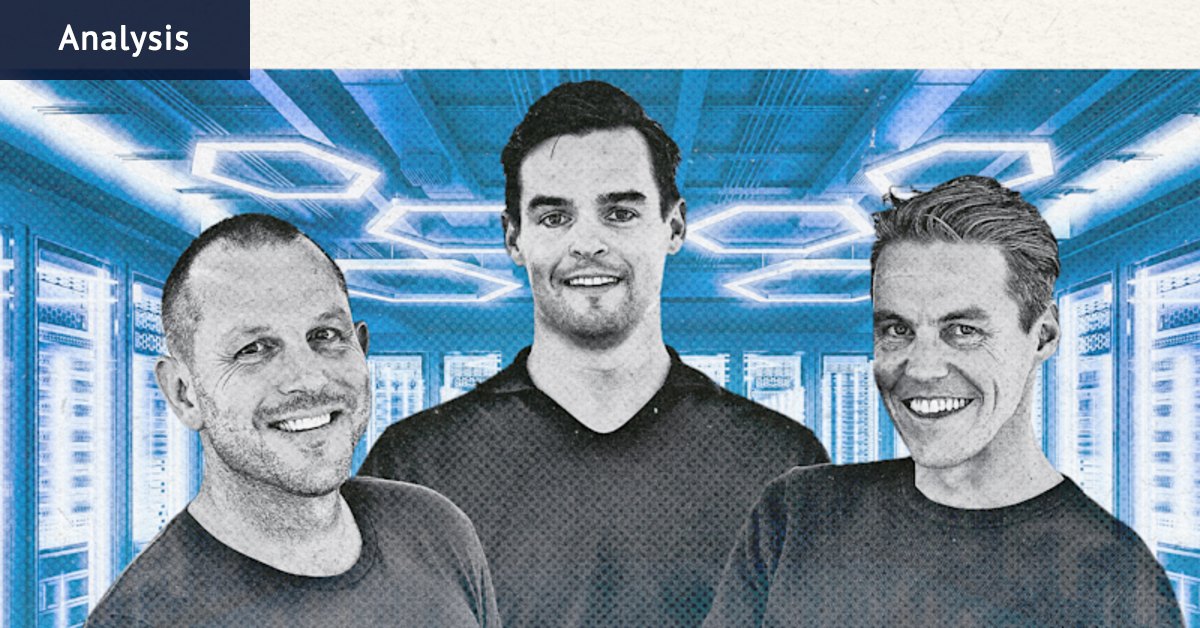
October was supposed to be former Cooma Correctional Centre resident Oliver Curtis’ moment not just of redemption, but ascension. Had the AI data centre company he co-founded, Firmus, gone public at a $43.7 billion valuation this month, Curtis’ corporate apotheosis would have been complete.Instead, the seven-year-old start-up’s plans for a sharemarket listing were hanging in the balance on Thursday morning, after its bankers cut the share price for the big institutions that buttress an ASX float before it starts trading from $11 to $8.25. And there were concerns the whole listing scheduled for October 23 could topple over.Jonathan Levee, Tim Rosenfield and Oliver Curtis all stand to take a major hit to their paper wealth should Firmus fail to go public, or list at a discount.Aresna VilleneuvaCurtis, who is Firmus’ chief executive and largest individual shareholder, owning about 13 per cent before the planned sharemarket listing, stood to end up with a stake worth billions if everything went to plan. Valuing such a shareholding amid the tumult of a public offering is difficult, but if the company’s shares drop the $2.75 to $8.25 The Australian Financial Review reported, that could imply a drop in Curtis’ paper wealth in the region of $1 billion.Investors had got cold feet, wary of Firmus’ high price, comparatively minimal revenue and aggressive forecasts of building lots of data centres around the world, running them efficiently and selling their output to AI giants like Meta. The company had surged from seeking a $1.2 billion valuation in late 2024, to raising money at a $6 billion valuation in November 2025, $15 billion in August this year, and then trying to more than double that again this month.Even in the AI world, that is staggeringly fast growth.Of course, what goes up need not come down in financial markets. Just look at Nvidia, where the AI chipmaker’s shares are up more than 1000 per cent over five years to $US237 ($340). That makes some sense, at least to AI bulls: its revenue has risen more than tenfold too.Firmus, by contrast, has all of two data centres in operation and reportedly recorded just $50 million revenue last year. Its target valuation was a cool 874 times that revenue number, to say nothing of profit. And this week, it had to concede that its marquee partnership with established Australia data centre company CDC, touted as being worth potentially more than $70 billion, was over.Curtis is not the only one in line for a major hit if the listing goes bad. His co-founders Jonathan Levee and Tim Rosenfield both have significant stakes in the company, as does his father and former Firmus chairman, Nick Curtis.Unless things go irredeemably, catastrophically wrong, all will remain wealthy men. They just won’t be on the fast track to being cash billionaires when the restrictions on share sales that come with a public offering lapse.Then there’s the rest of corporate Australia. Former NRL player Wes Maas restructured his $2.5 billion-odd industrial materials and construction company earlier this year around his plans to build facilities for Firmus. Its shares were down by about a quarter on Thursday, valuing it at close to $1.9 billion.Ellerston Capital’s JAADE fund, which is accessible to more or less any well-off Australian, too has become a proxy for Firmus because it has a stake in the privately held start-up. In a disclosure document published on September 30, the fund was declaring it believes “the Firmus IPO has a relatively high degree of certainty” and cited analysis from the company’s bankers indicating it could be worth up to $US99 billion ($142 billion).To state the obvious: that now looks far-fetched.But there are still Firmus believers. Karl Redenbach, the chief executive of a small start-up called AgenticScale that is trying to raise $US20 million and hopes to eventually list its business setting up micro AI facilities on the Nasdaq exchange in America, said Firmus was “incredible”.“I’m bullish because I’ve been in the US, and every client we talk to [says] the demand is not just there, but growing exponentially,” Radenbach said. While he said his business was different to Firmus’ plans for large-scale so-called AI factories, he found both were tapping into the same demand for more capable AI agents that is beginning to surge.One venture capitalist, who is not a Firmus investor and spoke on condition of anonymity, said he had received numerous pitches like Radenbach’s since Firmus-mania began. Whether they continue after this week is another question.The Business Briefing newsletter delivers major stories, exclusive coverage and expert opinion. Sign up to get it every weekday morning.Nick Bonyhady is the business editor of The Sydney Morning Herald and The Age. He is a former deputy federal editor, technology editor and industrial relations reporter.Connect via X or email.From our partners
Oliver Curtis’ transformation from jailbird to corporate kingpin has gone awry
Full Article
Original Source
Read the full article at Smh →KhanList aggregates and links to publicly available news content. We do not host full articles from third-party sources. Always verify important information with original sources.