
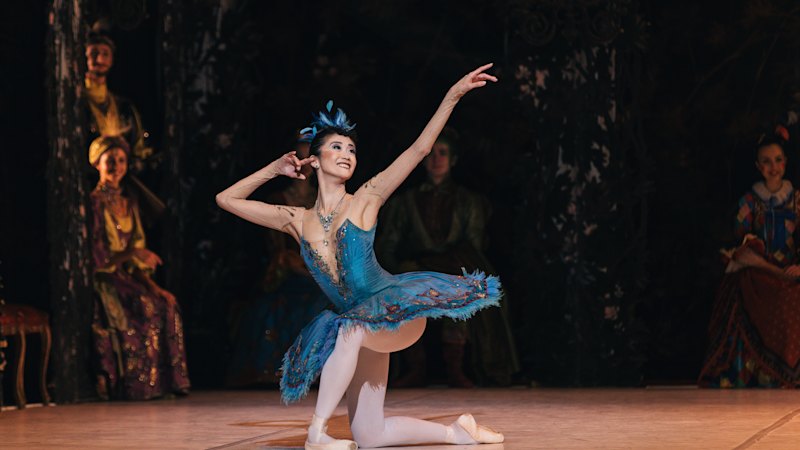
October 11, 2026 — 12:07pmDANCEThe Sleeping Beauty ★★★★Regent Theatre, until October 18The Stuttgart Ballet is in town, offering a rare chance to see a major European company dance one of its signature storybook ballets – with all the old-world charm and seriousness you could want. It’s also a chance to see a handful of genuine international ballet stars. First among them is Elisa Badenes, who danced Aurora on opening night, a dancer with exceptional composure and the silkiest of turns.The Stuttgart Ballet is in town.Kate LongleyHer Prince Désiré was Henrik Erikson: neat as a folded napkin in everything he does. His partnering with Badenes was compelling throughout, culminating in an exquisite grand pas de deux during the marriage festivities. The highlight was a diagonal of supported turns and plunging fish dives where, for one blissful moment, the two dancers appeared so connected, so entirely at one, that it was unclear who was supporting who.The wicked fairy Carabosse was danced by Jason Reilly, a veteran dramatic dynamo. He has a distinctive presence: quick, harassed, mocking, but earnest even when parodying the classical steps of the others.Carabosse has an elevated significance in Marcia Haydée’s version of the ballet. Haydée has transformed the contest between Carabosse and the Lilac Fairy into a sort of epic contest between good and evil.It can seem a little absurd – too much drama for the fey conceit – but this is a production that is very much of its time. Created in 1987, it’s essentially a Cold War fairy tale, showing a world dominated by two great powers.Mizuki Amemiya of The Stuttgart Ballet.Kate LongleyAbigail Willson-Heisel brought unflappable presence to the Lilac Fairy, while among the other dancers, Brazilian-born Adhonay Soares drew the eye with the height and energy of his leaps as the bare-chested Ali Baba.It’s a long way to travel just to perform The Sleeping Beauty, even if it is a defining production. Once upon a time, they might have brought a second ballet to show another side of their repertoire. But visits by international companies of this stature – any stature, really – are few and far between these days.Reviewed by Andrew FuhrmannMUSICIsata Kanneh-Mason ★★★★Melbourne Recital Centre, October 9Navigating a journey from darkness to light, pianist Isata Kanneh-Mason’s Australian debut recital offered plenty of familiar music. Bookended by two of Beethoven’s most popular sonatas, the “Moonlight” and the “Waldstein”, it also included Ravel’s astoundingly imaginative but fiendishly difficult Gaspard de la nuit. Two works by Bulgarian-English composer Dobrinka Tabakova provided a contrasting contemporary aesthetic.Isata Kanneh-Mason performs at Melbourne Recital Centre on October 9, 2026Laura ManaritiIn Beethoven’s famous moonlit opening, Kanneh-Mason’s striking ability for extremely restrained dynamics and tone colour might have suggested a burgeoning sense of drama, yet this remained unrealised. The blazing finale displayed her prodigious technique, even if greater detail could have been revealed with lighter pedalling.In Ravel’s brightly hued triptych, the water sprite Ondine splashed around in a luxurious aqueous soundscape while Kanneh-Mason’s trademark restraint lent the scene of the scaffold appropriate eeriness. She also convincingly captured Scarbo’s caprice, mischief and malevolence.After a symbolic change from dark evening gown to shorter pale blue dress, Kanneh-Mason turned to two works by Tabakova, containing the nucleus of the program. Nocturne, an attractive minimalist miniature summoned up night. Using harmonics and repeated notes, Halo effectively evoked a lunar halo which becomes increasingly bright.Clearly close to her heart, Kanneh-Mason played the “Waldstein” with great devotion, ensuring that the finale’s beginning did point to the dawn (an alternative nickname for the work). The blazing sunshine of the closing pages, however, were clouded over by some heavy pedalling.Impressive as Kanneh-Mason’s playing is, trading some technical brilliance for a wider tonal palette and greater emotional abandon would have taken the performance to a higher level.An over-the-top arrangement of the 1960s hit I Say a Little Prayer for You provided a buoyant encore for the enthusiastic audience.Reviewed by Tony WayMUSICPekka Kuusisto: Legends and Luminaries ★★★★Australian Chamber Orchestra, Melbourne Recital Centre, October 10Ebullience is at the heart of Pekka Kuusisto’s artistic DNA. Joy, passion, commitment and a sense of fun are among the enviable qualities the Finnish violinist and composer brought to his latest collaboration with the Australian Chamber Orchestra.Pekka Kuusisto (left) performs with the Australian Chamber Orchestra.Nic WalkerAs guest leader, Kuusisto helmed the orchestra through a program of contrasting styles, all with their own aural appeal. In Kuusisto’s thoughtful arrangement of excerpts from Mozart’s The Magic Flute, a little messiness was the price paid for an overture that ran at bullet train speed. Once the high-octane excitement subsided, beautifully shaped lyrical moments emerged before leading into the Queen of the Night’s aria.Written for Kuusisto and premiered with the ACO Collective in 2019, American composer Nico Muhly’s Shrink: Concerto for Violin and Strings is a tour de force that is a perfect fit for the dedicatee’s mercurial personality.Across the work’s 22 minutes, Muhly weaves an intricate, compelling tapestry of textures, while the soloist jumps through every technical hoop imaginable. Kuusisto clearly thrives on such challenges, bringing unflagging zeal and a wealth of colour and emotion to the cleverly constructed score that exploits narrowing intervals alluded to in the title.Receiving its first Australian performances on this tour, Pulitzer Prize-winning composer Ellen Reid’s “paean to the Californian landscape”, West Coast Sky Eternal elicited an empathetic performance. Its shifting textural perspectives are intriguing at first before an extended pizzicato passage tends to unbalance its structure.Clearly revelling in Kuusisto’s leadership, an arrangement of Mendelssohn’s String Quintet No. 2 in B-flat, Op. 87 received classic ACO treatment. Ebullience certainly radiated through the outer movements, while an elegant second-movement scherzando preceded an exquisite, heart-tugging slow movement.A superbly judged encore came with Reger’s arrangement of one of Bach’s most intimately rhapsodic works for organ, the chorale prelude O Mensch, bewein’.Reviewed by Tony WayThe Booklist is a weekly newsletter for book lovers from Jason Steger. Get it delivered every Friday.More:Melbourne live reviewsSee & DoWhat’s onFor subscribersPerforming artsVictoriaReviewLive musicLive musicFrom our partners
Old world charm abounds in this classic telling of a fairytale
Full Article
Original Source
Read the full article at Smh →KhanList aggregates and links to publicly available news content. We do not host full articles from third-party sources. Always verify important information with original sources.