
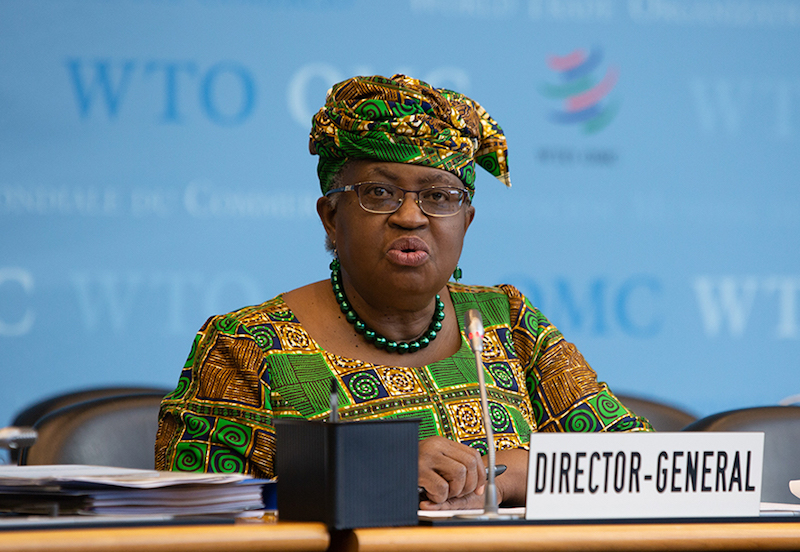
*Says green trade has exceeded $2 trillion *Remains optimistic about future of free trade Emmanuel Addeh in Abuja The Director General of the World Trade Organisation (WTO), Dr Ngozi Okonjo-Iweala, has stated that in spite of mounting disruptions to the global economy, including the aggressive tariff policies of the Donald Trump administration, US-China tensions and the impact of the Iran war on energy markets, 72 per cent of global goods trade is still being conducted under WTO rules.Okonjo-Iweala, who spoke with CNN’s Fareed Zakaria at the weekend, said the resilience of the multilateral trading system had surprised even officials of the WTO, arguing that businesses continued to rely on the stability and predictability provided by the organisation’s rules despite growing protectionism and geopolitical tensions “We are very truthful and say that even we are surprised by the resilience and grateful for it,” she said, explaining that the WTO had examined how much of global trade was still taking place according to its rules.“We find that 72 per cent of world trade, world goods trade, is still taking place on WTO terms, on most favoured nation terms. That’s what we call predictable, stable,” she emphasised. Her assessment comes against the backdrop of what she described as the worst disruption to global trade in 80 years, with the United States, historically one of the strongest proponents and beneficiaries of the multilateral trading system, increasingly turning towards protectionist policies.Okonjo-Iweala said businesses were helping to sustain the system because they needed stability and predictability to make investment and trading decisions. She also pointed to stronger-than-expected global trade growth as another indication of resilience. According to her, the WTO had initially projected growth in global goods trade of about 2.4 to 2.5 per cent last year, but actual growth came in at 4.6 per cent.A significant part of that expansion, she said, was driven by the rapid growth of artificial intelligence-related goods, including semiconductors and processors. “Forty-two per cent of that growth last year was contributed by trading AI, semiconductors, processors, all the things,” she said.The WTO chief, however, cautioned against interpreting the strong performance as evidence that the global trading system was immune to current shocks. For 2026, the organisation had initially projected global goods trade growth of 1.9 per cent amid tariff disruptions, geopolitical tensions, energy price pressures and bottlenecks such as the Strait of Hormuz. But first-quarter figures showed growth of 3.2 per cent, again exceeding the WTO’s expectations. Okonjo-Iweala said the strong performance of AI-related trade also required caution because the expansion was highly concentrated in East Asia and North America, particularly the United States.“We don’t know whether this can be sustained or it’s a bit of a bubble. So we have to watch out for that,” she said, warning that the concentration of the benefits could become problematic if other regions were excluded from the AI-driven expansion.She nevertheless said the persistence of trade under WTO rules had strengthened her belief that the multilateral system retained a strong core, even as its robustness remained under pressure. “I used to think that with what is going on, the worst disruption for global trade in 80 years, that we wouldn’t see these kinds of numbers, I’ll be honest with you. But now I’m seeing some persistence in those numbers that lead me to believe that there’s a core of the rules that really work, that it was largely well built, has benefited the world, you know, made prosperity, 1.5 billion people taken out of poverty as a result of this,” she stated. Okonjo-Iweala, however, drew a distinction between resilience and robustness, saying the system had proved capable of absorbing significant shocks but remained vulnerable to deeper structural pressures.“It doesn’t mean that the system, it’s resilient, but is it robust? And I don’t think it is,” she said.Despite those concerns, the former Nigerian finance minister said she remained fundamentally optimistic about the future of free trade, although she acknowledged that the global trading system would not return to its previous form.She said member countries had nevertheless recognised the need to reform the organisation if it was to remain relevant and preserve the resilience of the global trading system. “For whatever reason, they’ve come to accept that if we are going to be a modern organisation and maintain that resilience and robustness we talked about, they have to reform. So I’m optimistic,” she said.Beyond merchandise trade, Okonjo-Iweala highlighted the rapid expansion of digital trade and digitally delivered services, saying they represented important areas of opportunity in the evolving global economy. She also pointed to the growth of green trade, which she said had now exceeded $2 trillion, as another positive development.The WTO director general said the changing structure of global trade meant that the future would not be defined solely by traditional movement of physical goods, but increasingly by services, digital commerce, technology and green products.
Okonjo-Iweala: Despite Global Stressors 72% of World Trade Still Under WTO Terms
Full Article
Original Source
Read the full article at Thisdaylive →KhanList aggregates and links to publicly available news content. We do not host full articles from third-party sources. Always verify important information with original sources.