
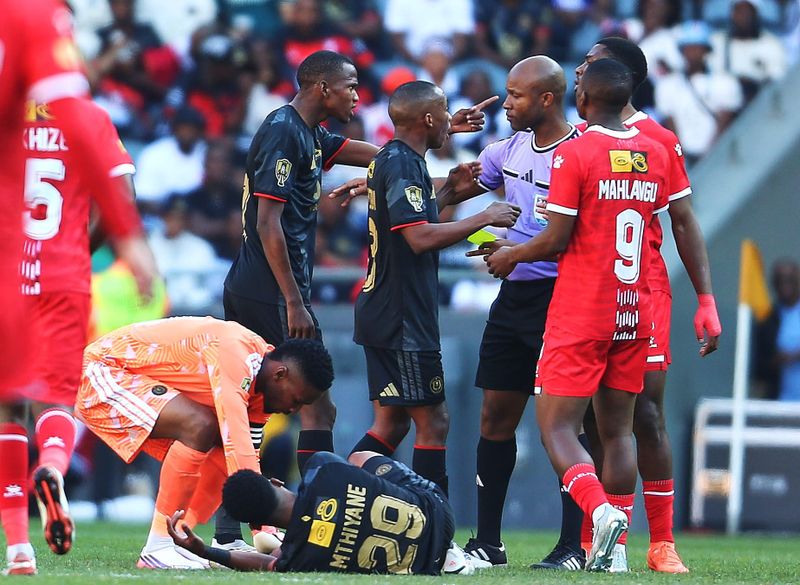
The 2026/27 South African top-flight season is still in its infancy after kicking off in early August. Yet, a number of teams have already been victims of sub-par officiating. One of the most controversial decisions to date came in a Premiership match between Orlando Pirates and AmaZulu on 12 August. The tussle ended 1-1, but more than the dropped points, defending league champions Pirates were dealt a major blow with a serious ankle injury to midfield anchor Sihle Nduli. The 30-year-old was playing his first competitive match since November 2025, after recovering from another severe injury suffered last season. However, a tackle from Usuthu striker Thandolwenkosi Ngwenya saw Nduli stretchered off, and it has since been confirmed that the midfielder will be sidelined for up to four months after his ankle ligaments were torn during Ngwenya’s ill-timed tackle . Of course, soccer is a contact sport and players don’t head into matches wanting to intentionally injure their rivals. The same is true for Ngwenya. However, it is also a fact that the referee on that fateful day, Luxolo Badi, should have shown the AmaZulu striker a red card for the reckless challenge on Nduli. He did not, and even his assistants missed the gravity of the incident. VAR’s contribution to SA soccerThat is just one example of many incidents that have already cast doubt on the integrity and competence of South African referees this season, from goals being wrongfully ruled out for offsides or imaginary handballs, to players escaping punishment for dangerous tackles. The introduction of the video assistant referee (VAR) system in South Africa would definitely help reduce glaring errors such as the Ngwenya-Nduli incident. Nevertheless, a bigger problem for the integrity of match officials in the country is that even though the Premiership is regarded as one of the best domestic leagues in Africa, its referees remain semi-professional.Minister of Sport Gayton McKenzie is a firm believer that VAR will fix South African soccer’s officiating woes. (Photo: Daniel Hlongwane / Gallo Images) During a heated parliamentary debate where the South African Football Association (Safa) appeared before the Department of Sports, Art and Culture’s portfolio committee (alongside the department itself), Democratic Alliance member Leah Potgieter brought up this very point. Potgieter essentially said the referees were only as good as their training, which is minimal considering that refereeing in South Africa is not a fully professional occupation. She asked why the department and McKenzie had paid Safa R20-million for the implementation of VAR before doing due diligence. During last month’s parliamentary session, McKenzie erroneously referred to sending R30-million to Safa. His department later clarified that it was indeed R20-million. DA MP Leah Potgieter. (Photo: Parliament SA) “The question is not whether we need VAR. I’m not disputing that we need VAR because I watch football avidly. The question is why it appears as if the cart has been put before the horse. Because it seems the money was paid over before a full implementation plan or feasibility study was done. Now we are seeing the consequences of that,” Potgieter said. Referee Luxolo Badi during the MTN8 semi-final second leg match between Golden Arrows and Mamelodi Sundowns on 30 August 2o26 in Durban. (Photo: Gallo Images) “There is no progress and there is no plan. That’s a huge problem because this is a lot of money,” Potgieter added. “But I do not think VAR will fix the refereeing problem that we have in this country. VAR is managed by referees. It can also be utilised on a very minimal basis in a game, it cannot be used for every decision that is made. “On that basis, what is being done by the department, in conjunction with Safa, to address the refereeing crisis that they alleged VAR is going to fix?” she asked.‘SA referees are not poor’Safa’s Head of Referees Abdul Ebrahim says South African soccer referees are not immune to mistakes, just like officials in any other sport. (Photo: Lefty Shivambu / Gallo Images) Safa’s Head of Referees Abdul Ebrahim defended the officials who serve under him, saying that, just like in any other sport, they were susceptible to error. Although referees primarily officiate in South African league matches across tiers, Safa is responsible for them and provides them to the Premier Soccer League. “We have development programmes that take place annually, from national, to provincial and even regional level,” Ebrahim stated. “There are not necessarily bad referees. Yes, they make mistakes. In any sporting code, referees will make errors. VAR is an enhancement for match officials. It is limited in its scope currently, but it will assist with those critical decisions that are causing the general public to speak about referees being poor. Referees in South Africa are not poor,” said Ebrahim. Indeed, VAR will assist in removing most of the clear and obvious mistakes from match officials. However, it is not a magic wand that will make referees apply the laws of the game consistently. Making the occupation fully professional would be a better contribution to South African soccer. DM
OFFICIATING STANDARDS: VAR can reduce errors in SA soccer, but professional referees are the real fix
Full Article
Original Source
Read the full article at Dailymaverick →KhanList aggregates and links to publicly available news content. We do not host full articles from third-party sources. Always verify important information with original sources.