
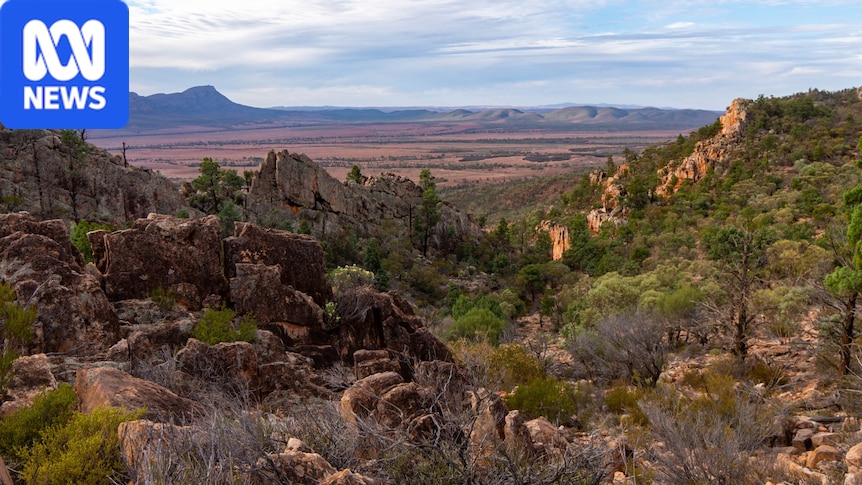
The ancient Flinders Ranges ocean that preserved early life on EarthABC North and West SATopic:GeologyPosted Sun 15 Nov 2026 at 7:36amSun 15 Nov 2026 at 7:36amChace Range in the Flinders Ranges has unusual rock formations that indicate the presence of submarine canyons. (Supplied: Adelaide University)In short:New research has painted a clearer picture of the ancient Flinders Ranges landscape and early fossil formations. Unusual rock formations were found to be evidence of canyons formed underwater.What's next?The area is included in an ongoing bid for UNESCO World Heritage status.Researchers have found new evidence about how ancient sea level changes led to the preservation of some of Earth's earliest complex life forms.Geological features across South Australia's Flinders Ranges were mapped in the study led by Adelaide University, reconstructing the landscape of hundreds of millions of years ago to investigate how sediment and fossils came to be. "You have to imagine that the Flinders Ranges … was under the ocean," University of Adelaide associate professor Diego Garcia-Bellido said.Researchers say the findings give a clearer picture of how the Flinders Ranges landscape changed. (Supplied: Adelaide University)"Canyons were being carved and creating this accommodation space for a lot more sediment."The findings focused on the Ediacaran period, about 550 million years ago, "at the time or just before the appearance of the first complex life on the planet".Diego Garcia-Bellido works at Chace Range in September. (Supplied: Xavier Damiani/Adelaide University)Looking at Nilpena Ediacara National Park in the Flinders Ranges, researchers noticed unusual rock formations that indicated the presence of submarine canyons.Dr Garcia-Bellido and his colleagues from the university and the South Australian Museum began finding the canyons "all over the Flinders", up to 280 metres deep and 6 kilometres wide. The findings suggest that flooding of seawater played a crucial part in the formation of the canyons, and subsequently the preservation of some of the first complex life on the planet.Knowledge about how the canyons formed could help with the understanding of early evolution."The environment is a very important point of reference; you need to know where these organisms started living, and why they settled there," Dr Garcia-Bellido said. Karol Faehnrich and Jim Gehling map the geological features in the Flinders Ranges in 2024. (Supplied: Diego Garcia-Bellido)"What we see is that, as the canyons get filled and the sea level rises, this creates in the shallow shelf an environment that is ideal for the shallow water microbial mat to grow."This is where this original Ediacara biota began to grow and actually produce the most diverse assemblage of this pre-animal world."Fossils of early soft-bodied organisms known as Ediacaran biota were first discovered in the Flinders Ranges in 1946Fossils like these form an important part of an ongoing bid for UNESCO World Heritage recognition for the Flinders Ranges.Jim Gehling does some mapping at Chace Range in 2016. (Supplied: Diego Garcia-Bellido)"The fact that this is so important is because we see how animals arrive on this planet, or start developing on this planet," Dr Garcia-Bellido said. "With these studies, we're trying to find more about these very earliest complex forms."It's glimpsing a world that is probably the most alien we can actually find because we've gone so far back in time that the animals that we see around us today … didn't even exist."
Ocean that once covered Flinders Ranges preserved Earth's earliest life
Full Article
Original Source
Read the full article at Abc →KhanList aggregates and links to publicly available news content. We do not host full articles from third-party sources. Always verify important information with original sources.