
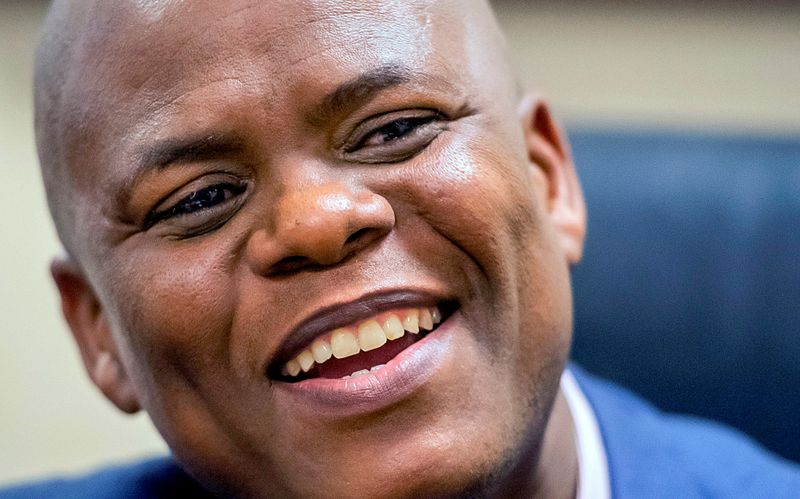
The once shy financial journalist who later became the definitive public voice of South Africa’s electricity crisis has died. Khulu John Bolekwa Phasiwe passed away on Sunday, 4 October, at the age of 52. Just three months earlier he was appointed head of corporate affairs and communications at the Air Traffic and Navigation Services. Phasiwe died after suffering a seizure, and according to his family he had been battling with them for several years leading up to his passing.For many South Africans, his voice belonged to the years when the lights went out without warning. He was the go-to man journalists called when Eskom had to explain another failure at a power station, another stage of load shedding or another day in which the country’s electricity supply could not be taken for granted. The job required him to defend an institution under sustained attack without pretending that its problems were smaller than they were. It was an unbearably stressful environment, but he handled it in a manner that became part of his reputation: calm, available and exacting about facts. The National Press Club said he had retained a “helpful and measured manner” even as the scrutiny intensified. He understood, they said, that the media had an important role and made himself available to journalists trying to make sense of “complex and often rapidly changing developments”.That combination of composure and candour was formed before he entered corporate communications. Phasiwe began as a journalist. Rams Mabote, a friend who worked in energy consulting, recalled first knowing him as a young reporter on Business Report in the late 1990s. When Mabote was consulting for the National Electricity Regulator, the predecessor of the National Energy Regulator of South Africa, and Phasiwe was at Business Day, their professional relationship deepened.Phasiwe was, Mabote said, one of the very few black journalists immersed in energy matters, an area that “was always the monopoly of white reporters”. He remembered a man who “never made noise to be heard” and “never wrote lies or exaggerations to be noticed”. He did his work “as a professional. Always with that childish smile and a boyish voice. But always with the authority of a professional.”The tension between the soft-spoken man and the hard subject was central to Phasiwe’s career. His friend, Xolisile Nxumalo, recalled that when other spokespeople were hiding during load shedding, Phasiwe was still picking up the phone. At 8pm on a Sunday, during Stage 4 outages, “he would still respond”. Many government communicators learnt from him, Nxumalo said, that being a spokesperson was not about defending an organisation at all costs. “It’s about respecting the public.”Khulu Phasiwe at Eskom’s headquarters in Sandton on 11 April 2019. (Photo: Gallo Images/ Netwerk 24 / Deon Raath) Pat Makape, another friend, met him at Wits in 1996. In a heartfelt tribute Makape called him “my dear brother and comrade of over 30 years” and ended with a farewell in the language of the institutions Phasiwe had served: “So long, Spokesperson of Eskom. So long, Spokesperson of South African Radio Astronomy Observatory. So long, Spokesperson of the Public Protector South Africa. So long, Spokesperson of Air Traffic and Navigation Services.”Also at Wits, Tlou Legodi, a fellow student involved in the university’s newspaper, recruited Phasiwe to join the publication as a reporter. In 2001 the two were later selected for the Business Day-Financial Mail financial journalism programme, run under Patty Clay.The programme introduced Phasiwe to the competitive world of financial reporting. He went on to work at Business Report and later at Business Day, at that stage among South Africa’s most influential business newspapers.Subsequently, he joined Eskom’s media department and became a senior communications adviser and then deputy spokesperson. In September 2015 he was appointed national spokesperson, a position he held for about four years. By then the utility’s troubles had moved into the daily lives of millions of people.Eskom’s ageing power stations were failing, maintenance was inadequate and its finances were under severe strain. The utility was facing questions over management, governance and allegations linked to State Capture.(Image: Tlou Legodi / Facebook) Phasiwe stood at the point where those failures had to be addressed. He had to answer questions about the power system while the system itself was becoming less reliable. He had to represent an organisation whose credibility was diminishing while preserving the lines of communication on which scrutiny depended. In an interview carried by SABC News when he announced his departure from Eskom in 2019, Phasiwe did not pretend that the role had been manageable. “The difficulty was that our problems never end,” he said.“Almost every day, every week there’s a new thing coming, so it was very difficult.” He described the work as “tantamount to being in a war zone”, with new crises arriving before the previous one had been resolved. Yet, he added: “Through the grace of God I have been able to do what I had to do.” He and his colleagues had done their jobs “diligently, with the necessary professionalism”.There was a cost to that discipline. Phasiwe compared the work to being in an emergency ward, where the pressure begins to affect a person’s mental and emotional state. In April 2019, after a decade at Eskom and five years as its national spokesperson, he resigned voluntarily. He announced that his last day would be 30 April. “There is a season for everything. I have run my race and completed the course,” he said. “My primary focus now is to take some time off to relax and recharge.” He wanted to spend time with his family and consider what came next. Phasiwe had been successful at a job that was designed to absorb anger, but he was not untouched by it.A friend and a perfectionistHis friends remembered the private man behind the public voice. Tlou Legodi recalled Phasiwe’s wedding to Dudu, when he was “at his happiest”, smiling and dancing in splendid Zulu attire. At Legodi’s own wedding, at the end of December 2007, load shedding had just begun and he had assumed Phasiwe would be unable to attend. Phasiwe arrived that morning in the heat, explaining that he could not let his friend down. He had already bought the suit and the matching traditional garments worn by members of the wedding party. Even during the celebrations he was answering media queries, with a smile.The same conscientiousness appeared in smaller, less-ceremonial moments. Legodi said that when they worked together at Business Day, Phasiwe sometimes telephoned late at night to correct a figure. “Legodi, sorry to bother you but I said the number is 120, in fact it is 121,” he would say. They would laugh as they amended the copy. He was, Legodi said, a perfectionist. He loved books, especially the work of the Nigerian novelist Chinua Achebe, and admired Achebe’s use of proverbs and idioms.‘Credibility, dignity and leadership’After leaving Eskom, Phasiwe became head of communications and stakeholder relations at the South African Radio Astronomy Observatory, an agency of the National Research Foundation. In May 2024 he was appointed spokesperson for the Office of the Public Protector of South Africa. His final move came on 1 July 2026 when he joined the Air Traffic and Navigation Services (ATNS) as head of corporate affairs and communications and company spokesperson.Matome Moholola, the ATNS chief executive, said that although Phasiwe’s time at the organisation had been brief, he had made a lasting impression through his “professionalism, judgement, humility and leadership”. Transport Minister Barbara Creecy said his impact had been immense despite his short time in the sector. Khulu Phasiwe during an interview with Rapport on 11 April 2019. (Photo: Gallo Images/ Netwerk 24 / Deon Raath) He had brought “credibility, dignity and leadership” to ATNS and had upheld “ethical communication when it mattered most”, she said. “South Africa has lost a gifted professional. The transport sector has lost a valued colleague.”The South African National Editors’ Forum described Phasiwe as a journalist, communicator and spokesperson who had served the country across the media and public sectors. The African Media and Communicators Forum called his contribution to the African media and communications sector invaluable. Eskom, the organisation whose most difficult years had made him familiar to the nation, remembered a trusted voice who had explained complex operational matters with professionalism, commitment and integrity.The tributes repeat certain words: calm, humble, credible, gentle. They are not the usual language of institutional combat, yet they describe the quality Phasiwe brought to it. Thebe Mothelesi Khonkhobe, who interviewed him when he was Eskom’s national spokesperson, remembered simply: “Owhhhhh what a humble being he was.”He also leaves the memory of a man who understood that authority did not require authoritarianism or hubris. During the electricity crisis, when the country wanted explanations and the institution he represented could offer few satisfactory ones, he kept answering the phone. He is survived by his wife, Dudu, family, friends and colleagues in journalism, communications and public service. DM
OBITUARY: The quiet authority of Khulu Phasiwe, the voice South Africa heard in the dark
Full Article
Original Source
Read the full article at Dailymaverick →KhanList aggregates and links to publicly available news content. We do not host full articles from third-party sources. Always verify important information with original sources.