
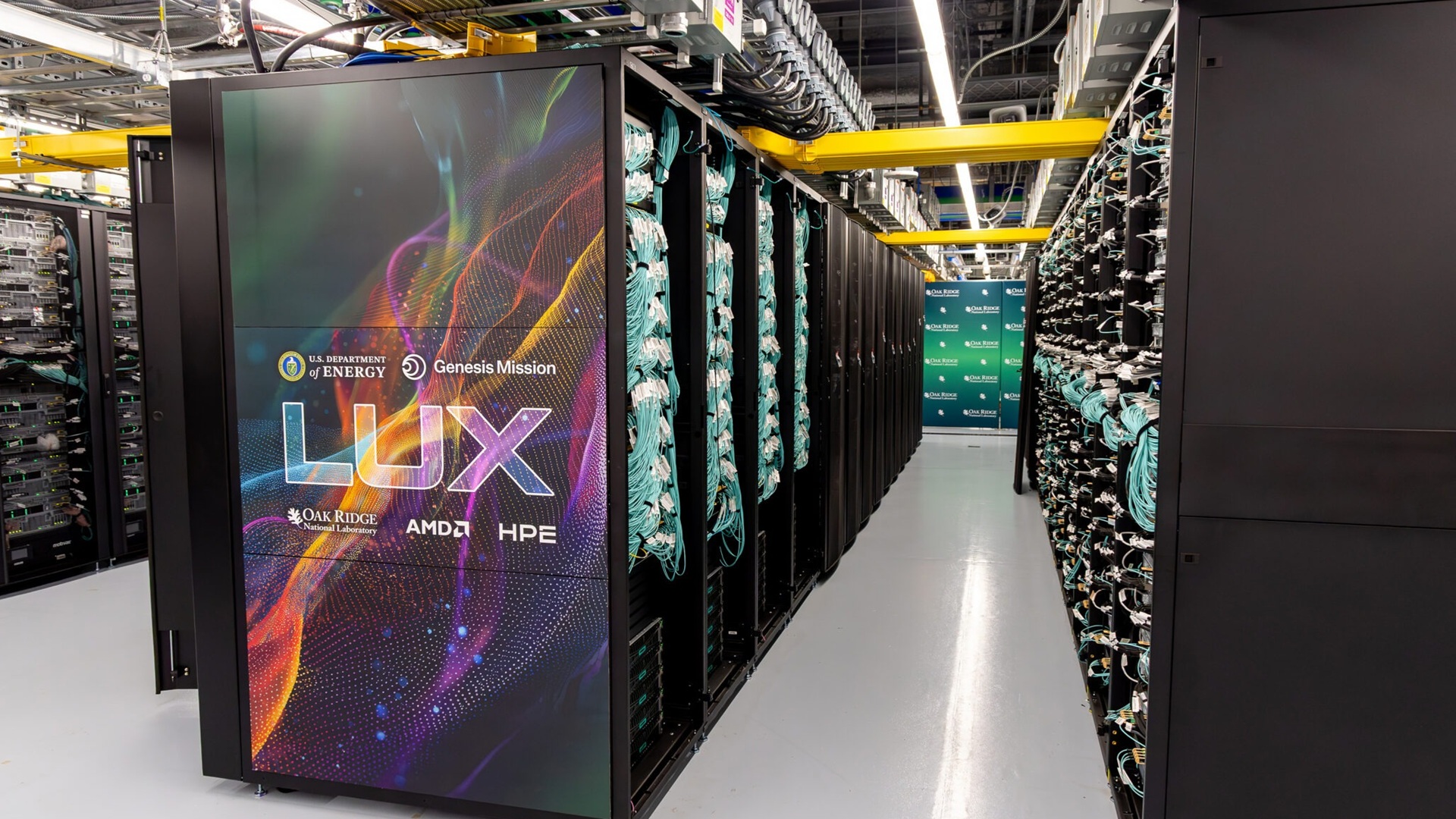
The Lux supercomputer.ORNLKey TakeawaysLux debuted at No. 14 on the TOP500 list with 220.79 petaflops, opening to scientific users at Oak Ridge National Laboratory.The supercomputer is the first dedicated US AI Factory for DOE’s Genesis Mission, combining AMD processors, GPUs, networking and software with HPE infrastructure.Genesis Mission projects using Lux will target fusion power plant design, advanced materials development and manufacturing, and Earth system prediction. A new supercomputer at Oak Ridge National Laboratory (ORNL) has entered the world’s top 15, delivering 220.79 petaflops as it opens to scientific users supporting the US Department of Energy’s Genesis Mission. Named Lux, the system ranked No. 14 on the latest TOP500 list, which tracks the world’s most powerful supercomputers. Its debut marks the first major addition to DOE’s computing infrastructure dedicated to the Genesis Mission, a national initiative to accelerate scientific discovery by combining Super Intelligence (SI), high-performance computing (HPC), quantum systems and advanced scientific instruments. Lux was developed through a public-private partnership involving ORNL, AMD and Hewlett Packard Enterprise (HPE). The system pairs AMD Instinct MI355X graphics processing units (GPUs) with AMD EPYC central processing units, Pensando networking and ROCm software. HPE built the system using its ProLiant Compute XD685 platform. The combination is designed to bring SI workloads closer to traditional scientific modeling and simulation. Researchers can use the system to train and run models, process experimental data and coordinate complex workflows, including those involving autonomous agents. A hybrid computing architecture Lux supports both Slurm and Kubernetes for resource scheduling, combining established practices from supercomputing with tools commonly used in cloud environments. The arrangement is intended to let researchers run HPC simulations alongside SI training, inference, and agentic workflow orchestration. The system is part of DOE’s Genesis Mission, which aims to build an integrated science discovery platform connecting government, industry, academia and philanthropy. Its first phase targets challenges in energy, scientific discovery and national security. About half of Lux’s annual 3.5 million node-hours will be allocated to Genesis Mission projects. The remaining capacity will be available to AMD under the partnership, allowing the company to develop its SI and HPC technologies, software ecosystem and workloads. Research targets span disciplines Projects allocated to Lux include work on SI-assisted fusion power plant design, materials development and advanced manufacturing, and Earth system prediction. The fusion project aims to develop an SI platform integrating HPC tools with robotic system design. A separate materials initiative will create a “foundation model factory” to develop customized models that US industry can use. Another project will forecast water availability, streamflow, and river temperatures weeks to years ahead in the Tennessee Valley Authority region, with potential applications for hydropower and thermoelectric operations. ORNL is leading six other Genesis Mission projects and participating in 30 more led by national laboratories, universities and industry partners. The laboratory is also spearheading the American Science Cloud, a secure platform intended to connect computing, data and experimental resources across the DOE’s 17 national laboratories. Lux joins ORNL’s Oak Ridge Leadership Computing Facility alongside Frontier, the first supercomputer to break the exascale barrier. DOE’s next flagship system, Discovery, is scheduled for delivery in 2028. The launch extends a long-running collaboration between the national laboratory and industry, while giving researchers additional computing capacity to combine modeling, simulation, and data-driven methods. Its TOP500 debut places it among the leading systems available for scientific workloads.Get the latest in engineering, tech, space & science - delivered daily to your inbox.With over a decade-long career in journalism, Neetika Walter has worked with The Economic Times, ANI, and Hindustan Times, covering politics, business, technology, and the clean energy sector. Passionate about contemporary culture, books, poetry, and storytelling, she brings depth and insight to her writing. When she isn’t chasing stories, she’s likely lost in a book or enjoying the company of her dogs.
Oak Ridge’s Lux supercomputer breaks into world’s top 15 to advance US Genesis Mission
Full Article
Original Source
Read the full article at Interestingengineering →KhanList aggregates and links to publicly available news content. We do not host full articles from third-party sources. Always verify important information with original sources.