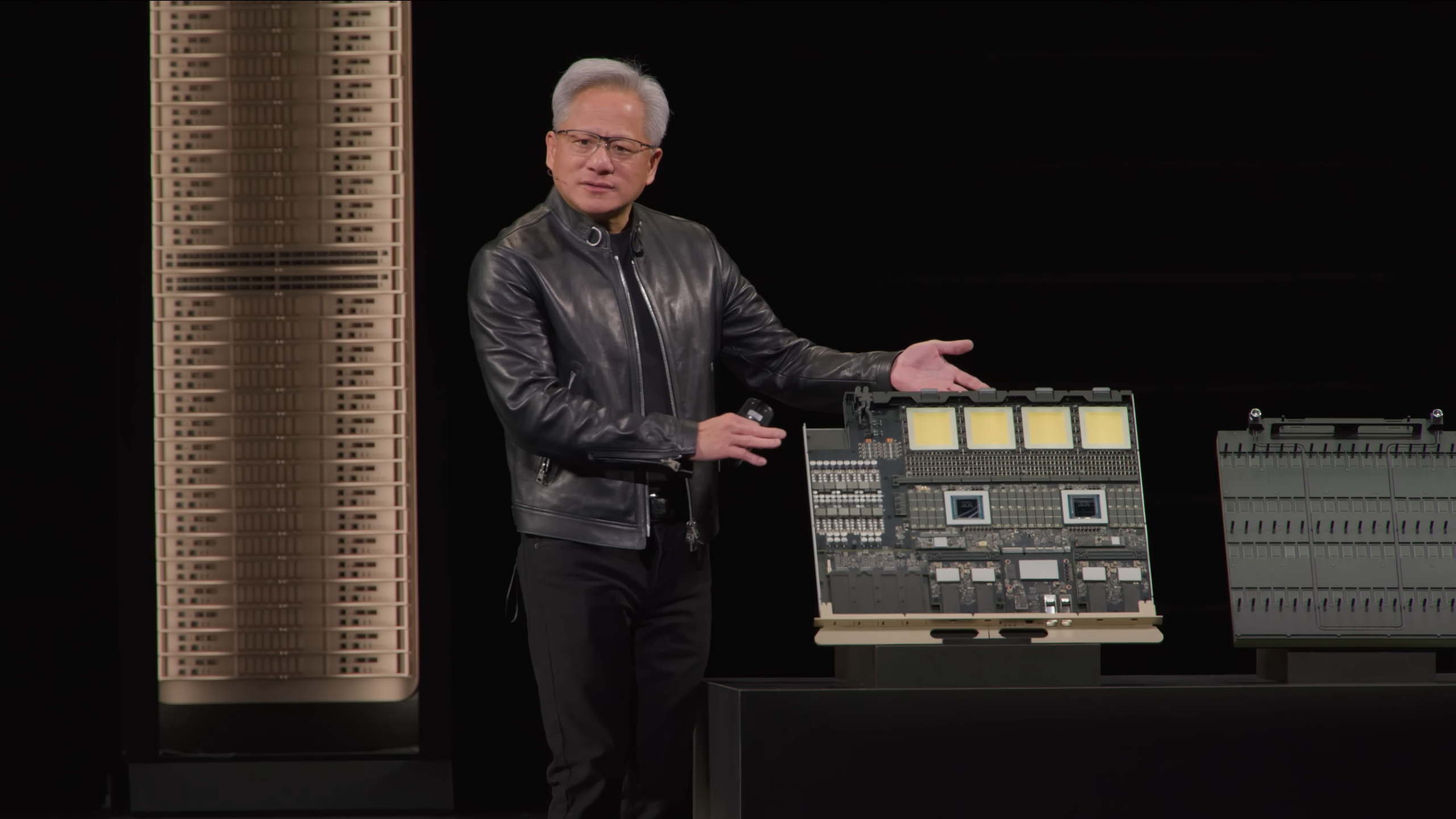
(Image credit: Nvidia) Nvidia is reportedly testing variations of its upcoming Rubin Ultra accelerator with less memory due to concerns it won't be able to source enough HBM. Some versions include just 192 GB of memory and use HBM4 instead of HBM4E, as originally announced, according to The Information. The report confirms an earlier comment from firm SemiAnalysis about a potential Rubin Ultra memory downgrade.Go deeper with TH Premium: MemoryWe first saw Rubin Ultra in the flesh earlier this year at GTC, where Nvidia showed off a compute tray housing four compute chiplets alongside 1 TB of HBM4E memory. The accelerator is part of Nvidia's Kyber NVL144 design, which is set to roll out in 2027. SemiAnaylsis reported that the rack was delayed to 2028. "Our roadmap is intact," said Nvidia to Tom's Hardware in response, though the company made no clarification on if the delay was real or not. We've reached out to Nvidia regarding this latest report.According to The Information, Nvidia is testing versions of Rubin Ultra with 192 GB or 256 GB of memory, as well as versions that use fewer than the 16 announced memory stacks. Perhaps most importantly, Nvidia is reportedly testing with HBM4, not HBM4E as originally announced. Along with the traditional improvements we see in each new HBM generation, HBM4E is unique in that it offers a customizable base logic die. Last year, Micron announced a partnership with TSMC to manufacture the base die and allow customers to tweak the logic die based on their needs.The complexity of HBM4E has reportedly caused a strain on supply, with memory manufacturers unable to keep pace with Rubin Ultra's rollout. At least three lower-memory designs have been tested by Nvidia, according to the report, though we don't have a full picture of details on those prototypes. The report claims testing with HBM4, as well as 192 GB and 256 GB configurations, though it makes no mention of the number of compute dies, nor the memory type for each tested capacity.The number of dies is important. In June, reports circulated that Nvidia cancelled its quad-die Rubin Ultra design due to manufacturing complexities. Although Nvidia has yet to comment, reports at the time suggested Nvidia would move ahead with a dual-GPU Rubin Ultra. In such a case, less memory would make more sense. Even with a dual-die Rubin Ultra, the quoted capacities are lower than expected. Each base Rubin GPU currently ships with 288 GB of HBM4.It's clear Nvidia is trying to get ahead with memory in a world where agreements have been signed multiple years into the future. Nvidia has several of its own agreements. In June, the company announced a partnership with SK hynix to develop next-generation memory technology, which includes HBM, but also LPDDR5X and DDR5. In July, Nvidia expanded that partnership with a $500 billion strategic relationship that includes a long-term memory supply agreement with SK.Although Nvidia is considering lower-memory configurations, one Nvidia customer told The Information that per-GPU memory isn't a top concern, valuing the relationship with Nvidia over the long term.Get Tom's Hardware's best news and in-depth reviews, straight to your inbox.Memory shortages are touching nearly every design currently on the market, though enterprise systems packing HBM are particularly vulnerable. Last week, Digitimes reported that Samsung, SK hynix, and Micron have sold through their HBM capacity through 2027. Last month, SK Hynix CEO Kwak Noh-jung said 2027 will be the "worst year" for the memory shortage, with supply constraints lasting through 2030. Follow Tom's Hardware on Google News, or add us as a preferred source, to get our latest news, analysis, & reviews in your feeds. Jake Roach is the Senior CPU Analyst at Tom’s Hardware, writing reviews, news, and features about the latest consumer and workstation processors.
Nvidia reportedly testing lower memory configs of Rubin Ultra as memory shortage bites back — designs tested include as little as 192 GB and step back to HBM4
Full Article
Original Source
Read the full article at Tomshardware →KhanList aggregates and links to publicly available news content. We do not host full articles from third-party sources. Always verify important information with original sources.