
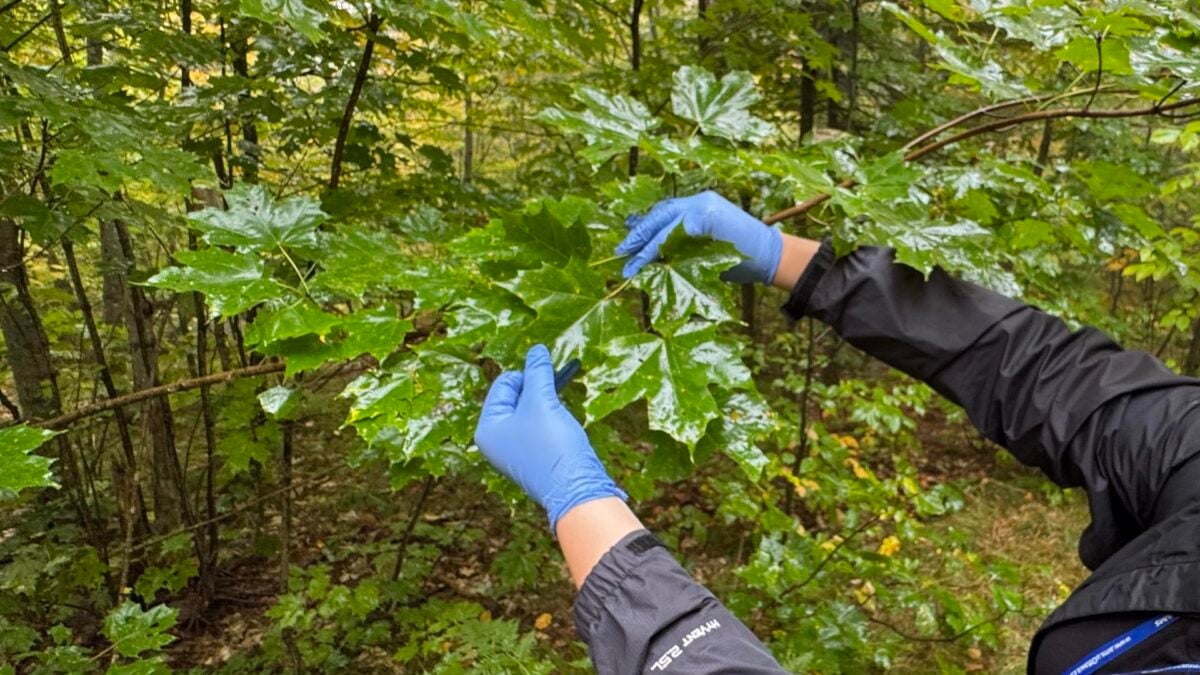
Scientists call it the “bomb pulse.” At the height of the Cold War, above-ground nuclear weapons tests by the Soviet Union, the U.S., and their respective allies roiled quiet stretches of the Pacific and other test sites around the world. The tests dramatically altered the isotopic composition of Earth’s atmosphere, doubling its carbon-14 levels. Neutrons radiating from these blasts collided with nitrogen gas, transforming some of them into carbon-14 and forming traceable patterns across the planet’s carbon cycle for decades, nearly doubling global levels of this radiocarbon at the bomb pulse’s peak. In Quebec’s Gatineau Park, across the river from Ottawa, this bomb-pulse carbon-14 recorded in sugar maple leaves reached its highest saturation at 842 parts per thousand above the reference level in 1964, as recorded by the Geological Survey of Canada. But, mysteriously, these maples’ carbon-14 ratios did not drop back down to their pre-Cold War baseline for over six decades—roughly two years after the rest of Earth’s surrounding atmosphere got back to normal. Now researchers at the University of Ottawa have finally figured out why. “Plants often use older carbon, stored from previous years, to grow new leaves,” Leonard Wassenaar, a geoscientist at the university, explained in a statement. “We didn’t know how much that changed a leaf’s radiocarbon signature or whether leaves tracked the atmosphere consistently. Now we do.” This surprisingly consistent time lag for Canada’s iconic sugar maple (Acer saccharum), Wassenaar noted, has serious implications for atmospheric science, offering to improve how scientists reconstruct historic atmospheric conditions from “places and periods we never measured directly.” Delayed reaction bomb pulse In what was clearly an early hint at these trees’ delayed-response mechanism, Gatineau Park’s maple leaves hit their highest concentration of bomb-pulse carbon-14 about a year after above-ground atomic weapons tests ended under the Limited Test Ban Treaty of 1963. By 2025, that 842 parts per thousand above the reference value had dropped down into the negatives, to an estimated -13.9 parts per thousand. That value trailed behind atmospheric radiocarbon by roughly 2.2 years, give or take a margin of uncertainty of about three to four months. Earth’s atmospheric carbon-14 returned to its pre-bomb baseline between 2021 and 2022, whereas the maples hit that mark around 2024. Wassenaar and his colleagues identified the biological mechanism for this, in part, thanks to small but distinct positive offsets in radiocarbon, averaging about 7.4 parts per thousand above reference between 1990 and 2019. Comparing these little bumps to the worldwide average for atmospheric radiocarbon data showed that the Ottawa maples’ carbon-14 levels “reflected biological recycling of older carbon rather than being an atmospheric phenomenon,” as the team noted in its study for the journal Scientific Reports. Historically, climate studies that reverse engineer past atmospheric conditions from the carbon-14 present in leaves and tree rings have presumed a more immediate relationship between those samples and atmospheric carbon from the year that plant matter was grown. This kind of modeling will now have to be “corrected explicitly” by plant species, the researchers said. A fossil-fuel carbon bomb Over six decades might sound like a long time for this nuclear weapon-generated carbon-14 to filter out, but these radiocarbons had a lot of help from humanity’s past half century of coal, oil, and natural gas consumption, according to Wassenaar and his coauthors. Eons of radioactive decay have ensured that the carbon dioxide created by fossil fuels contains almost no carbon-14, a fact that has helped dilute this byproduct of the nuclear arms race since the 1960s. “These leaves are a 65-year diary of the atmosphere,” according to Wassenaar, who serves as executive director of the André E. Lalonde National Facility for Accelerator Mass Spectrometry at the University of Ottawa. Oceans too played a role in absorbing this carbon-14, but without civilization’s world historic hydrocarbon-burning bonanza, it’s hard to guess how much longer this radiocarbon evidence would have lingered. “The 2025 leaf measurements […] confirmed that fossil-fuel dilution has now overwhelmed the bomb-pulse residuals in Ottawa-region maple leaves,” Wassenaar and his coauthors wrote.
Nuclear Tests Left Something Behind in Canada’s Iconic Maples—and It Lasted 60 Years
Full Article
Original Source
Read the full article at Gizmodo →KhanList aggregates and links to publicly available news content. We do not host full articles from third-party sources. Always verify important information with original sources.